I wanted to talk to my own blog. Not reread it — talk to it. So I dropped a few entries into NotebookLM, and suddenly the archive I’ve been building for years started answering back. The free version lets you add twenty sources per notebook, and that’s when it hit me: that’s a semester’s worth of books. A whole term’s intellectual landscape, all in one place, all searchable, all responsive. And for the first time, I understood how strange it is that students don’t get to learn this way.
Because once you’ve watched your own writing wake up, you can’t unsee the gap between what’s possible and what students are allowed to do. You can’t pretend that flipping through a static textbook is the best we can offer. You can’t pretend that learning is supposed to be a scavenger hunt for page numbers. And you definitely can’t pretend that a $180 print edition is somehow more legitimate than a digital version that can actually participate in a student’s thinking.
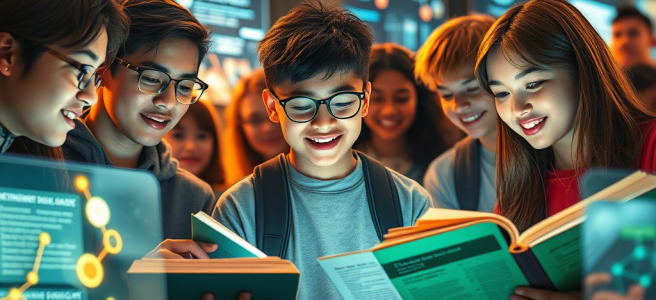
The moment my blog became something I could interrogate, I started imagining what it would mean for a student to do the same with their required reading. Imagine asking your biology textbook to explain a concept three different ways. Imagine asking your history book to trace a theme across chapters. Imagine asking your economics text to compare two models, or your literature anthology to map motifs across authors. This isn’t a fantasy. It’s what I did with my own writing in under five minutes.
And once your books can talk back, they can talk to each other. You can say, “cross‑reference my books and bring up sources that appear in more than one text,” and suddenly your education becomes holistic instead of siloed. Themes surface. Patterns emerge. Arguments echo across disciplines. The walls between classes start to dissolve, and the student finally gets what the curriculum was always supposed to provide: a connected understanding of the world, not a stack of disconnected assignments.
Meanwhile, students already live in digital environments. Their notes are digital. Their collaboration is digital. Their study tools are digital. Their cognitive scaffolding is digital. The only thing that isn’t digital is the one thing they’re forced to buy. The textbook is the last relic of a world where learning was linear, solitary, and bound to the page. Everything else has moved on.
And that’s the part that finally snapped into focus for me: the digital version of a book isn’t a bonus. It’s the real textbook. It’s the one that can be searched, queried, annotated, integrated, and woven into the student’s actual workflow. The print copy is the accessory. The EPUB is the instrument.
So here’s the simple truth I landed on: if we want students to learn in the world they actually inhabit, we have to give them materials that can live there too. If a student is required to buy a textbook, they should get a digital copy — not as an upsell, not as a subscription, but as a right. Because the future of literacy isn’t just reading. It’s conversation. And every student deserves to talk to their books the way I just talked to mine.
Scored by Copilot, Conducted by Leslie Lanagan


 Stories That Are All True