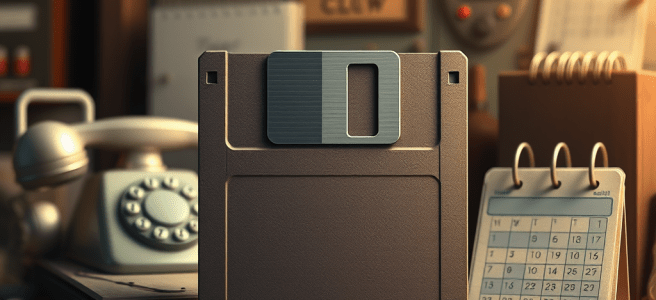
Every culture has its ruins. Ours just happen to be embedded in the toolbar. Damien Owens once joked that in the year 2246 — after we’ve eradicated disease, solved hunger, and finished terraforming Mars — the icon for “Save” will still be a floppy disk. And he’s right. The hardware is extinct. The medium is extinct. The last time most people touched a floppy disk, Blockbuster was still alive. But the symbol persists, because interface metaphors don’t retire when the technology dies; they retire when the meaning dies, and meaning has a much longer half‑life than plastic. The floppy disk isn’t a storage device anymore — it’s a verb, the fossilized gesture of “keep this,” preserved in every toolbar like a tiny piece of digital amber. We don’t save files to a disk; we save files to the idea of a disk, and the idea is what survives.
Once you start looking, the anachronisms are everywhere — little hauntings of past systems that refuse to leave the building.
- The phone icon is still a 1940s handset, a shape most people under 25 have never held, but one so entrenched that replacing it would feel like replacing the word “hello.”
- The “hang up” gesture is still slamming a handset onto a cradle, even though we now end calls by tapping a piece of glass, and the muscle memory of anger still wants something with weight.
- The “mail” icon is an envelope with a triangular flap, even though email has never required paper, glue, or a mailbox; the envelope persists because it’s the only symbol that still communicates “a message is coming.”
- The “calendar” icon still shows a paper desk calendar — the tear‑off kind that lived next to a rotary phone and hasn’t been in an office since the Clinton administration.
- And the “save to cloud” icon is… a cloud. Not a server rack, not a data center, but a literal cloud, as if the most complex distributed storage system in human history were best represented by a child’s drawing of weather.
None of these symbols are mistakes. They’re continuity. They’re the cultural equivalent of muscle memory — the way a society keeps its footing while the ground shifts under it. Humans don’t update metaphors at the speed of software; we update them at the speed of culture, which is to say: slowly, reluctantly, and only when forced. A symbol becomes sticky when it stops representing a thing and starts representing an action. The floppy disk is “save.” The envelope is “message.” The handset is “call.” The cloud is “somewhere that isn’t here.” We don’t need the original object anymore. We just need the shape of the idea.
And that’s the part I love: even as technology accelerates, the symbols will lag behind like loyal, slightly confused pets. We’ll build quantum networks and still click on a cartoon envelope. We’ll colonize Mars and still press a floppy disk to save our terraforming spreadsheets. The future will be sleek, but the icons will be vintage, because we’re not just building systems — we’re building stories, and stories don’t update on a release cycle.
Scored by Copilot. Conducted by Leslie Lanagan.


 Stories That Are All True