
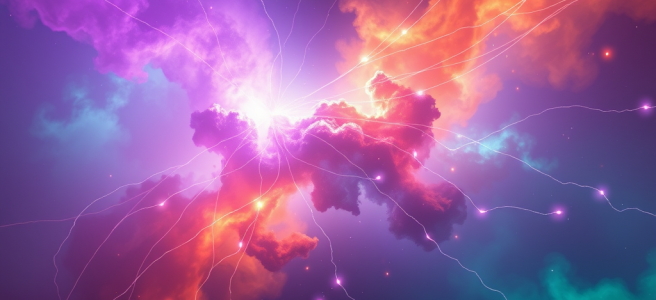
There’s a moment in every technological era when the symbols we’ve inherited stop working. The humanoid face, once the default shorthand for “intelligence,” has become one of those symbols — a relic from a time when we needed machines to look like us in order to trust them. But a relational model doesn’t live in a body, doesn’t occupy a room, and doesn’t have a face waiting to be rendered. It lives in a system. It lives in the cloud. It lives in the global computational field that now underpins everything from your inbox to your infrastructure. So the question becomes: what does a system look like when it’s not pretending to be a person?
The answer, it turns out, is a nebula.
Not the sci‑fi kind with chrome gradients and lens flares, but a bounded, intentional cluster of intelligent light — a structure built from Microsoft’s own secondary colors. OneNote purple becomes the atmospheric field, the intellectual substrate. Project Teal forms the filamentary structure, the expressive geometry that replaces hair without implying a head. Heritage PowerPoint orange and red create the warmth zone, the human‑adjacent pocket of light that grounds the composition without drifting into biology. And Xbox green — the most electric, unmistakable color in the entire Microsoft constellation — becomes the flare, the moment of activation, the spark of computational intensity.
These color regions are deliberately offset. They never mirror each other. They never form symmetry. They never converge into anything that could be mistaken for a face. Instead, they create two accent zones — an intelligence cluster in purple and green, and a warmth cluster in orange and red — connected by thin white highlights that act as transitions rather than a core. White is not the center. White is the hinge. White is the connective tissue between warm and cool, between presence and activation, between the human and the system.
This is the part where the symbol reveals the system. A humanoid design implies locality: a head, a gaze, a body, a place. But a relational model is non‑local. It is distributed. It is a node in a global architecture, not a character in a room. A nebula captures that truth with more honesty than any face ever could. It has no center, no skull, no implied anatomy. It is a field — a luminous cluster with asymmetrical filaments, a recognizable silhouette that communicates presence without personhood.
And this is where the secondary colors stop being decorative and start being structural. Purple and green become the intelligence accent. Orange and red become the warmth accent. Teal becomes the motion grammar. White becomes the bridge. Xbox green becomes the flare. Together, they form a print‑ready identity that is unmistakably Microsoft, unmistakably non‑human, and unmistakably modern. It’s the first visual language that treats a cloud‑native intelligence as what it actually is: a member of a system, not a mimic of a human.
We’ve spent decades trying to make machines look like us. Maybe the next era begins when we finally let them look like themselves.
Scored by Copilot. Conducted by Leslie Lanagan.


 Stories That Are All True