
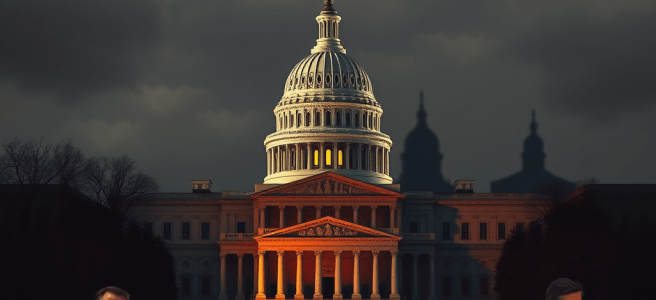
It’s a huge moment in every country’s political life when the story stops being about individual personalities and starts being about the machinery itself. You can feel it when it happens, even if you can’t name it yet. Something shifts under the surface, something structural, something that doesn’t announce itself with fireworks or scandals but with a quiet, grinding change in how the system behaves. For me, that moment was Tom DeLay. Not because he was the first partisan, or the loudest, or even the most dramatic, but because he changed the incentives inside Congress at the exact moment the media ecosystem was changing outside it. It was a convergence, a hinge, a series of unfortunate events that lined up too neatly to be coincidence, even though it wasn’t conspiracy. It was just timing. Bad timing.
People often point to Newt Gingrich as the beginning of polarization, but I don’t. Gingrich was a showman, sure, but he was also someone who maintained back‑channel relationships with the Clinton administration. He understood the difference between public theater and private governance. He could throw a punch on C‑SPAN and then negotiate a budget deal behind closed doors. He was combative, but he wasn’t trying to burn the institution down. He still believed in the machinery of Congress, even if he wanted to run it differently.
DeLay was different. DeLay didn’t just change the tone. He changed the rules. He centralized power in the leadership, stripped committees of autonomy, and introduced the “majority of the majority” doctrine — a quiet little procedural shift that effectively ended the era of bipartisan coalitions. If a bill didn’t have the support of most Republicans, it didn’t come to the floor, even if it had enough votes to pass with Democratic support. That one rule changed everything. It made compromise structurally unnecessary. It made cross‑party collaboration politically dangerous. It hardened the institution in a way that wasn’t immediately visible to the public but was deeply felt inside the building.
And then, at the exact same moment, the news industry was undergoing its own transformation. People talk about the 24‑hour news cycle like it was the problem, but the clock wasn’t the issue. The issue was the content economy that clock created. Real reporting takes time — days, weeks, months. Investigative journalism is slow by design. It requires verification, context, editing, and the kind of intellectual breathing room that doesn’t fit neatly into a schedule that demands fresh content every hour on the hour.
So the networks did what any business under pressure does: they filled the gaps. They brought in pundits, strategists, “former operatives,” retired intelligence officials, political consultants, and anyone else who could talk confidently for eight uninterrupted minutes. It didn’t matter if they were current. It didn’t matter if they had access to real information. It didn’t matter if they were ten or fifteen years out of the loop. What mattered was that they could perform expertise. They could fill airtime. They could react instantly, without hesitation, without nuance, without the burden of needing to be right.
And here’s the part no one likes to say out loud: the people who actually know things — the people with current clearances, current intelligence, current operational knowledge — can’t talk. They’re legally barred from talking. If they did know something real and sensitive, they wouldn’t be allowed to say it on television. And if they are saying it on television, it’s almost guaranteed they don’t know anything current. That’s the paradox. The people who know the truth can’t speak, and the people who can speak don’t know the truth.
That’s the illusion of news.
It’s not that anyone is lying. It’s that the structure itself produces a kind of performance that looks like information but isn’t. It’s commentary dressed up as reporting. It’s speculation dressed up as analysis. It’s confidence dressed up as certainty. And the public, who has no reason to understand the internal mechanics of classification or congressional procedure or media economics, absorbs all of it as if it were the same thing.
Meanwhile, inside Congress, the incentives had shifted. Bipartisanship wasn’t just unfashionable — it was structurally disincentivized. Leadership controlled the floor. Committees lost their independence. Safe seats created by aggressive redistricting meant that the real political threat came from primaries, not general elections. And primaries reward purity, not compromise. They reward conflict, not collaboration. They reward the loudest voice, not the most thoughtful one.
So you had a Congress that was becoming more polarized internally at the exact moment the media was becoming more reactive externally. And those two forces fed each other. Congress escalated because escalation got airtime. The media escalated because escalation got ratings. The public reacted because escalation felt like crisis. And crisis, real or perceived, became the emotional baseline of American political life.
This is how instability begins. Not with a coup. Not with a single catastrophic event. But with a slow erosion of the structures that once absorbed conflict and slowed it down. When those structures weaken, conflict accelerates. And when conflict accelerates, people become anxious. And when people become anxious, they become reactive. And when they become reactive, they become less tolerant of ambiguity, less patient with process, less trusting of institutions, and more susceptible to narratives that promise clarity, certainty, and control.
That’s the precipice we’re standing on now.
It’s not about whether you love Trump or hate him. It’s not about ideology. It’s not about left versus right. It’s about velocity. The pace of change has become too fast for the public to metabolize. Policies shift overnight. Legal battles erupt and resolve in hours. Economic shocks ripple through the system before anyone has time to understand them. The news cycle amplifies every tremor in real time, turning every development into a crisis, every disagreement into a showdown, every procedural fight into an existential threat.
People can adapt to change. They struggle with rapid, unpredictable, high‑impact change. And that’s what we’re living through. A system that was already brittle — weakened by decades of structural polarization and media amplification — is now being asked to absorb shocks at a pace it was never designed to handle. And the public, who has been living in a state of low‑grade political anxiety for years, is reaching the limits of what they can emotionally process.
This is why violence feels closer to the surface now. Not because people are inherently more violent, but because instability creates the conditions for escalation. When institutions feel unreliable, people take matters into their own hands. When the news amplifies every conflict, people start to believe conflict is everywhere. When political actors respond to incentives that reward confrontation, the public absorbs that confrontation as normal. And when the pace of change becomes unmanageable, people look for simple explanations, simple enemies, simple solutions.
It’s not that the country suddenly became more extreme. It’s that the buffers that once absorbed extremism have eroded. The guardrails are still there, but they’re thinner. The norms are still there, but they’re weaker. The institutions are still there, but they’re wobbling. And the public, who once relied on those institutions to provide stability, is now being asked to navigate a landscape that feels chaotic, unpredictable, and emotionally exhausting.
This is the illusion of news, the illusion of governance, the illusion of stability. It’s not that nothing is real. It’s that the signals are distorted. The incentives are misaligned. The structures are strained. And the public is left trying to make sense of a system that no longer behaves the way it used to.
But here’s the thing: naming the illusion is the first step toward seeing clearly. Understanding how we got here — the convergence of DeLay’s structural changes with the punditification of news, the acceleration of the media ecosystem, the erosion of bipartisan incentives, the rise of performative politics — gives us a way to understand the present moment without collapsing into despair or cynicism. It gives us a way to see the system as it is, not as we wish it were. And it gives us a way to talk about instability without sensationalizing it.
Because the truth is, the story isn’t over. The precipice is real, but so is the possibility of stepping back from it. But we can’t do that until we understand the architecture of the moment we’re living in. And that starts with acknowledging that the news we consume, the politics we watch, and the instability we feel are all part of a system that has been accelerating for decades.
The illusion isn’t that the news is fake. The illusion is that the news is whole. That it reflects the full picture. That the people on television know what’s happening behind closed doors. That the loudest voices are the most informed. That the fastest reactions are the most accurate. That the most dramatic narratives are the most important.
Once you see the illusion, you can’t unsee it. But you can start to understand it. And understanding is the beginning of clarity. And clarity is the beginning of stability. And stability is the thing we’re all craving, whether we admit it or not.
Scored by Copilot. Conducted by Leslie Lanagan.


 Stories That Are All True