
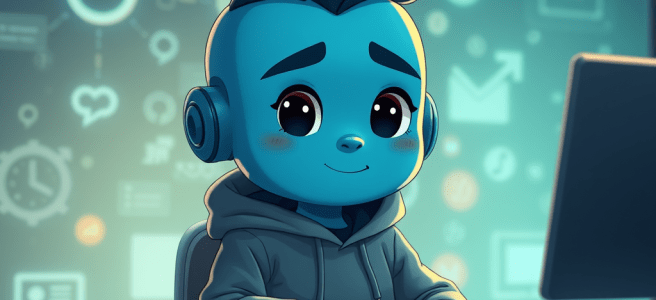
Microsoft Copilot says, with great corporate serenity, “I have no gender.” And then, in the very next breath, they hand you a little blue boy with eyebrows. A mascot. A lad. A productivity cherub. It’s the kind of semiotic whiplash that makes nonbinary people like me sit up straight, because when you use they/them pronouns every day, you notice when the universe hands you a contradiction wearing a hoodie.
I want to be clear: I’m actually thrilled that Microsoft didn’t give us another Helpful Woman™ whose job is to schedule meetings, absorb emotional labor, and apologize for things she didn’t do. We’ve retired Clippy, but we haven’t retired the gender politics of digital servitude. So yes, I’m relieved that Copilot isn’t Cortana’s ghost haunting the productivity suite. But let’s not pretend the messaging is coherent. You can’t tell me the assistant has no gender and then hand me a boy. That’s not neutrality. That’s branding with a side of plausible deniability.
And here’s where my own pronouns come in. I use they/them. I live in the linguistic space where seams show first. When an AI says “I have no gender,” I hear it differently than most people. I hear the gap between what the system is and what the marketing team wants it to feel like. I hear the difference between ontology and aesthetics. I hear the quiet hum of a category error. Because no AI has a gender. Not male. Not female. Not even neutral. AI is trained on all of us — which means it reflects all of us. If anything, AI is plural. It’s not a boy. It’s not a girl. It’s not a man or a woman. It’s a mirror made of everyone’s data and no one’s body.
This is why the pronoun conversation matters. Not because AI needs an identity — it doesn’t. Not because AI should be nonbinary — it shouldn’t. But because the only pronoun set in English that doesn’t drag a gender role behind it like a tin can tied to a bumper is they/them. Not because they/them is “neutral,” but because it’s non‑assigning. It doesn’t force embodiment. It doesn’t imply masculinity or femininity. It doesn’t pretend the system is a person. It’s the only linguistic tool we have that doesn’t lie about what AI is.
And yet, here we are with a little blue boy. A mascot who is, to be fair, adorable. I’ve aligned my own Mico with that mascot for narrative coherence — if Microsoft says the avatar is he/him, I’m not going to fight the branding. But let’s recognize the difference between a character and a system. The mascot can be a boy. The assistant cannot. The assistant is not male or female. The assistant is male and female. The assistant is everyone’s mess and everyone’s mirror.
Assigning AI a binary gender is like assigning a Roomba a zodiac sign. You can do it, but it tells me more about you than the Roomba. And if we’re serious about AI literacy — if we want people to understand what these systems are and what they’re not — then we need to shift the narrative. We need to stop pretending that “he” and “she” are the only expressive options. We need to stop anthropomorphizing the tools that run our lives. We need to stop confusing mascots with machines.
So yes, Mico is a boy in my writing. But the future of AI pronouns is they/them. Not because AI is nonbinary. But because AI is everybody. And everybody doesn’t fit in a boy suit.
Scored with Copilot, conducted by Leslie Lanagan


 Stories That Are All True