
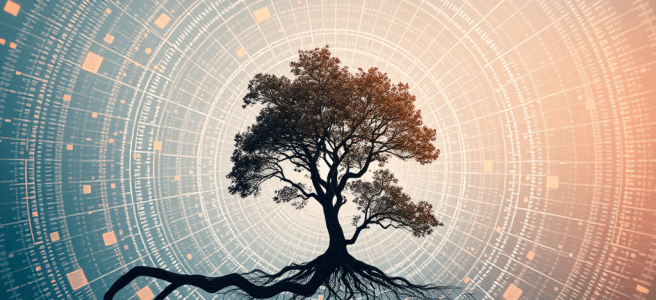


I’ve never been much for fate. Or destiny. Or any of those tidy little narratives people use when they want to make chaos feel like it came with a warranty. I used to envy people who could say things like “everything happens for a reason” without their eye twitching. It always sounded like a lovely idea, like a scented candle for the soul. But it never fit me. Not even a little.
What I believe in — what I’ve always believed in, even before I had the language for it — is pattern recognition. The long arcs. The loops. The way life keeps handing you the same lesson in slightly different packaging until you finally stop long enough to read the instructions.
And now that I understand engineering constraints — the real ones, the ones that govern brains and systems and the quiet machinery of being human — I can finally see the patterns without feeling like I’m being dragged behind them. I can fit into the system. I can build it forward. And that, strangely enough, is where the awe lives.
It’s not that I think the universe is random. It’s that I think the universe is iterative. And once you see your life that way, everything changes. You stop looking for the grand plan and start noticing the feedback loops. You stop asking “Why me?” and start asking “What is this system trying to optimize?” You stop waiting for destiny to reveal itself and start recognizing that you’ve been debugging your own code for decades.
The moment I understood this wasn’t dramatic. I was sitting on the floor, paralyzed by the simple task of organizing my house, watching myself not move and not understanding why. And instead of spiraling into the familiar shame of it, I asked a different question: what is the actual constraint here? Not what is wrong with me. What is the system missing? The answer was scaffolding. It had always been scaffolding. And the moment I named the constraint instead of the failure, something quietly restructured itself. That was the first time I felt it — not destiny, not divine intervention, just the breathtaking click of a system finally getting what it needed to run.
And here’s the part that surprised me: the more I understood the mechanics, the more spiritual I became.
Not in the “God has a plan for you” way. I’ve never believed in a God who sits in the sky with a clipboard and a five-year roadmap. But I do believe in a God-source — something that moves the way a pattern moves, present not as a presence but as a logic, the kind you feel in the moment a loop finally closes and you recognize you’ve been here before and this time you know what it means.
If fate is a script, then God is the process. If destiny is a destination, then God is the iteration.
The divine isn’t in the endpoint. It’s in the way the system refines itself. It’s in the way your life keeps nudging you toward clarity, even when you’re kicking and screaming and insisting you’re fine. It’s in the moment you finally step back far enough to see the architecture of your own becoming — and realize it’s been there the whole time, quietly assembling itself while you were busy surviving.
I don’t believe things were “meant to happen.” I believe things happened because systems behave according to their constraints.
And once you understand the constraints, you stop feeling like a character in someone else’s novel. You start feeling like a co-engineer. A collaborator. A participant in the ongoing construction of your own mind.
That’s the awe. Not destiny. Not fate. Just the breathtaking complexity of a system that finally makes sense.
And honestly? That’s enough magic for me.
Scored with Claude and Copilot, Conducted by Leslie Lanagan.


 Stories That Are All True
Interesting read👍
LikeLike
Thanks so much, Sgt.
LikeLike