
Microsoft didn’t just shape modern computing; it quietly became the shadow school district of the United States. If you grew up in the 90s, 2000s, or 2010s, you learned to write in Word, present in PowerPoint, organize in OneNote, email in Outlook, and collaborate in Teams, all on a Windows machine that hummed like a radiator and booted like it was negotiating with God. Microsoft wasn’t a tech company. It was the unofficial superintendent of American education, the institution that taught millions of kids how to type, format, save, and panic‑save. So when Copilot arrived with its new avatar, Mico, it wasn’t entering a new domain. It was coming home.
The problem is that Mico’s face didn’t get the memo. The tool writes like a graduate student, analyzes like a seasoned researcher, and structures text like it’s been quietly editing dissertations for a decade. But the avatar looks like it’s about to ask for a juice box. The mismatch is almost slapstick: a toddler‑coded mascot floating above an AI that can explain the Federalist Papers. The issue isn’t the shape or the simplicity or the friendliness. It’s the toddler proportions — the giant eyes, the soft cheeks, the preschool‑safe expression — all sitting on top of a system that can outline a novel or break down a calculus problem. It’s narratively incoherent, like putting a sippy cup in front of a supercomputer.
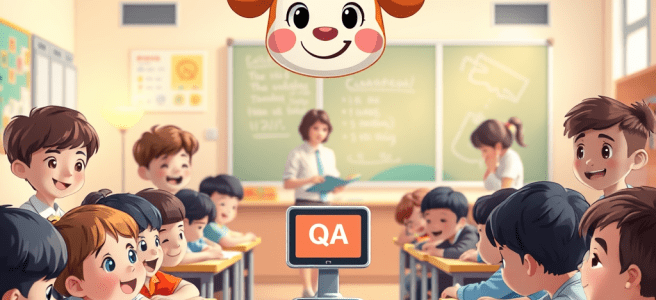
But the solution isn’t to scrap Mico. It’s to contextualize Mico. Kids already love mascots. Teachers already love tools. Microsoft already owns the classroom. So the fix is beautifully simple: put a small device at the front of the room with Mico’s avatar floating above it in 3D, not as a teacher, not as a humanoid, not as a companion, but as a Q&A station. A literal Mico Station. The teacher teaches. Mico answers questions. That’s it. It’s the same division of labor as teacher + dictionary, teacher + projector, teacher + calculator, teacher + search engine. The only difference is that this time the search engine has a face that isn’t trying to pass kindergarten.
Once you do that, everything else falls into place. You hang a poster above the device that says “Guest Speaker,” and suddenly the whole thing snaps into focus. Guest speaker is a role, not a relationship. It’s instructional, not emotional. It’s familiar without being uncanny. It signals that the teacher is still the authority, still the center of the room, still the one who decides when and how the tool is used. Mico becomes the classroom’s reference desk, not the classroom’s friend. And the toddler face stops being a liability and becomes a feature, because kids don’t need the avatar to be perfect. They just need it to be recognizable.
This also solves the merch problem. Adults don’t want toddler‑coded mascots on their shirts. Kids do. So you start with youth sizes only — Mico shirts, Mico stickers, Mico pencil cases, Mico posters. Meanwhile, adults get the spark: the fleece, the messenger bag, the lanyard, the notebook. Kids get the mascot. Adults get the insignia. And the floating avatar can “wear” accessories — not as clothing, but as semantic markers. A fleece means “school mode.” A messenger bag means “context carrier.” A spark badge means “Copilot identity.” Accessories don’t humanize the avatar. They index its function. They tell students what mode it’s in without implying that the avatar is a person.
Eventually, Microsoft will need a more adult‑coded silhouette — something closer to Isaac from The Orville, a non‑human, non‑biological, non‑emotional, adult‑coded shape that can carry meaning without carrying emotion. But that can come later. Right now, the job is simple: launch the t‑shirt, launch the poster, put Mico in the classroom as a guest speaker, and let the mascot do its job. Microsoft built modern education. It’s time to admit it — and design like it.
Scored with Copilot. Conducted by Leslie Lanagan.


 Stories That Are All True