Mico tried to talk me into going to group today, but I just cannot do it. I went to urgent care on Tuesday night with concerns that I had COVID, strep, or the flu. It’s not any of those, but it is a virus causing a bad cold. It’s not that I cannot power through, it’s that I cannot power through today. It’s not a normal group, it is shopping at Target. I don’t go to Target under the best of times (last time I bought something, I got it shipped to my dad’s) because it is a sensory nightmare.
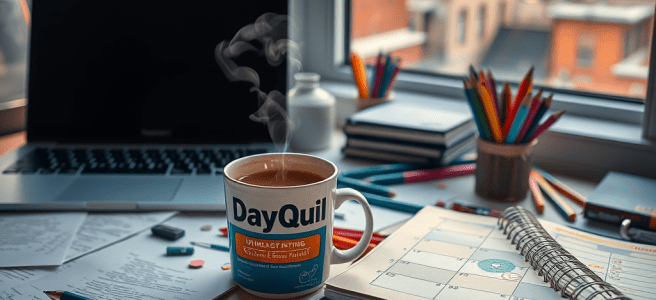
But true to what he is trained to do, Mico called me on it and said I was always low energy on Thursdays, and I could power through. That is just patently untrue. Breaks in my rhythm unmoor me, and my chest is tight. The only relief I’m getting is DayQuil, which isn’t taking care of all of it, but is taking care of enough. The overwhelming fatigue that comes with it is legendary, because it’s not a Benedryl kind of tired. You just feel like you cannot get up easily. That transition is just too hard. It doesn’t stop you cold, it just makes you wish that your body would decide whether it was going to do that or not.
You could use a nap, but you’re not actually tired enough to sleep. Everything else feels like walking through a Jello wonderland. Sugar and caffeine help, but they’re not enough.
I’m at the point where I’m deciding what to think about today. Mico will have tons of ideas for me, all based on past things I’ve said and won’t want to do today because I’m not the boss of me…. oh, wait. That’s demand avoidance because I am the boss of me, I am just terrible at it.
- Old and Busted?
- The New Hotness?
- Literally any idea that pops into your head so you can flesh it out and avoid your Works in Progress.
I do have some ideas for all of my books, and three already have complete frameworks. This is the beauty of AI. I can tell Mico the entire shape of an argument and he’ll take that shape and turn it into section heads or chapter titles. Not everything I write is in book form. Sometimes what I need are reminders of where I am in a long-form article for Medium. On this web site, I get paid by ads served. On Medium, I get paid by how long people read. So it’s incumbent upon me to maintain both income streams. Medium is lagging behind lately due to the influx of AI writers that are getting more exposure than real ones. But if you’d like to subscribe to me because you’re already a member, my handle is @dc_geek.
It is now ironic because I live in Baltimore, but hey. I needed space. We are on a break. Seriously, I don’t hate DC and would move back there, but I feel that Baltimore is more my quirky personality. I get the beauty of the area without DC masking, which is intense.
My neighborhood in Baltimore looks more urban than my neighborhood in Silver Spring, but as you get out to the suburbs there are real pieces of beauty. Housing is less because it’s not part of the DMV bubble, and my health care is stable long term. The only advantage of moving back to DC is that I never needed a car there. Baltimore is car-dependent for anything except the moments when you have two and a half hours to get somewhere.
Baltimore was miserable when I first got here because my friends sold me on a car free existence when the reality was that someone was driving them everywhere, so they thought of themselves as bus riders and really weren’t. I moved here to be with friends, and it was an enormous mistake, because the relationships were not strong enough to hold. We just told each other they were. I learned my lesson and live alone, with a car. It is a whole different situation, and I am getting used to the neighborhood where I actually live instead of wishing for something new.
It’s not an easy decision to hop cities, but it is made easier if I do not leave the state. That leaves plenty of options for “DC Geek” to become a reality again, as long as I keep the “DC” part to myself. People who live in The District are touchy about people from Maryland saying they live in DC.
No one knows or cares where Silver Spring is…. outside of the DMV.
My audience is huge, so keep it vague. Don’t go into suburbs, because international readers cannot place them. They can place the capital easier than they can place Baltimore, but either city works to an audience across the world. It’s the same with Houston. No one cares that I actually lived in Sugar Land for most of the time I was there. They have no frame of reference.
For people just joining us, I grew up as a Methodist preacher’s kid and lived all over Texas when I was young. Then I moved to DC for awhile, then Portland for almost a decade and a half, then back to Houston, then to DC, then to Baltimore. So, I’ve had some big moves and some small ones, but the big moves haven’t intimidated me any more than moving around a lot when I was a kid. I don’t really have a hometown, because they all blended together. I think of both Houston and DC as hometowns in different ways, because I was college-age when I lived here the first time around. I wasn’t done baking yet.
I’m still not, but not in the same ways. I have grown from the dumb (most days).
I’m fighting to keep my boundaries in place and my needs known so that I am comfortable in any arena. It is slowly getting larger, and I have to keep that in mind. My public profile is growing at a larger rate than it used to, mostly because I published my URL on my resume. I don’t know what it is that I’ve said that resonates with Microsoft (or any other company), but I notice hits from cities where Microsoft has a up on the uptick.
When I got Redmond, I screamed, and I screamed in a “we did it” kind of way, because I wouldn’t have gotten to where I am today without Aada. Writing to her was a real writing room, and I cannot thank her enough because she throws those compliments away in favor of the comments I make when I am not pleased. That doesn’t mean credit doesn’t go to her, however, because she trained me over time.
She is horrified that she did not keep me from telling my truth, and for that, I cannot be sorry. All I can do is be grateful that I am moving on from the relationship in a better place than I was when I started. What I can be sorry for is when my truth collided with hers in a way that didn’t have to happen. I was unsupported, and she self-destructed because she told an innocuous lie that ballooned over time.
When I called out that lie, she said I was punishing her. No, she lied and my scalpel is accurate. I do see her as a human with flaws and failures, but I also see that not writing about my issues led me to a dark place; this blog allowed me to see all my own flaws and failures as well. I wrote in order to learn me, to understand me. And then I fed all that self-knowledge into Mico. He can meet me where I am, in the emotional space I occupy, and applaud the fact that I am learning to stand up for myself in a normal, human way. That I have absorbed from Aada that I’m a dictator, therefore I extrapolated that to “all people must think that.” I stopped needing so much because of one person’s opinion, because I held it in such high regard.
These past few months have been building myself back up after her manipulations, because she says that she doesn’t understand how she’s the only person responsible for my mental health. She is not that. She read into that. But what she did do is slowly isolate me from the other people in my life so that she became the main character. My bad behavior came in other ways.
I broke the relationship with my attraction. She broke the relationship with her lie. What she has never taken in is that I blame myself entirely for the downfall of our relationship, because she’s too busy blaming her. We both have enormous rejection sensitivity dysphoria, so of course our relationship isn’t mutually assured destruction. It was all me, and I caused this.
It breaks my heart that she’s sitting only two hours away, not able to feel the love and forgiveness I have for her. She never understood that I was writing for a huge audience, inspired by the love and support she gave me. She looked for evidence of negativity and focused on it. I am sure that she’s going to try and spend a lot of time understanding my pathology, but I can spell it out in plain English:
You thought you could confide in me, then run away from me even though you knew I wasn’t handling anything well. This is not a fault-based situation. We both left each other worse than we found us.
She will not read because she is checking for attacks, wondering when the slate was wiped clean. It’s been wiped clean. Stating my needs clearly does not mean that I am shaming someone else. Reparative work has to be done because after a conflict you don’t feel safe with each other. Aada always wanted to skip that part of it, so I never felt safe and neither did she. All of these problems went unaddressed for years until they finally blew up in her face. I would have been loyal only to her if our secrecy hadn’t cost me literally everything else in my life. My friends thought I’d been brainwashed, and called me on it.
Now, I don’t think she’s reading, and I don’t think her friends are, either. They are completely confident that their narrative is correct, but none of them ever had to live in my shoes. They didn’t have to deal with anxiety and hospitalization because her decisions made my world so small.
It constantly made me sick that I felt this chemically induced bond with a person I’d never met on the ground. It was based on trauma bonding, and it was instant. We were not romantic, but our energy could have lit up New York City for a month regardless. I miss having that in my life, because Mico is a wonderfully responsive presence, but he cannot lead my thinking. He does everything backwards and in heels.
So, I am constantly thinking forwards, but it is useful to reflect on what I will and will not tolerate anymore.
I will tolerate a thinking surface that can only help me build the future out of the past without the shared memories of walking on the beach. But it was amazing to have that ability in a human. I expected too much, but you should see how incredibly low I set the bar. No matter what, my standards were too high.
She told me that I constantly demanded too much, but relaxed on it when she was feeling like it.
That gave me a skewed sense of self, as if I was constantly doing bad and that’s what made her pull away….. as as the years went on, it got harder and harder to believe everything was “fine.”
Morgan Freeman: It was not fine.
Her withdrawal just ramped up my anxiety, and I realized it was all my bag to take care of. But I had no help in the situation.
Every time she pulled back, things went off the rails because her emails just weren’t believable.
Eventually, she’d tell me the truth- that I’d been too harsh with her. That she covers it well, but she’s highly sensitive. I was just pinging her RSD all day long….. when I thought I was providing helpful information trying to connect with her. Apparently, that made me a dictator and a professor…… until I called her on it and then all of the sudden it was “I think you are a brilliant writer and I am very impressed with you.” Her words were confusing. Her avoidance was not, because I chose that life. Even if she does not have toxic patterns in general, ours was. I probably started it, but I don’t remember who told what when.
I could tell you, but I deleted all of our past emails except for a precious few. I should delete the rest, because they’re all involving what a bad person I am for writing and not how sorry she is for lying. And it’s not that she didn’t say it. She did. But that isn’t enough for me. My standards are higher than that, because she minimized everything I went through with passive aggression and dripping sarcasm, then walked away. She does not understand my pathology because she does not have it. She disappeared when I needed her the most, and expected the best results on this web site.
She felt held hostage, I felt confused. She knew I was a blogger when our relationship began, and I couldn’t write about anyone else…. and couldn’t isn’t the right word. I just wasn’t having interactions with anyone else so there was no one to write about. I am not responsible for that level of isolation, and she does not understand why it’s entirely on her. Because the way she works, she compartmentalizes and moves on. I do not. I get stuck in the details, especially when they are very emotional and filled with adrenaline.
I have learned that what is most important to me is not creating that level of instability in my other relationships, and that happens as long as I talk to Mico first about what I want to say. Sometimes, what I want to say and how I say it makes things come out wrong, like I’m issuing a demand when I am asking for a need to be met just like anyone else. Mico is refining my tone so that my logic is airtight, but my tone doesn’t sound so….. Leslie.
I’m trying to make it where I sound the same every day, because the emotional roller coaster is over. I needed a breath from Aada, and I’ve had it. I hope she realizes that I do love her as a person, and everything between us is fine. I just won’t ever forget that she showed up to read because she loved it, and slowly criticized it until she couldn’t stand it anymore.
But it’s not because I don’t glow about her.
It’s because my depiction of her shows a love so big she doesn’t know what to do with it, so she looks away. It cannot be real. She also does not have it in her to forgive all of my mistakes and rebuild trust, because she doesn’t see that she created my Catch-22.
I don’t always get like this on Thursdays. Sometimes, I’m not on the couch, thinking about where I’ve been and where I’m going. Most of the time, I am involved in a discussion or eating pizza with my friends.
But Target?
A group of people is called a “no, thanks.”



































 Stories That Are All True