


When I think back on my most memorable road trip, I still don’t land on a single journey. My memories have never arranged themselves around destinations. They live in the in‑between places — the convenience stores humming under fluorescent lights, the gas stations where I stretched my legs, the odd little roadside attractions that broke up the monotony of the highway. Even now, the road trip I take most often is the one from Baltimore down to Stafford, a drive so familiar I could probably trace it with my eyes closed. I usually make it solo, a Wawa latte or an energy drink riding shotgun, the quiet caffeine companion that marks the beginning of a ritual I’ve repeated enough times to feel like muscle memory.
Leaving Baltimore, the skyline falls away quickly. I merge onto I‑95 and pass the big green sign for the Harbor Tunnel, even though I’m not taking it — just seeing it is part of the rhythm. The city thins out, replaced by the long industrial stretch near Halethorpe, the BWI exit, and the slow curve past the giant white towers of the power plant near Jessup. I always clock the exit for Route 32, not because I need it, but because it’s one of those markers that tells me I’m officially “on the way.”
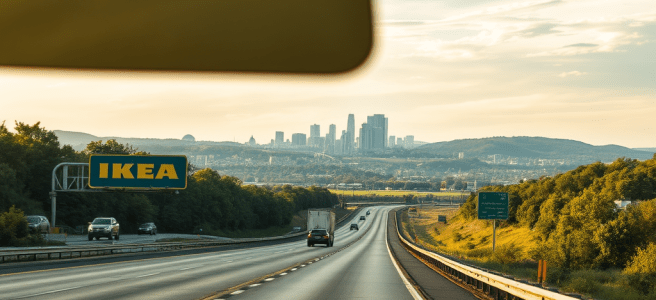
By the time I hit Laurel, the traffic thickens in that predictable, almost comforting way. I pass the IKEA sign — a landmark that feels like a rite of passage for anyone who’s ever lived in Maryland — and then the exits for College Park and the University of Maryland. The Capital Beltway rises ahead, that great concrete ring that holds the whole region together, and I slip onto it like joining a river. There’s always a moment where I glance toward the skyline of Silver Spring, then let it fall behind me as I curve toward the Woodrow Wilson Bridge.
Crossing the Potomac is its own kind of exhale. The water opens up beneath me, the National Harbor Ferris wheel off to the right, the Alexandria skyline rising to the left. It’s the threshold between the life I’m leaving for the day and the one I’m driving toward. Once I’m in Virginia, the landmarks shift: the long stretch past Lorton, the exit for Occoquan with its little historic district tucked out of sight, the massive sprawl of Quantico Marine Base. I always notice the brown sign for the National Museum of the Marine Corps — that soaring, angled building you can see from the highway — even though I’ve never stopped there.
And then the landscape softens. The exits start to feel familiar in a different way: Garrisonville Road, Route 610, the markers that tell me I’m close. The anticipation builds quietly, not dramatic, just steady — the sense of moving toward people who matter, toward a place that feels more like home each time I make the drive. By the time I pull into the neighborhood, the caffeine is gone, the road hum is fading, and the only thing left is the warmth waiting on the other side of the door. I step out of the car, walk up the path, and before I can even knock, I’m wrapped in hugs from my friends — the real destination all along.

 Stories That Are All True