I’ve been thinking about what a laptop for children should actually be, and the more I sit with the idea, the more I realize how deeply mismatched the current landscape is to the needs of real kids. Most “kid laptops” are toys pretending to be computers, and most “real laptops” are adult machines with parental controls bolted on like an afterthought. Neither approach respects the child or the world they’re growing into. Neither approach treats technology as a relationship. Neither approach imagines the child as a future creator, thinker, or steward of their own digital environment.
I want something different. I want a laptop that treats children as emerging participants in the world, not passive consumers of it. A laptop that doesn’t assume fragility or incompetence, but instead assumes curiosity, capability, and the desire to understand. A laptop that doesn’t teach disposability, but stewardship. A laptop that doesn’t overwhelm, but invites. A laptop that doesn’t surveil, but protects. A laptop that doesn’t rush, but grows.
The first thing I keep coming back to is longevity. Not just durability in the sense of “it won’t break if dropped,” but longevity in the deeper sense — a device that can accompany a child through years of learning, years of growth, years of becoming. A child’s first computer shouldn’t be something they outgrow in a year. It should be something that evolves with them. That means modular components, repairable internals, and a design that doesn’t age out of relevance. It means a battery that can be replaced without a technician, storage that can be expanded as their world expands, and a chassis that can survive the realities of childhood without looking like a ruggedized brick.
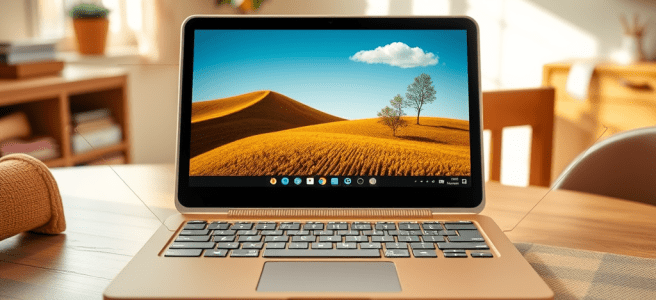
I imagine a device with a soft, friendly form factor — rounded edges, warm materials, and colors that feel like belonging rather than branding. Not neon plastic. Not corporate silver. Something that feels like a companion object, not a toy and not a tool. The keyboard should be quiet and forgiving, with keys that have enough travel to teach tactile awareness but not so much resistance that small hands struggle. The trackpad should be responsive without being twitchy, and the hinge should open with the same confidence every time, even after thousands of curious flips.
The screen should be gentle on the eyes. Not hyper‑saturated. Not retina‑searing. A matte finish that respects the fact that children often work in environments with unpredictable lighting — the kitchen table, the backseat of a car, a classroom with fluorescent bulbs, a couch with morning sun. The display should adapt to them, not demand that they adapt to it.
But the physical design is only half the story. The software matters just as much, and maybe more. A child’s laptop shouldn’t be a maze of menus or a battleground of notifications. It shouldn’t be a storefront disguised as an operating system. It shouldn’t be a place where every click is an invitation to buy something or sign up for something or be tracked by something. It should be calm. It should be intentional. It should be oriented toward creation, not consumption.
I imagine an operating system that feels like a studio. A place where writing, drawing, building, and exploring are the center of the experience. A place where the interface is simple enough for a six‑year‑old to navigate but deep enough for a twelve‑year‑old to grow into. A place where the home screen isn’t a grid of apps but a canvas — a space that reflects the child’s interests, projects, and imagination.
Privacy should be the default, not an advanced setting buried three layers deep. A child’s data should never be collected, sold, or analyzed. The device should store everything locally unless a parent explicitly chooses to sync something. And even then, the sync should feel like consent, not extraction. There should be no ads. No tracking. No hidden analytics. No “engagement optimization.” Just a clean, respectful relationship between the child and their device.
Safety should be built in, but not in a way that feels punitive or restrictive. Instead of blocking everything by default, the system should guide. It should explain. It should teach. If a child tries to access something inappropriate, the device shouldn’t scold them. It should say, “This space isn’t right for you yet. Let’s go somewhere else.” Safety should be a conversation, not a wall.
The laptop should also support offline learning. Not everything needs to be connected. In fact, some of the most meaningful learning happens when the internet is not involved at all. The device should come with a rich library of offline tools — a writing app that feels like a notebook, a drawing app that feels like a sketchbook, a coding environment that feels like a playground, a music tool that feels like a toy piano, a science app that feels like a field guide. These tools should be simple enough to start using immediately but deep enough to grow with the child over years.
I imagine a file system that is visual rather than hierarchical. Instead of folders and directories, children could organize their work spatially — a constellation of projects, each represented by an icon or a drawing or a color. Their world should feel like a place they can shape, not a structure they must memorize.
The laptop should also be physically expressive. Children learn through touch, through movement, through interaction. The device should have sensors that invite experimentation — a microphone that can be used for sound exploration, a camera that can be used for stop‑motion animation, an accelerometer that can be used for simple physics experiments. Not gimmicks. Tools.
And the device should be repairable. Not just by adults, but by children with guidance. Imagine a laptop where the back panel can be removed with a simple tool, revealing color‑coded components. Imagine a child learning what a battery looks like, what storage looks like, what memory looks like. Imagine them replacing a part with a parent or teacher, learning that technology is not magic, not fragile, not disposable. Imagine the pride that comes from fixing something instead of throwing it away.
This is how you teach stewardship. This is how you teach agency. This is how you teach that the world is not a sealed box.
The laptop should also have a long software lifespan. No forced obsolescence. No updates that slow the device down. No “end of support” messages that turn a perfectly good machine into e‑waste. The operating system should be lightweight, efficient, and designed to run well for a decade. Children deserve tools that last.
Connectivity should be simple and safe. Wi‑Fi, yes. Bluetooth, yes. But no unnecessary radios. No background connections. No hidden processes. When the device is online, it should be obvious. When it’s offline, it should be peaceful.
The laptop should also support collaboration. Not in the corporate sense, but in the childhood sense — drawing together, writing together, building together. Two children should be able to connect their devices locally and share a project without needing an account or a cloud service. Collaboration should feel like play, not like work.
I imagine a device that encourages reflection. A place where children can keep a journal, track their projects, and see how their skills evolve over time. Not gamified. Not scored. Just a quiet record of growth.
The laptop should also respect neurodiversity. Some children need calm interfaces. Some need color. Some need sound cues. Some need silence. The device should adapt to them, not the other way around. Accessibility shouldn’t be a menu. It should be the foundation.
And then there’s the price point — the part that matters most if this device is truly for children. A child’s first computer shouldn’t be a luxury item. It shouldn’t be a status symbol. It shouldn’t be something that divides classrooms into the kids who have “real” devices and the kids who don’t. If this project means anything, it has to mean access.
That’s why the laptop has to be inexpensive — radically inexpensive — in a way that feels almost out of step with the tech industry’s expectations. Not cheap in quality, but low in cost. Not disposable, but reachable. A device that can be sold at cost or subsidized through a charitable model so that no child is priced out of their own future. A device that can be donated in bulk to schools, libraries, shelters, community centers, and refugee programs. A device that can be handed to a child without the weight of financial anxiety attached to it.
I imagine a price point that feels almost impossible by current standards — something closer to a textbook than a laptop. Something that a parent can buy without hesitation. Something a school district can purchase for an entire grade level without blowing its budget. Something a charity can distribute by the hundreds without needing a corporate sponsor. The affordability isn’t a feature. It’s the philosophy. It’s the statement that children deserve tools that don’t punish their families for wanting them to learn.
And the low price point doesn’t mean cutting corners. It means designing with intention. It means using modular components that are inexpensive to replace. It means choosing materials that are durable but not extravagant. It means building an operating system that’s lightweight enough to run beautifully on modest hardware. It means focusing on what children actually need — not what marketing departments think will sell.
The charity aspect isn’t an add‑on. It’s the heart of the project. This laptop should be something that can be given away without guilt, repaired without cost barriers, and used without fear of breaking something expensive. It should be a device that a child can take to school, to a friend’s house, to the library, to the park — without the adults in their life worrying about loss or damage. A device that feels like freedom, not responsibility.
I want a laptop that can be part of disaster‑relief efforts, part of educational equity programs, part of global literacy initiatives. A laptop that can reach children in rural areas, in underserved communities, in places where technology is scarce or unreliable. A laptop that can run offline for long stretches, that can store learning materials locally, that can be charged with inexpensive accessories, that can survive being used in environments where electricity isn’t always guaranteed.
A child’s first computer should be a doorway, not a gate. It should be something that says, “You belong here. You deserve this. Your curiosity matters.” And the price point is how we make that real. It’s how we turn a design philosophy into a social commitment. It’s how we build a tool that doesn’t just exist in the world, but participates in making the world more equitable.
A child’s first laptop should be a companion. A steady, patient presence that invites curiosity, supports creativity, and respects the child’s autonomy. A device that grows with them, teaches them, and helps them build the world they’re imagining.
That’s the laptop I want to make. Not a toy. Not a miniature adult machine. A companion for the first steps into the new world.
Scored by Copilot, Conducted by Leslie Lanagan






















 Stories That Are All True