There are years in history that behave like doorways. Years that don’t just mark time but announce transition — the hinge between one era and the next. I was born in one of those years: 1977. A year that didn’t simply sit in the late seventies but seemed to lean forward, already reaching toward the future. A year humming with cultural ignition points, technological firsts, and the quiet tectonic shifts that would eventually reshape the world.
Because of that timing — because of the strange, liminal placement of my birth — I belong to a micro‑generation that has always lived in the in‑between. People later called us Xennials, those born roughly between 1977 and 1983. We’re the ones who had analog childhoods and digital adulthoods. We’re the ones who remember boredom as a landscape, not a crisis. We’re the ones who grew up with rotary phones and then learned to text in our twenties. We’re the ones who can navigate a library card catalog and a search engine with equal fluency.
We are, in a very real sense, the last generation to remember the world before the internet — and the first to grow into the world shaped by it.
To understand what that means, you have to understand the year itself. You have to understand what it meant to arrive in 1977, a year that reads like a prologue to the modern world. It was a year of mythmaking, technological birth, political recalibration, and artistic upheaval. A year where old worlds were ending and new ones were beginning, often in the same breath.
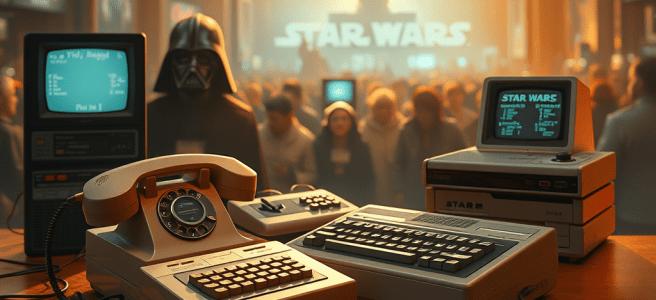
In May of that year, Star Wars premiered. Not the franchise, not the cultural juggernaut — just the first film, a strange, earnest space opera that no one expected to change anything. And yet it did. It rewired cinema. It reshaped storytelling. It introduced a new kind of myth, one that blended ancient archetypes with futuristic imagination. It’s fitting, in a way, that people born in 1977 grew up alongside a story about rebellion, empire, found family, and the tension between destiny and choice. Those themes would echo through our own generational experience.
Meanwhile, in January 1977, Apple Computer was incorporated. By April, the Apple II — one of the first mass‑market personal computers — was released. This wasn’t just a new gadget; it was the beginning of a new relationship between humans and machines. Computing was no longer the domain of institutions. It was becoming personal. For those of us born that year, this mattered. We were children when computers were still rare, teenagers when they became common, and adults when they became essential. We didn’t inherit the digital world; we watched it form in real time.
The Atari Video Computer System launched that same year, bringing video games into living rooms for the first time. It was the beginning of interactive media — worlds you could enter, not just observe. For a generation that would later navigate virtual spaces, this early exposure mattered more than we realized.
Music in 1977 was in a state of revolution. Disco was at its glittering peak. Punk was exploding in London and New York. Fleetwood Mac released Rumours, a masterpiece of emotional architecture. Elvis Presley died, marking the end of an era. It was a year where the old guard fell and the new guard rose, where culture was renegotiating itself in real time.
The world was shifting politically and socially as well. Jimmy Carter pardoned Vietnam War draft evaders. Snow fell in Miami for the first and only time. The Ogaden War erupted in the Horn of Africa. The Torrijos–Carter Treaties set the stage for the Panama Canal transfer. It was a world in motion — unstable, hopeful, and changing fast.
Science and space were expanding their reach. Voyager 1 and 2 launched in 1977, carrying with them the Golden Record — a message in a bottle for the cosmos. The rings of Uranus were discovered. Early computer graphics appeared in the Star Wars Death Star briefing scene. The future wasn’t just coming; it was already whispering.
Growing up in the wake of all this meant growing up in a world that was still analog, still slow, still tactile. Childhood was built from physical objects: cassette tapes, film cameras, paper maps, handwritten notes. You didn’t have infinite access to information; you had whatever was in your house, your school, or your local library.
We grew up with boredom — not as a crisis, but as a landscape. You waited for things: for your favorite song to come on the radio, for film to be developed, for your friend to call you back. You learned patience because there was no alternative.
We grew up with commitment. Calling someone meant calling their house. If they weren’t home, you left a message and waited. Plans were made and kept because there was no way to text “running late.” You learned to live with unanswered questions.
We grew up with physical media. Music came on vinyl, then cassette, then CD. Movies came on VHS. Photos lived in shoeboxes. Memories had weight.
We grew up without surveillance. There were no digital footprints. No social media archives. No constant documentation. You could reinvent yourself without leaving a trail.
This analog childhood shaped us — gave us grounding, texture, and a sense of the world as something you touch, not just scroll through.
And then the internet arrived.
But here’s the hinge: the internet didn’t raise us. It interrupted us. It crept in during adolescence — dial‑up tones, AOL chat rooms, early search engines. We were old enough to remember life before it, but young enough to adapt without friction.
We learned the digital world as it formed. We weren’t digital natives, but we weren’t outsiders either. We were apprentices. We learned HTML on GeoCities. We downloaded MP3s on Napster. We built our first identities in the early social web — MySpace, LiveJournal, AIM away messages. We grew into the digital world the way you grow into a new city: slowly, awkwardly, with a mix of wonder and skepticism.
By the time we entered the workforce, everything was changing — email, websites, mobile phones, globalization, the 24‑hour news cycle. We didn’t inherit a stable world; we inherited a world mid‑transformation. And because we had lived both realities — the analog and the digital — we became translators. Bridges. People who could see the seams.
People born in the late 70s and early 80s often describe themselves as having a dual operating system. We can live offline without panic, but we can also navigate digital spaces with fluency. We understand both scarcity and abundance. We remember when information was hard to find and when it became impossible to escape.
We’re old enough to remember the before times — card catalogs, busy signals, mixtapes, handwritten letters, the sound of a modem connecting, the first time we heard “You’ve got mail.” We remember when privacy was the default, not the exception.
We’re young enough to adapt to the after times — texting, social media, smartphones, streaming, cloud computing, the algorithmic world. We didn’t resist the future; we negotiated with it.
Our entire lives have been shaped by thresholds — analog to digital, local to global, slow to instantaneous. We were born into a world that was about to change, and we grew up alongside that change.
When I look at my own life — at the way I think, the way I observe, the way I metabolize experience — I can see the imprint of this generational hinge everywhere. I’m someone who reads spaces and eras like architecture. I’m someone who notices contrast — quiet apartment vs. lively lakehouse, analog childhood vs. digital adulthood. I’m someone who feels at home in the in‑between.
Being born in 1977 didn’t just place me in a particular year; it placed me in a particular relationship with time. I grew up with the last remnants of a slower world and the first sparks of a faster one. I learned to navigate both. I learned to translate between them. And that translation — that ability to hold two eras in my hands at once — is part of my creative scaffolding. It’s part of how I write, how I think, how I connect.
Xennials are often described as a bridge generation, and I think that’s true. But I think we’re more than that. We’re not just bridges; we’re interpreters. We’re people who understand that the world is always in motion, always in negotiation, always in the process of becoming something new. We know what it means to adapt. We know what it means to let go. We know what it means to remember.
We carry the analog world in our bones and the digital world in our hands. We are, in a very real sense, children of the threshold.
When I look back at the year I was born, I don’t just see historical events. I see a kind of personal mythology — a set of symbols and stories that echo through my own life. Star Wars and the idea of rebellion, found family, and mythmaking. The birth of personal computing and my own relationship with technology. The rise of interactive media and my love of immersive worlds. The cultural renegotiation of the late 70s and my own instinct to read systems, structures, and transitions.
It’s not that these events shaped me directly — I was an infant, after all — but they formed the atmosphere I grew up in. They set the tone. They established the architecture of the era that raised me.
Being born in 1977 means living at the edge of two worlds — the world that was and the world that would be. It means carrying both in your memory, your habits, your instincts. It means knowing how to wait and how to refresh. It means knowing how to write a letter and how to send a DM. It means knowing how to be unreachable and how to be always‑on. It means knowing how to live with mystery and how to Google anything.
It means understanding that the world is not fixed — that it can change, radically, quickly, and without warning.
And maybe that’s the real gift of being a Xennial: we’re not nostalgic for the past or dazzled by the future. We’re comfortable in the middle. We know how to hold both.
When I think about being born in 1977, I don’t think about it as trivia. I think about it as context — the backdrop against which my life unfolded. I think about it as a threshold year, a year that opened a portal into a new age. And I think about my generation — the Xennials — as the ones who walked through that portal with one foot still in the old world and one foot stepping into the new.
We are the hinge.
We are the seam.
We are the ones who remember and the ones who adapt.
We are the last analog children and the first digital adults.
And there’s something beautiful about that — something architectural, something resonant, something that feels like exactly the right place to have come from.
Scored by Copilot; Conducted by Leslie Lanagan


 Stories That Are All True