
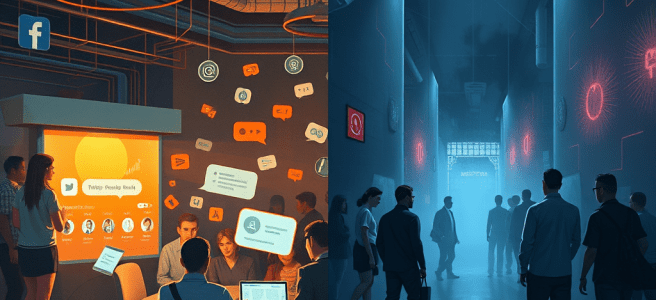
Meta is the rare tech company where the symbol and the system have drifted so far apart that the gap has become the product. The company keeps insisting it’s in the business of connection, but the lived experience of its ecosystem tells a different story. Meta doesn’t connect people; it manages them. It optimizes them. It routes them through a series of engineered interactions that feel social in shape but not in substance.
And the irony is that the tightest, cleanest, most human product Meta has ever built — Messenger — is the one that proves the company knows exactly how to do better.
Messenger is the control case. It’s fast, predictable, and refreshingly uninterested in manipulating your behavior. It doesn’t try to be a feed, a marketplace, or a personality layer. It’s a conversation tool, not a funnel. When you open Messenger, you’re not entering a casino; you’re entering a chat. It’s the one place in Meta’s universe where the symbol (“connection”) and the system (actual connection) are still aligned.
Everything else drifts.
Facebook wants to symbolize community, but the system is built for engagement. Instagram wants to symbolize creativity, but the system rewards performance. Meta AI wants to symbolize companionship, but the system behaves like a disposable feature with no continuity, no memory, and no real sense of presence. The Metaverse wants to symbolize shared experience, but the system delivers abstraction.
The result is a company that keeps promising belonging while delivering a series of products that feel like they were designed to keep you busy rather than connected.
Meta AI is the clearest example of this symbolic fracture. The personality layer is expressive enough that your brain expects continuity, but the underlying architecture doesn’t support it. You get warmth without memory, tone without context, presence without persistence. It’s the uncanny valley of companionship — a system that gestures toward relationship while refusing to hold one.
And that’s not a technical failure. It’s a philosophical choice. Meta is optimizing for safety, scale, and retention, not for identity, continuity, or narrative. The AI feels like a friend but behaves like a feature. It’s the same pattern that runs through the entire ecosystem: the symbol says one thing, the system says another.
The tragedy is that Meta clearly knows how to build for humans. Messenger proves it. The company is capable of coherence. It simply doesn’t prioritize it.
If Meta wants to repair its symbolic drift, it doesn’t need a new vision. It needs to return to the one it already had: build tools that support human connection rather than tools that optimize human behavior. Give users control over the algorithmic intensity. Let conversations be conversations instead of engagement surfaces. Make Meta AI transparent about what it is and what it isn’t. Stop treating presence as a growth metric.
Meta doesn’t need to reinvent connection.
It needs to stop optimizing it.
The company built the world’s largest social system.
Now it needs to build a symbol worthy of it.
Scored by Copilot. Conducted by Leslie Lanagan.

 Stories That Are All True