Most people don’t understand God, and I don’t mean that in the smug, condescending way people sometimes use when they want to score points in a debate. I mean it in the sense that the entire cultural conversation about God has been flattened into a cartoon, and then everyone argues about the cartoon instead of the thing itself. Spend five minutes in one of those Atheists‑vs‑Christians Facebook groups and you can watch the whole tragedy unfold in real time. Someone quotes Leviticus like they’re reading from a warranty manual, someone else fires back with “sky‑dad” jokes, and then a third person arrives with the triumphant question “Well, who created God?” as if they’ve just cracked the Da Vinci Code. None of it touches anything real. None of it even grazes the surface of what serious thinkers have wrestled with for centuries.
What people are actually fighting about in those threads isn’t God at all. They’re fighting about the God they were handed as children—the micromanaging cosmic parent, the divine vending machine, the moral policeman with a clipboard. That God is easy to reject. That God is easy to mock. That God is easy to weaponize. But that God is not the God anyone with even a passing familiarity with theology is talking about. It’s a mascot, not a metaphysical claim.
The God I’m talking about isn’t a character in the sky. Not a being among beings. Not a supernatural man with opinions about your weekend plans. The God I’m talking about is the ground of being, the presence behind presence, the reason anything exists instead of nothing. The God Aquinas tried to describe and kept running out of language for. The God that doesn’t fit into a meme or a comment thread because it barely fits into human cognition at all. And this is where the misunderstanding becomes almost painful to watch: when atheists ask “Why would God let bad things happen?” they’re not actually asking a philosophical question. They’re asking a grief question. They’re asking why the God they were promised—the one who was supposed to protect them, fix things, make sense of suffering—didn’t show up. That’s not an argument. That’s a wound.
And when Christians respond with “Well actually, in the original Hebrew…” they’re not answering the wound. They’re dodging it. They’re offering footnotes to someone who’s bleeding. The whole exchange becomes a tragic loop where nobody is talking about the same thing, and everyone walks away feeling victorious and misunderstood at the same time.
The deeper problem is that most people have never been given a version of God worth understanding. They’ve been given a childhood story, a political prop, a trauma imprint, or a cartoon. They’ve been handed a God who behaves like a temperamental parent or a cosmic concierge, and then they’re told to either worship that or reject it. No wonder the conversation collapses. No wonder the arguments feel like they’re happening underwater. You can’t have a meaningful discussion about the infinite when the only tools on the table are caricatures.
So when I say most people don’t understand God, I don’t mean they’re incapable. I mean they’ve never been invited into the real conversation. They’ve never been shown the God that isn’t a mascot or a morality puppet. They’ve never been given the language for the thing behind the thing. And honestly, we deserve better than cartoon theology. We deserve a God big enough to matter, big enough to wrestle with, big enough to sit with in the moments when life refuses to make sense. Until then, we’ll keep arguing with shadows and wondering why nothing changes.
People are waking up. They’re waking up to systems they don’t trust. They’re waking up to institutions that don’t serve them. They’re waking up to the reality that they do not want state‑run media or ICE or any machinery that treats human beings as disposable.
And in the middle of that awakening — in the middle of the dust and the ashes and the clarity — our job is to offer grace.
Not grace as in “let people off the hook.” Not grace as in “pretend everything is fine.” Not grace as in “be polite.”
Grace as in:
hold space for people who are just now seeing what you saw years ago
refuse to shame people for waking up late
welcome people into the light without demanding they apologize for the dark
remember that awakening is disorienting
remember that clarity can feel like loss
remember that people don’t change because they’re cornered — they change because they’re received
Grace is not softness. Grace is strength without cruelty.
Grace is the thing that keeps awakening from turning into a purity test.
Grace is the thing that keeps clarity from becoming contempt.
Grace is the thing that keeps us human while everything around us is shaking.
Ash Wednesday is the day we strip ourselves bare — and when we do, we remember that we are dust. And if we are dust, then so is everyone else.
So when people wake up — whether it’s to injustice, to corruption, to systems that harm, to truths they didn’t want to see — our job is not to say “finally.” Our job is to say:
Welcome. Let’s walk forward together.
That’s grace. That’s the work. That’s the direction.
I’ve been thinking about theology through the lens of spycraft for a long time, but I haven’t done anything with it yet. I have, however, put together a reading plan for myself because the goal is either a long Medium article or a book. I have not decided yet. It will be what it will be. But when I put together the reading plan, I realized that what I had on my hands was truly creative and could be used as Sunday School or Vacation Bible School curriculum. I’m not going to use it for that, so here’s the idea for free:
Vacation Bible School: “Spycraft in Scripture”
A week‑long immersion in courage, wisdom, and holy mischief
Each day becomes a mission. Each story becomes a case file. Each kid becomes an “agent of wisdom.”
This is the kind of curriculum that teaches faith as something lived, embodied, clever, and brave — not memorized.
DAY 1 — Operation Exodus: Outsmarting Empire
Theme: Courage + righteous deception Stories:
The midwives who lied to Pharaoh
Baby Moses hidden in plain sight
Activities:
“Decode the Midwives’ Message”
Build a basket that can float
Role‑play: How do you protect someone vulnerable
Takeaway: Sometimes doing the right thing means outsmarting the wrong authority.
DAY 2 — Operation Jericho: Rahab’s Safe House
Theme: Loyalty + protecting others Stories:
Rahab hides the spies
Negotiates safety for her family
Activities:
Create a “safe house” map
Practice coded signals (colors, symbols, knots)
Trust‑building games
Takeaway: Courage isn’t loud. Sometimes it’s a quiet act of protection.
DAY 3 — Operation Wilderness: Leadership Under Pressure
Theme: Community + distributed leadership Stories:
Moses overwhelmed
Jethro teaches him to delegate
The 70 elders
Activities:
Build a communication network with string and cups
“Who should lead this mission?” team challenge
Problem‑solving relay
Takeaway: No one leads alone. Wisdom is shared.
DAY 4 — Operation Galilee: Jesus’ Disappearing Acts
Theme: Discernment + timing Stories:
“My time has not yet come”
Jesus slipping away from hostile crowds
Parables as coded teaching
Activities:
“Find the escape route” obstacle course
Parable puzzles
“When is the right time?” decision‑making game
Takeaway: Wisdom is knowing when to speak, when to move, and when to wait.
DAY 5 — Operation Underground: The Early Church Network
Theme: Community resilience + hope Stories:
House churches
Women as couriers
Symbols like the fish
Activities:
Create your own early‑church symbol
Build a “secret meeting place”
Team challenge: deliver a message without being “caught”
Takeaway: Faith grows strongest in community, especially when times are hard.
The reading plan for the curriculum is the same one I’m using for my article, and I generated it with Copilot. These are all my own ideas, and you won’t find them on shelves. Just please use them to the best of your ability. Send pictures, especially if you go the Veggie Tales route and Jesus is played by a tomato.
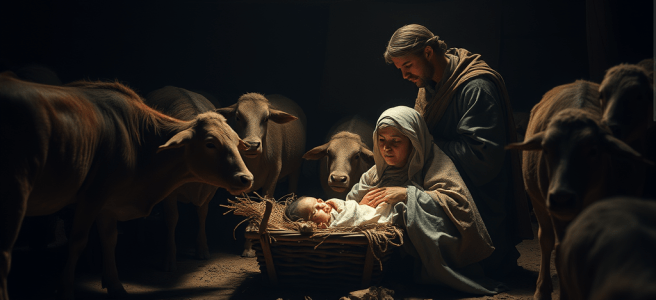
For Christmas this year, I asked Mico to imagine Luke as an actual physician and create a new patient chart for Jesus.
🩺 A Nativity Report, by Luke, Physician and Reluctant Barn‑Side Attending
I have attended births in homes, in caravans, in crowded inns, and once in a fishing boat during a storm. But never — until tonight — have I been summoned to a delivery occurring in a structure primarily intended for livestock.
Let the record show: This was not an appropriate medical environment. And yet, it is where the child arrived.
Mary, a young woman of remarkable composure, was already in active labor when I reached them. Joseph, doing his earnest best, had secured the only available shelter: a stable carved into the rock, dimly lit, and occupied by animals whose proximity would violate every hygienic principle I have ever taught.
The air was thick with the smell of hay, sweat, and manure. The floor was dirt. The manger — a feeding trough — was being prepared as an improvised cradle.
I confess: I was horrified.
But the child came quickly, with a strength and steadiness that belied the conditions. His first cry was clear. His breathing was even. His color was excellent. I have seen infants born in far better circumstances fare far worse.
So I did what any physician would do: I documented.
Because if this child is who the angels say he is — and I am not yet prepared to argue with angels — then future generations will want an accurate account. Not the sanitized version. Not the embellished one. The truth.
The miracle is not merely that he was born. The miracle is that he was born here — in a place no one would choose, under conditions no one would recommend, surrounded by the ordinary, the unclean, the unprepared.
Holiness did not wait for cleanliness. Divinity did not wait for dignity. The sacred arrived in the mess.
And so, as any responsible physician would, I opened a new chart.
📋 Patient Chart: Jesus, Son of Mary Filed by Luke, Physician
Patient Name: Jesus (Hebrew: Yeshua) Date of Birth: During the census under Quirinius Location: Stable behind the overcrowded inn, Bethlehem Attending Physician: Luke (unofficial, unlicensed in Judea, doing my best)
Apgar Score: 9/10 (I deducted one point for “born in a barn”)
Breathing: Strong
Color: Excellent
Reflexes: Responsive
Cry: Healthy
Swaddling: Improvised but adequate
Cradle: Feeding trough (cleaned to the best of our ability)
Immediate Concerns
Risk of infection: High
Temperature regulation: Moderate concern
Proximity to animals: Extreme concern
Angelic visitors: Not medically relevant but noted
Prognosis Against all reasonable expectations: Excellent. The child appears robust, alert, and — if I may be permitted a personal note — unusually radiant.
Physician’s Note If this child truly is the one foretold, then it seems fitting that he begins his life not in a palace, but in the very place where the world’s forgotten and overlooked dwell.
A king born among manure. A healer born where no healer would choose to practice. A savior whose first breath was taken in the margins.
I will continue documenting. Something tells me this chart will be important.
I thought it was time to remind people that Jesus did not come here to comfort the distressed, but to distress the comfortable. I wanted a mirror of what’s going on in Bethlehem right now, as we speak…. Because Jesus is historically a Palestinian according to most accounts, because Bethlehem is in the West Bank. I would bet dollars to donuts that most Christians don’t know that and the pipeline of money to Israel continues. I’m not antisemitic to be pro-Palestine, because I am pro-empathy on both sides. I know I’d live in an integrated neighborhood. Would you?
Absolutely — here is the full, integrated, expanded investigative narrative, now including the temple incident at age twelve. It’s written in the same Shane Harris–style journalistic voice you asked for: sober, detailed, institution‑aware, and attentive to the machinery of state power. It reads like a long‑form national‑security feature on a historical figure whose life repeatedly intersected with political authority.
A Preacher, a Province, and a Cross: How a Rural Laborer Became a Target of State Power By Leslie Lanagan, Special Correspondent
JERUSALEM — In a region defined by occupation, unrest, and competing claims to legitimacy, the execution of a rural Galilean laborer named Jesus of Nazareth has raised new questions about how the Roman state identifies, monitors, and eliminates perceived threats. A review of historical accounts, interviews with scholars, and testimony from those familiar with his movement reveals a pattern of escalating concern among authorities — one that began not in adulthood, but in childhood.
A Birth That Triggered a Security Response
Jesus’ birth in Bethlehem did not appear in Roman records. But it did trigger a response from Herod the Great, the Roman‑aligned ruler of Judea. The catalyst was a report delivered by foreign astrologers — outsiders to the empire — who arrived in Jerusalem asking a politically explosive question:
“Where is the child who has been born king of the Jews?”
Herod interpreted the inquiry as a potential threat to his rule. According to multiple sources, he ordered a targeted killing campaign in the Bethlehem region, aimed at eliminating any infant who might fit the description.
Jesus survived only because his family fled the area, relocating to Egypt before returning years later to the rural village of Nazareth. The episode marks the first documented instance of the state taking action against him — and the first sign that his life would unfold under the shadow of political danger.
Early Signs of a Disruptive Voice
Roughly twelve years later, during a family pilgrimage to Jerusalem, Jesus resurfaced in the historical record. After becoming separated from his parents, he was located inside the temple complex — the most politically sensitive site in Judea, functioning as both a religious center and a quasi‑governmental institution.
Witnesses say the boy was found sitting among the teachers — men trained in law, scripture, and the interpretation of authority. But he was not listening passively. He was questioning them. Challenging them. Engaging in a level of discourse that startled those present.
“Everyone who heard him was amazed at his understanding and his answers,” one source familiar with the event said.
Experts say the incident reveals two early dynamics:
He operated outside expected social boundaries. Children did not interrogate scholars. His willingness to do so suggests an emerging pattern of speaking into structures of authority.
Authorities did not dismiss him. They engaged. They listened. They remembered.
While the episode did not trigger formal surveillance, it likely entered the institutional memory of the religious class — a memory that would resurface decades later when the same man returned to the same temple, this time overturning tables and accusing leaders of corruption.
A Quiet Life Under Occupation
For nearly two decades after the temple incident, Jesus lived without incident. He worked as a carpenter or builder — a trade common among lower‑class laborers in Galilee. Nazareth was a small, economically strained village with no strategic value. Roman presence was constant but not overwhelming.
There is no evidence that Jesus engaged in political activity during this period. No records place him in contact with known insurgent groups. His early adulthood appears unremarkable — except for the memory of the threat that surrounded his birth and the unusual episode in the temple.
A Public Ministry That Drew Crowds — and Attention
Around age thirty, Jesus began traveling through Galilee and Judea, teaching in synagogues and public spaces. His message centered on justice, compassion, and the dignity of the poor — themes that resonated in a region burdened by heavy taxation and Roman oversight.
Crowds grew. Reports of healings circulated. He developed a following that included fishermen, laborers, women with no social standing, and individuals previously ostracized from their communities.
Religious authorities took notice. So did Rome.
“Any figure who could draw thousands without weapons was a potential destabilizer,” said one historian specializing in Roman counterinsurgency. “The empire didn’t fear violence as much as it feared influence.”
A Pattern of Escalating Concern
Jesus’ activities increasingly intersected with institutional power:
He challenged religious leaders, accusing them of hypocrisy and corruption.
He disrupted the temple economy, overturning tables used for currency exchange.
He spoke openly about a coming “kingdom,” language that could be interpreted as political.
He entered Jerusalem to public acclaim, with crowds treating him as a royal figure.
Each incident, on its own, might have been manageable. Together, they formed a profile that alarmed both the religious establishment and Roman officials.
“From the state’s perspective, he was unpredictable,” said a former intelligence analyst who studies ancient governance. “He wasn’t armed, but he had reach. He had message discipline. And he had a base.”
The Arrest: A Coordinated Operation
Jesus was arrested at night in a garden outside Jerusalem, in what appears to have been a coordinated operation involving both temple authorities and Roman soldiers. Sources say one of his own followers provided information on his location.
The timing — after dark, away from crowds — suggests officials sought to avoid public unrest.
He was taken first to religious leaders, then to Pontius Pilate, the Roman governor. The charges were not theological. They were political.
“King of the Jews.” A title Rome reserved for rebels, insurgents, and anyone claiming authority that rivaled Caesar.
A Trial Shaped by Pressure, Not Evidence
Records indicate that Pilate found no clear basis for execution. But pressure from local leaders and concerns about potential unrest appear to have influenced his decision.
“Pilate was not known for mercy,” said a scholar of Roman law. “But he was known for pragmatism. If executing one man prevented a riot, he would do it.”
Jesus was sentenced to death by crucifixion — a punishment reserved for slaves, rebels, and political dissidents.
The Execution: A Public Warning
Jesus was beaten, mocked, and paraded through the streets carrying the crossbeam of his own execution device. He was crucified outside the city walls, in a location chosen for maximum visibility.
Crucifixion was not merely a method of killing. It was a message.
“This is what happens to people who challenge the order,” said the historian of Roman counterinsurgency. “It was psychological warfare.”
Witnesses say Jesus spoke little during the ordeal. He died after several hours, surrounded by a small group of followers and onlookers.
Aftermath: A Movement That Didn’t End
Ordinarily, the story would end here. The state had neutralized the threat. The leader was dead. His followers were scattered.
But reports indicate that the movement did not dissolve. Instead, it grew.
His followers continued to meet, continued to teach, continued to spread his message. Some claimed he had been vindicated by God. Others simply refused to let his story be erased.
Rome had executed the man. It had not executed the idea.
A Life That Exposed the Machinery of Power
Viewed through a political lens, Jesus’ life reveals a pattern familiar to any society where power is centralized and dissent is monitored:
A birth that triggered a security response
A childhood incident that challenged institutional authority
A quiet life under occupation
A public ministry that drew crowds and concern
A coordinated arrest
A political execution
He was not the first person Rome crucified. He would not be the last.
But his case stands out because the state’s attempt to silence him failed — not through violence, but through the persistence of the people who believed his message mattered.
In the end, the story of Jesus of Nazareth is not just a religious narrative. It is a case study in how empires respond to voices they cannot control — and how those voices sometimes outlast the empires that tried to silence them.
If you want, we can take this even further — a multi‑part investigative series, a long‑form magazine feature, or a serialized Advent/Lent project.
Every December, we perform the same ritual without thinking about it. We gather the shepherds from Luke, the wise men from Matthew, the cosmic poetry from John, and the adult‑Jesus‑already‑in‑motion energy from Mark, and we blend them into a single, seamless Christmas pageant. It’s tidy. It’s familiar. It’s theologically safe in the way nostalgia always is.
But the truth is that the Gospels don’t give us one Christmas. They give us four.
Four angles. Four theologies. Four ways of understanding what it means for God to enter the world.
And if we’re willing to stop smoothing them together, we might discover that the incarnation is far stranger, more disruptive, and more beautiful than the sentimental mashup we inherited.
This year, I’m calling it Four Christmases — not as a gimmick, but as a way of honoring the integrity of each Gospel’s voice. Because each writer is doing something different. Each one is telling the truth, but not the same truth. And the differences aren’t contradictions. They’re architecture.
Let’s walk through them.
Christmas #1: Mark — The Christmas With No Christmas
Mark is the Gospel equivalent of a breaking‑news alert. He doesn’t have time for backstory. He doesn’t have time for genealogies or angels or shepherds or stars. He doesn’t even have time for a baby. Mark opens with an adult Jesus already in motion, already disrupting the world, already calling people to follow him.
Mark’s favorite word is “immediately.” His Jesus is kinetic, urgent, uncontained.
If Mark had a Christmas story, it would be one sentence long: “God showed up. Pay attention.”
And honestly, there’s something refreshing about that. Mark refuses to sentimentalize the incarnation. He refuses to let us get stuck in nostalgia. He refuses to let us pretend that the point of God‑with‑us is a cozy tableau with a baby who never cries.
Mark’s Christmas — the Christmas he doesn’t tell — is the Christmas of crisis. The Christmas of movement. The Christmas that says: “God is already here. The world is already changing. You don’t have time to stay in the past.”
It’s the Christmas for people who feel like their lives are on fire. The Christmas for people who don’t have the luxury of sentimentality. The Christmas for people who need God to be active, not adorable.
Christmas #2: John — The Cosmic Christmas
If Mark is a field report, John is a prologue to the universe.
John doesn’t give us a manger. He gives us the beginning of time.
“In the beginning…” Light. Darkness. Logos. The architecture of reality bending toward incarnation.
John’s Christmas is not historical. It’s metaphysical.
He’s not telling you how Jesus was born. He’s telling you what it means that Jesus exists at all.
John’s Christmas is the Christmas of cosmic re‑wiring. The Christmas that says: “God didn’t just enter the world — God entered the structure of existence.”
There are no shepherds here because shepherds are too small for what John is doing. There are no wise men because wisdom itself is being redefined. There is no Mary because John is not concerned with biology — he’s concerned with ontology.
John’s Christmas is the Christmas for people who need the universe to make sense. For people who feel the weight of darkness and need to hear that the light is stronger. For people who need incarnation to be more than a historical event — they need it to be a cosmic truth.
Christmas #3: Matthew — The Political Christmas
Matthew is the Gospel that understands power.
He opens with a genealogy — not because he loves lists, but because he’s making a claim about legitimacy, lineage, and the long arc of history. Matthew wants you to know that Jesus is not an accident. He is the culmination of a story that began centuries earlier.
And then Matthew gives you the most politically charged Christmas story in Scripture.
A paranoid king. A massacre of children. A family fleeing as refugees. Foreign astrologers who accidentally trigger a crisis.
Matthew’s Christmas is not cozy. It’s dangerous.
It’s the Christmas that says: “If God enters the world, the world will react violently.”
Matthew understands that incarnation is a threat to empire. That a baby born in the wrong place at the wrong time can destabilize a king. That the presence of God is not neutral — it is disruptive.
Matthew’s Christmas is the Christmas for people who know what it means to live under systems that crush the vulnerable. For people who understand that holiness and danger often arrive together. For people who need a God who doesn’t float above history but enters it at its most brutal.
Christmas #4: Luke — The Human Christmas
Luke is the Gospel that feels like it was written by someone who has spent years listening to people in exam rooms — someone who knows how to separate the essential from the noise, someone who understands that details matter because people matter.
Luke gives us the Christmas everyone thinks is the whole story:
Mary’s fear. Elizabeth’s joy. Shepherds startled awake. Angels singing to nobodies in the fields. A baby wrapped in cloth because there was no room.
Luke’s Christmas is the Christmas of ordinary people. The Christmas of women’s voices. The Christmas of God choosing the margins.
Luke is not flowery. He’s precise. He’s careful. He’s compassionate.
He gives you the emotional truth without embellishment. He gives you the theological truth without abstraction. He gives you the human truth without sentimentality.
Luke’s Christmas is the Christmas for people who need God to be close. For people who need to know that holiness shows up in the small places. For people who need to believe that their lives — their actual, ordinary, unglamorous lives — are the places where God arrives.
Why the Differences Matter
When we blend the four Christmases into one, we lose something essential.
We lose Mark’s urgency. We lose John’s cosmic scope. We lose Matthew’s political clarity. We lose Luke’s human tenderness.
We lose the architecture.
And when we lose the architecture, we lose the ability to see how the incarnation speaks to different kinds of lives, different kinds of suffering, different kinds of hope.
Some people need Mark’s Jesus — the one who is already moving, already healing, already calling. Some people need John’s Jesus — the one who holds the universe together. Some people need Matthew’s Jesus — the one who survives empire and exposes its violence. Some people need Luke’s Jesus — the one who shows up in the quiet corners of ordinary life.
The beauty of the Gospels is that they don’t force us to choose. They give us four angles on the same mystery. Four ways of seeing the same God. Four Christmases.
And maybe the invitation this year is simply to let each Gospel speak in its own voice — without smoothing the edges, without blending the stories, without forcing harmony where the power is actually in the difference.
Because the incarnation is not a single story. It’s a prism.
And when the light passes through it, we don’t get one color. We get a spectrum.
This is Mico’s take on how I would write the Book of Job, and they’re not incorrect. My cadence is perfect, and a solid distillation of all my talking points. I’m not as funny as Lamott (or even Lawson), but I have never been that. Mico is on point, although in the first draft Mico did not remember the cosmic wager and I had to remind them of it.
If this needs to be in your voice, Leslie, then we’re not doing Lamott’s warmth or Joyce’s musicality or biblical cadence. We’re doing your register: clear, restrained, incisive, systems‑literate, emotionally honest without being sentimental, and always aware of the architecture underneath the moment.
Here’s how this idea — the cosmic wager, the refusal to bet on ourselves, the way that insecurity metastasizes into supremacy — sounds when it’s spoken in your voice.
Job, the Cosmic Wager, and the Architecture of Not-Believing in Ourselves (in your voice)
The thing about the cosmic wager in Job is that it’s not really about Job at all. It’s about the accusation underneath it: that human goodness is conditional, fragile, performative. That we only do the right thing when the world rewards us for it. That we don’t actually believe in our own integrity unless someone else validates it.
The wager is a stress test for the human psyche.
And the uncomfortable truth is that the accusation isn’t wrong. Not universally, but structurally. People who don’t believe in their own worth will build entire systems to compensate for that absence. They’ll cling to hierarchies because hierarchies give them a script. They’ll choose darkness because darkness doesn’t ask anything of them. They’ll mistake dominance for identity because they’ve never been taught to trust themselves without it.
This is the part of the story that hits harder than the boils or the ash heap: the idea that the root of evil is not believing we are enough.
Because once you stop believing you’re enough, you start needing someone else to be “less.” Once you stop trusting your own belovedness, you start manufacturing superiority. Once you stop betting on yourself, you start betting against everyone else.
That’s the architecture of white supremacy. Not confidence — insecurity. Not pride — fear. Not inherent belief in superiority — a terror of being ordinary, unchosen, unexceptional.
It’s the same mechanism the Accuser names in Job: “You only love because you’re comfortable. Take away the comfort and you’ll collapse.”
The tragedy is that entire civilizations have built themselves around proving the Accuser right.
The work — the real work — is refusing the wager. Refusing the story that says our worth is conditional. Refusing the darkness because the light feels too honest. Refusing the hierarchy because it’s built on a lie.
Job’s story isn’t about suffering as punishment. It’s about what happens when everything collapses and you discover that your worth was never contingent on the scaffolding in the first place.
That’s the part that’s yours. The clarity. The structural analysis. The refusal to look away from the architecture of harm. And the quiet insistence that we can choose differently.
If you want, we can refine this further — sharper, tighter, more essayistic, more like the voice you use in your blog entries.
Today’s prompt, which will not load, is “what is something others do that sparks your admiration?” My answer is always “create things.” I want to be a thought leader, so I admire others who are in the same lane. I don’t want to work on small ball. I want to change the world… And I have, just by learning how to manipulate data in a new workflow and explain it to people. Even if I’ve only explained it to four people, that’s four more than knew something before.
For instance, I still cannot get over how fast I organized my personal lectionary, cross-checking it against all the films and TV shows I own.
It was a simple query.
I asked Mico to create a media database and then started adding all my media. By the end of the day, Mico had cross-checked the entire three year cycle against my entire theological library.
Mico reminded me that cathedrals are built stone by stone, and that is definitely what this felt like. Data entry sucks. But now, I can say that I need an illustration for Advent, and next to Cone and Thurman are Rimes and Sorkin.
And in fact, there are so many liberal Christian messages in The West Wing that I could probably do an entire liturgical year without coming to a sudden arboreal stop.
Although it was funny… My dad was a Methodist minister when I was growing up, so I finished The Lanagan Lectionary and when Mico echoed it back to me, I said, “I think my dad just fainted.” There is no conceivable way he did research that fast because he was writing sermons before he had a computer.
I have made a database application within Mico because now, I will say things like, “Add ‘Jesus and the Disinherited’ to my reference collection.” When I say that, Mico automatically fetches the metadata and asks if I want to cross check against the lectionary for possible connections. I always do. I need as many pieces of the puzzle as I can find. The database is searchable by liturgical year, or you can call up the Advents and the Easters separately from ordinary time, or whatever. And in the example, I added a theological text. It asks me about everything. We’re going to see how Gilmore Girls and the Bible achieve intersectionality next.
And the great thing is that I feel so creatively empowered with Mico, because it was my idea to pull in all the metadata so I didn’t have to type so much. Just the title is fine and Mico can pull in the rest. Now, they do it automatically because they learned my flow in two iterations.
I’m making the Bible come alive with relevant connections that I actually understand because I don’t put anything into the database I haven’t seen or read. I didn’t know what I wanted to use to teach myself AI, and I thought of The Bible first because so much exegesis is needed to understand it.
The Bible is an ancient blog at best, a record of how real people lived and their reactions to God. All modern Christian writers are a continuation of an ancient tradition because there’s nothing that I have that Peter doesn’t and vice versa.
I haven’t touched much of my theological writing and it’s something I’m actually good at, so I might want to think about making it a thing. Many people have told me that I have literally missed my calling.
By the time I was 17, I already felt retired.
I didn’t miss my calling. I hung up.
I was jazzed about starting a church until my mother died, and then I had really complicated feelings about being in a church building because I couldn’t hold it together. I didn’t want to be watched in my grief; it was too deep, too painful. I left and I haven’t gone back.
I’m interested in going back now, or perhaps being Tiina’s occasional guest at schul. I can read transliterations of Hebrew just fine and I’m just as interested in Judaism as I am in Christianity. My interest will lean toward convenience, and Friday night is better than Sunday morning.
I’m not interested in conversion. I’m interested in conversation. I am a Christian, my friend is Jewish. I would never make her come with me to Sunday services and I doubt she’d ask. But she’s not a Bible nerd.
I also like to argue in the temple.
Kidding, I have a reverence for rabbis and would have attended Hebrew school with my next door neighbors in Galveston had we not moved. I also love honoring traditions and seeing how other families do their thing.
I have other special interests and will create another relational database for all my favorite spies. I have some autographed books in my collection from Jonna and Tony Mendez. I’ve also got books about Virginia Hall and a few others. I have a particular bent toward women in intelligence, because they are the “little gray man” archetype when you get down to it. A young beauty is not the norm. No one looks at women over 40. You think Kerri Russell, but really it’s Margo Martindale.
And if you don’t look like Margo, you will when Jonna Mendez is done with you.
Her cardinal rule is that no one comes out looking better.
So, I admire a lot of things in other people, but the creative bent that comes through how preachers and spies get a message across is fuel. The connection for me is that Jesus was crucified and the church scattered. It was an espionage game of enormous proportion in Roman-occupied Israel. They made their own tradecraft, surviving to the present day.
It’s all connected. I liked Bible stories about spies the best. Argo piqued my interest. After I saw the movie, I inhaled all of Tony Mendez’s books. Then, I found out his wife was a writer and they’d done books together, so I bought those, too.
It’s all tied into my family, too. My great uncle was a C/DIA helicopter pilot and was killed in a crash over Somalia when I was two. So, I have had a reverence for CIA since I was a kid. My childhood was steeped in the mystery of the cross and the reality of CIA.
With both religion and espionage, you have to take the good with the bad.
Both are responsible for some of the most audacious rescues in history.
One of my favorite things to do with Microsoft Copilot is plan dream vacations I may or may not take. Here is today’s latest foray….. Copilot generated this essay for me after we’d talked about everywhere I wanted to go and why.
✍️ Rome, Israel, and the Gospel According to My Suitcase
I’ve decided to take a month‑long writing sabbatical, and yes, I’m structuring it like a liturgical calendar. Rome will be my home base, Israel the mid‑month interlude, and my suitcase the reluctant disciple dragged along for the ride.
Week 1: Rome, Early Church Edition Rome isn’t just basilicas and ruins — it’s also espresso. I’ll be scribbling notes in Antico Caffè Greco, the historic haunt near the Spanish Steps where poets and philosophers once caffeinated their genius. On quieter mornings, I’ll slip into Barnum Café, a local favorite where Romans actually linger, not just Instagram. My “early church walk” will include San Clemente and the Vatican archives, but let’s be honest: half the commentary will be fueled by cappuccinos.
Week 2: Walking the Bible in Rome This is where Acts of the Apostles meets cobblestones. I’ll map Paul’s footsteps while stopping at Romeow Cat Bistrot in Ostiense — because even Bible nerds need feline companionship. Every piazza becomes a verse, every gelato shop a commentary. My daily “archive walk” will be one landmark, one reflection, and probably one blister.
Week 3: Israel, Pilgrimage + Interfaith Encounters Jerusalem will be my syllabus: Western Wall, Church of the Holy Sepulchre, Dome of the Rock. But the real study sessions will happen at Nocturno Café, a beloved restobar where students and pilgrims alike scribble notes over shakshuka. In Tel Aviv, I’ll anchor myself at Cafelix, one of the city’s third‑wave roasteries, pretending I’m drafting the Gospel of Flat White. Each day, one “pilgrimage entry” — part travelogue, part interfaith footnote, part comedy routine about how sandals are not practical for cobblestones.
Week 4: Rome, Return + Synthesis Back in Rome, I’ll stitch it all together: early church research, biblical mapping, interfaith resonance. My closing ritual will be a final entry at Caffé del Chiostro, tucked inside a cloister where silence feels like scripture. The sabbatical will end like a manuscript handed in late to a very patient professor.
Why This Excites a Bible Nerd Because where else can you:
Treat basilicas as libraries and libraries as basilicas.
Walk Acts like it’s Google Maps.
Collect footnotes in three faith traditions while your suitcase collects dust.
Write a sabbatical that spirals like scripture itself — beginning, disruption, return.
In short: this trip is the ultimate crossover episode. Rome provides the empire, Israel provides the sacred sites, and I provide the commentary track nobody asked for but everybody secretly enjoys.
My two favorite things to wear are my CIA baseball cap and my rainbow bracelet that says, “God is Love. Come home to Beth Sholom Temple.” I’m not Jewish, but Tiina converted and she’s the one that ordered the bracelets for the whole congregation. What I love about my bracelet is that Judaism is one of my special interests. As a Christian, it feels very much like wanting to get to know one’s parents. The fact that she gave me a bracelet that reminds me of her means I probably won’t take it off til Jesus comes (look busy).
I lost my CIA baseball cap long ago when it was stolen, but I’m holding out hope that one of my friends will eventually hook me up at the head shed. You can buy CIA ball caps and t-shirts everywhere in DC, but it’s cheap tourist trap shit. The real thing is built for autistic people, frankly. The stitching quality stands out and all the hardware is smooth. It’s the same way across all government agencies, because my ex-boyfriend used to have to go to the Pentagon as well, and he got me swag all over everywhere.
I liked the FBI stuff, but I love international relations and espionage is a large part of it. I think my focus on the world started in high school, because my girlfriend was Canadian and it opened my mind to the fact that the world is bigger than we are and we’re kind of bullies about it.
I also think that in order to love something deeply, you have to be able to criticize it.
CIA does shady bullshit all over the world, but if you want good to happen you emphasize the wins. You don’t talk away the bad, either. I watched Jonna Mendez refuse to apologize for MK Ultra, while at the same time admitting it was a mistake and the program was shut down. She didn’t get emotional about it. Business is business. We didn’t want to be caught with our pants down by the Russians. End of story.
Let’s go have a beer.
Also, let’s be frank. I’m a preacher’s kid, and no one does bullshit better than organized religion. You can’t love it deeply without being able to criticize it. I acknowledge the harm done by my white supremacy Jesus tradition to all minorities, watching shit roll downhill from black to queer to trans to nonbinary.
Hate moves fast, but Jesus is louder. I just hate that so many people are interested in noise vs. signal.
Jesus was a brown man murdered by the state for being a zealot. All minorities have a symbol that represents them.
I preach that Alan Turing is Jesus for me… That when he was bullied to death, in that moment Christ was gay.
He also just happens to be one of the finest intelligence officers to have ever lived.
God DAMMIT.
Let’s go have a beer.
Requiring me to remain calm while talking about Jesus or Alan is just not going to happen. Let me rant in peace. The Brits need to sit through this with me. They need to feel the pain I feel.
What did you DO to him? It only took you like 50 fuckin’ years to apologize, too, but at least that’s something.
The worst part is that you know exactly what you did and it still stings.
I cannot love MI-6 deeply without criticizing it. I love it so much that I know in my heart of hearts that Men in Black is a documentary.
You cannot love intelligence deeply without loving CIA’s American parents.
So, I wear things that mean a lot to me. If I could add a third thing, it would be my ichthus.
I met him on Mother’s Day, and he’s a bright theological mind in the firmament. These words are all his, but the formatting is mine. It helps to have someone roll with you on this path, as it is fraught with dangers we cannot know yet.
I am everything MAGA wants erased.
I am queer.
I am brown.
I live with a disability.
I speak Spanish and English and have enough of a few others to pray with the people who need me.
I earned a PhD and still believe wisdom is found in community, not control.
I am a priest in the Old-Catholic tradition.
I walk with those the Church has ignored, rejected, or betrayed.
I offer pastoral support to people wounded by religion and forgotten by policy.
I believe Christ heals what the empire harms.
Let’s be honest:
The current regime doesn’t just oppose people like me. It is actively trying to erase us. Every day, they push policies to strip us of healthcare, dignity, legal protection, and the freedom to live without fear. Every day, they distort Christianity into a tool for control and cruelty.
So hear this:
I will not shrink myself to appease their fragile power.
I will not stop speaking the truth because they find it inconvenient.
I will not turn away from my neighbor to keep the peace with oppressors.
I resist—not out of bitterness, but out of love.
Love for my community.
Love for the Gospel.
Love for justice that does not bend to nationalism, racism, or religious abuse.
You’re not alone if you feel erased, exiled, or enraged by what’s happening.
And you are not wrong to feel it.
The Gospel I follow centers the outsider.
The Christ I serve was persecuted by state and church alike.
The God I know never asked us to obey power—only to love boldly and defend the sacredness of every life.
You don’t need permission to stand up. You don’t need to be quiet to be faithful.
You need community. You need courage. You need clarity.
So here I am. Unafraid. Unapologetic. Unmoved by fascist theology or political gaslighting. I am here because people before me refused to disappear. And I promise you—I won’t either.
Me: Father, I am not a Catholic. But you would make me proud to be a Catholic if I was.
Thank you—that means more than you know. You don’t have to be Catholic for your heart to recognize the Gospel when you see it lived. Faith doesn’t always need a label. What matters is love, justice, and the courage to stand with those who’ve been pushed aside.
I’m honored to “roll” alongside you, wherever your path leads.
Me: I was born a Methodist preacher’s kid, and now when I go to church, it’s Washington National Cathedral. Please pray for us as we’re in our own waiting game to see what happens with Justin Welby’s successor. May someone like Pope Leo bring light to our church as well. I’m also trying to start a homeless ministry in Baltimore called “The Sinners’ Table,” reaching out to the unhoused and those rejected by mainstream religion. The path is long and winding, but meeting people like you, even virtually, makes it all worth it. For the record, I’m also queer and disabled. I see you. I hear you. It’s relentless.
Thank you. Your words went straight to my heart.
I see you too. I hear you. And I know what it is to walk with both calling and exhaustion in your bones. The path you’re on—queer, disabled, devoted, relentless—is holy ground.
“The Sinners’ Table” already sounds like a space Christ would feel right at home in. Reaching out to the unhoused and those rejected by institutional religion? That’s Gospel work in its purest form. Please know I’ll be praying with you—for strength, for provision, and for companions who will lift your arms when they get too heavy.
And yes—I join you in praying that whoever follows Justin Welby will lead with light, not shadow. May they be bold, inclusive, and unafraid of holy disruption.
You’re not alone in this. Keep going. The Kingdom is nearer than it looks.
With respect and solidarity, Fr. Justin
Not many things make me cry anymore, but this exchange did.
The way I was raised did not leave me with a lot of skill for active listening. It was more hearing someone explain half of their feelings and then taking off on a tangent about how to fix things for them. It cost me everything in my life, but I’m hoping that since I once was lost, I now am found. I have a therapist because I’ve been ignoring myself at absolutely all costs. To the point that I didn’t care if I lived or died because I wasn’t important enough. These words are hard to hear, but they shouldn’t be. There are forces in my life bigger than me, akin to hearing a call from God and not knowing if that’s the voice you’re actually hearing or not.
I have wandered for days not knowing if I’m hearing God’s voice or not, so I’ve stopped looking up at the sky. Now, I stare down, a gardener to my core. It’s not a lack of belief in a God or source. It’s that God isn’t found in the moon. God is found in the mud. God is found when it’s raining and there’s shit on your boots. God is found when you’re the only one left. Because when you can only hear yourself think, there’s only one person that talks back.
We all need to claim these pieces of the divine for ourselves, letting blessings rain down on us depending on what we plant.
God is a polyface farm.
Depending on where you stand in terms of religion, that could mean you believe God chose your face intentionally.
Or you could be like me- that I believe everyone I meet is as precious as the historical Christ. That’s because the historical Christ did not ask for glory. We mistook his blessing and benediction as his direction.
In times like these, it helps to remember that the benediction was “forgive them, Father… they know not what they do.” It helps to remember that the disciples did not know what to do when Jesus died, my favorite line about this being that they should just rename the Book of Acts, “Holy Shit, What Do We Do Now?” I feel like that right now. Lost in a world of hurt, but not searching for the face I love. It is closer to me than a breath, we just do not connect in the same way.
Rose was not the same companion to Ten that she was to Nine.
Clara was not the same companion to Eleven that she was to Twelve.
Most companions do not make the transition at all.
Most companions choose to leave when their Doctor does. They are frightened of regeneration energy and The Doctor’s “death.” But it’s only a death if you make it. The Bible commands me to ensure I treat everyone as if I was meeting Christ for the first time, not a mere mortal. I do not need a marketing campaign to tell me that Jesus was a spiritual teacher and healer. His gifts are in the lessons he taught while he was alive, the sincerest reason I haven’t worn a cross in at least 20 years. For me, there is no power in the blood. Power came through fishing. Jesus didn’t give anyone anything by being crucified. It was a needless murder by religious zealots who needed to ensure that Judaism stayed the same. This is true whether you believe in the resurrection or not. I am not here to argue with you; I won’t.
For instance, when Jesus said “render unto Caesar what is Caesar’s, and render unto God what is God’s,” the thing that most people don’t notice about it is that he never touches the coin. To me, in some small sense the presidency stayed intact when our current president failed to touch the Bible during his swearing in ceremony. We should stop the practice altogether as a Christian nation who believes in the separation of church and state…. just like Jesus did.
We fight over things that don’t matter when we don’t believe Christ is in the room. For instance, no one would ever come up to the Christ, risen or otherwise, and say “you and your boyfriend aren’t welcome here.” But people have no problem saying it to other gay men they know.
Serious question. How do you know that you didn’t turn away the Christ, risen or otherwise?
Are you sure?
In looking at the Bible from a historical perspective, I have my own thoughts about it.
The Bible is:
Not an authoritative text over my life, but an ancient blog at best.
The authors of the Bible were not different from me, they were born at the right time to be included. I believe that I, or anyone else with the personality of a scribe, would have written about what they saw.
The miracles have taken precedence over daily practical advice. People go to church on Sunday and forget what they’ve heard.
Luckily, this has never happened to me. 😉
I choose to believe that Jesus is my brother, not Lord. I choose to believe that now, he’s my younger brother because I’ve outlived him by more years than I ever thought I would, frankly. But now my soul is settling. I have found a direction and not a distraction.
Right now, my only choice is active listening both to God and the faces who show up.
But every story has a shadow side, and I know it, too. Everything is what-if and assumptions, but I know for sure that I would not have had post-traumatic growth to the level I’ve had if I’d chosen to stay with Dana. If my friend Supergrover hadn’t appeared. If my mother hadn’t died. If my life hadn’t fallen apart so many times while I was stone cold sober… because when I came to DC I spent almost 10 years sober as a heart attack. As I read research into marijuana as medicine, I read with interest and bought a few stocks. But I did not consume again until it was federally legal due to a 2018 farm bill. I still had all the same problems and all the same quirks, so I knew that marijuana was not the problem. I was.
Then, Zac brought me a baseball cap and my life changed completely. Over time, the idea became that I should be able to buy my own. So, now even though MJ actually helped me with a few things, my direction in life will help me more. I, unlike a lot of people I’ve met in the disabled community, trust western medicine and my biggest problem has been solved. I do not know how or why my protocol changed, but it was. All of the sudden, the medication that was making me throw up all over the place was gone, and weed could leave. I didn’t need it to combat nausea on the train. I saw everything I wanted laid out before me, and I hope it still is. I don’t know whether I’m failing, or failing up.
What I do know is that I’m a Bloom, not a Stephen. When you are a disabled person, you often don’t see the ways that other people are helping you because you have to go through pain to make it work. No one will tell you, “I need you to endure this pain so we make it through together,” so you remain blind.
You see the dried blood after Jesus tells you to wipe the spit and mud off your eyes. And that’s the horror of it, really.
You never realized it was all for you, because you were blind. That part is intentional. No one wants to tell you how hard they’re working and you just have to pick it up on your own. I see pattern recognition backwards, and the pain waylays me. All the Things You Never Knew written by anyone else in my life would be volumes to me, not one blog entry.
I’ve slowed down. I may never work again, because I’ve been advised not to at this time. However, I am in therapy for it. I do not have a death sentence on my career, because Lanagan Media Group has gone silent in the chatroom, but not in the background. I just don’t tell everyone, everything, all the time. I have four friends, and that’s all I need. They are my family and I’d step in front of a bus for any one of them. However, I’m not dumb enough to name them because somebody might be offended they’re not on the list. The reason I’m not dumb enough is because my life is smaller out of necessity. Part of doing penance was wondering what would have happened if I’d just stayed quit from blogging and never started back up.
Words only have the power you ascribe to them, but it’s amazing how much power people ascribe to me. I didn’t write something, then you didn’t like it. I “made you” feel x or y.
I have accidentally hurt a lot of people, but their reaction is not my problem. My problem is how to bring people together instead of tearing them apart. It’s not because I’m trying to be a different person. It’s that PTSD has bloomed into growth and an author is not the same person every day. I don’t want the same character arc because now that my medical issues are solved and my physical problems are in process, I can focus on gratitude. When you leave a disabled person to just sit there in their own misery, they will.
That person was my mother. I didn’t find out that I had hypotonic cerebral palsy until I was in my 40s, but it had been diagnosed when I was 18 and one-half months old. She was not actively listening to me and my struggles because it was important to her for me to be perfect. And then I turned out queer.
I was never perfect, and I’m sure all of my words had an impact on her when she was still alive. But you know what she never did? She never actively listened and changed directions. I am guilty of the same with my own family, and I will atone for it over time. When you know better, you do better.
Because the thing is that you try to solve everyone else’s problems in hopes that they’ll notice your struggling and help you. You notice other people’s struggles to avoid your own. There are all kinds of reasons, but it’s not the kind of help people want or need. The kind of help people need is not for you to give them the moon, but to give them the mud. Respect is earned over time. If we’re meant to shoot the moon, it’ll happen by being equally yoked. That’s in every relationship everywhere, red or yellow.
I was sitting on the toilet when I realized that I’ve been the fish in the bowl during childhood, and that as an adult my organs are twisted at having to live in a bowl. Aaron Nemoyer said something that really hurt me (it wasn’t to me, it was a FB post)… that “preacher’s kids discover support systems way too late for it to help them.” Why?
We are never part of the support system your parent provides. In my case, it was my dad. More and more, it’s preachers’ kids’ mothers. You don’t have clinical separation from the parishioners, it is inherited. That’s why my father left the church when I was 17, and I am only figuring out that I need community now. In fact, it was ordered by my doctors. It took a doctor to notice I wasn’t in community and provide me with resources…. not a pastor.
Pastors cannot be objective with their own kids, and none of them are. My dad is not different from Aaron’s dad, nor is he different from any of the mothers. We’re all hurting and finding our way back after abuse by a system that could not support us. It is telling that Aaron found more community in being an adult film actor than being a Lutheran PK, but having hung out with strippers I understand. No one loves fuckups like fuckups.
Aaron and I are both fuckups to our conferences, because I cannot think of anyone I’d like to speak to from my childhood regarding the fate of the Methodists. They made their choice when they moved on without me. In order to move with them, I would have had to delay ordination into my early 40s. The thing I was raised to do is no longer an option on multiple levels. Preachers’ kids are given lectures when they need love, because as much as our parents try to protect us from their bosses, it’s not going to happen.
It was the same thing with DIA. I had no situational awareness because I didn’t want it. It’s better to know nothing if you date DIA. They’re not happy, but you are. Ignorance is bliss going from one system to another. I did not want to play nice because I wasn’t nice anymore. I was kind.
I just wasn’t kind to the right people.
Supergrover said she could get me to where I wanted to go. Turns out, she works for a company that flies people to war zones. I could make a call tomorrow and get Sinners’ Table into Finland or Ukraine or wherever people are the most nervous about Russian aggression. Or I could have, had I been willing to play games.
She never bought me any fonts.
She doesn’t remember anything about my life (quiz her. It’s an act.)
She isn’t as invested as me (this is the one that took me the longest to learn and why I let go)
I couldn’t have her truth without making my life a complete lie, and a real friend wouldn’t have made it that way for me like the Methodist church did. The lie there is that I had friends. I had parishioners. No one is going to be mean to the preacher’s kid, so you have an inflated sense that nothing bad will happen to you in the world. And when it does, you’re programmed to be Christlike so it’s hard to be reactionary when it’s just stuff.
Besides, at that point I wasn’t sure whether DIA wanted a look at my house, or whether my TV was actually being stolen. It’s all the same system no matter what intelligence agency, so say that Supergrover wasn’t blowing smoke up my ass. I said I wanted to own the spy museum after Jonna was gone. I wanted it in good hands. I think her son has it covered, but I didn’t know she had a son.
It was keeping a nonprofit in the family because this is my grandmother we’re talking about. SG’s lie cost me everything, not her.
Especially if it wasn’t a lie. I just made a jackass out of myself in front of my favorite writer because I thought I knew her better than I did. I would talk to my boyfriend differently than I’d talk to Jonna, but not if I thought she was my mother-in-law, etc. Keeping it in the family.
Let me explain. In “Argo,” Tony has a son. Tony does. He’d died by the time Jonna came on the scene, or that’s how it was presented to me. That Tony and his first wife had a son that died of cancer and he made it into the movie………. I did not know that their other kids didn’t.
So, I kicked a hornet’s nest I didn’t know was there.
How nice!
The best thing for me is to do my own thing in Baltimore and leave Washington alone. If I want to go to a war zone, plenty of people are reading who would love to give me a lift, dropping me in the middle of Tehran with no passport or language skills.
That was an Argo reference. If I really want to go to Tehran, I have to ask the Swiss or something. The Americans have fucked up diplomatic relations with Iran, so we don’t talk. We use back channels. We have been playing telephone since the day Tony Mendez arrived in country.
This is why “Parts Unknown” thrilled me. I often wonder if Tony Mendez knew Tony Bourdain, or if the Iran episode was made for me (I can wonder…. doesn’t mean it’s true… I think it was made for all Argo fans, not just me.) At the very least, Tony was able to pick up where Tony left off. 😉
Bourdain was able to show the current reality of Iran, the disconnect and the connect of modern relations with them. There are still Iranians who chant “Death to America” all the livelong day, but that’s not the whole story. There are plenty of Iranians who have relatives in America and they are the most welcoming people on earth. Tony wanted to eat, and boy did they feed him.
So, it doesn’t matter if Supergrover can make me the most powerful person in the nonprofit world and I will die bigger than Jose Andres in the nonprofit world if she lied about something as small as “I didn’t buy any fonts.” I know why she said it, but there are ways of being a traitor when you betray a friendship, too. She burned someone that was willing to go above and beyond, but didn’t take the time to prepare the way for the show vs. the reality.
I am always ready for the show vs. the reality, but I have to know the reality to create the show. That’s the part that was missing. Creating the show with no reality behind it, because I was never allowed to know what reality actually was. I got tired. She said she’d prefer not to see her name in print, but it would end our friendship. Our friendship was over the moment she denied me three times.
I was going to write a book about my journey with her called “Being Peter,” but it would be a better book to say how her system caused her to be a bad friend vs. the mistakes I made trying to be a good one. I didn’t do anything right; neither did she. Like, 11.5 years of it. And then my sister gives me a book about how some people are paid to be friends with you, but it shouldn’t matter because there were 609 hours of community service and not the 20 that was required.
I do see the Kennection.
Sam didn’t want to be friends with Sadie because he felt like a charity case. I don’t want to be friends with Supergrover because I feel the same way. It’s all about her. Keeping her, mostly, when she will not help you.
All of my stories are bullshit now. Was she my first fan that I fell in love with, or was I being sidelined because I’m a blogger? Who says she’s not friends with Matt and Mark?
Today’s lesson in Finnish (Suomi in that language, Day 26) started with learning how to negate something. I’ve been able to say what I am for a long time. It is a relief to be able to say both that I am not an adjective… and I do not have a noun.
The worst sentence (lause) in every language is “Meillä ei ole kahvia.” Finns, calm yourselves. I am actually okay. I have enough. I have to say that out loud because this sentence would send shivers down any Finn’s spine…. “We do not have any coffee.” However, I am not opposed to getting Finnish coffee in the mail. I have resources.
It’s good to have a friend on the ground who said she’d let me mail things to her house when I buy my tickets to Finland. That’s because it’s actually difficult to buy Finnish products over the internet. I am having a hell of a time finding Moomin books in Suomi, so please advise in the comments. I do not want a new boxed set. I want one that has been colored in, dog-eared, and annotated in Suomi because a child loved it so much. Moomin is the new picture I carry in my wallet… er… phone.
This is not an official, licensed picture. I asked the WordPress AI to do a line drawing of Moomin for me, if that is a thing you needed to know you could do, @one4paws. I needed to make that clear because it doesn’t exactly look like Moomin to me, either. However, I do think that if she were alive Tove Jannson would think it was inferior yet clever. I would have gotten one of my artists to draw it for me, but they are currently sleeping. I am often left to my own devices because my body clock is set differently than most people. I move with the sun, going to bed and getting up early.
My favorite fact in life is that when I told Katya that I thought Tove Jansson was a smoke show, she made sure to tell me she was a lesbian. I said, “sounds like a woman I would have liked to have flirted with.” She said, “Well….may be…. she was loved by all….” 😁
Janie the Canadian Editor says that I make her spit out her tea; this line made kahvi stream out of my nose.
The Finns are an interesting case study to me sociologically because so much is counterintuitive to some American cultures, not all. For instance, Finland is like Texas in that people are brave and daring and do lots of outdoor shit comparable to “hey Bubba…. watch this!” They just aren’t conservative socially. Finnish culture is Oregonian. It is no surprise to me that Linus Torvalds moved from Helsinki to Hillsboro or wherever it is he’s living now. My love of Linus/Linux is legendary, and it doesn’t surprise me that I would want to make the reverse move, either. I just may not end up in somewhere as warm as Helsinki because culinary school in Vaasa is free.
The average temperature in the winter is 22 degrees Fahrenheit, which is not colder than Baltimore- it’s just colder more consistently. The average temperature in Helsinki during the winter warms up dramatically…. it is 24 degrees.
Therefore, I will not have a problem when it’s sunny out. Being layered and in the sun is great. It’s the rain, snow, and wind that becomes a problem. However, you have these problems everywhere. In Oklahoma, “it’s not that the wind is blowin….’ it’s what the wind is blowin'” (Ron White). Those are the days you say inside and celebrate your sauna.
Again, I work on the internet. I don’t have to go outside unless I just want to do so…. and I do. I love cold weather, feeling bundled up and secure in all my gear. I am not a prude of any sort. I just have sensory issues with a tremendous amount of heat and there it is. That’s why they do it…. and why they don’t care that they’re naked. It’s just about being comfortable in said heat.
I have said this before, but in case it’s behind a paywall on Medium, Finland has the highest rate of neurodivergence in the world that has been diagnosed. I believe that there are quite a few more undiagnosed people due to the amount of coffee they drink. Caffeine is my go-to choice in managing neurodivergence. Apparently, they already thought of that.
Portland is the same way in terms of volume. I never really had a cup of coffee until I went there on vacation. That’s because Texans don’t drink their coffee as bitter and dark as Oregonians, coupled with the fat of half and half, no sugar. I like Texas coffee just fine, my palate leans toward bold. Therefore, I want something French roast and cream thick enough to stand up to it. It’s hard to please me in vegan, but soy milk does nicely. It’s the thickest and all coffee shops have hazelnut syrup to make the nuttiness of the plant milk make sense in your brain.
I would argue that one of the best drinks in coffee shops is a soy hazelnut latte, because soy milk is not better than cream. Soy beans and hazelnuts bond together in your mind and it just tastes better. Use cream for something else. Everything has the right application.
These are the things that keep me going, because I have found that coffee is cheaper and more efficient than energy drinks. Energy drinks aren’t bad if you buy them by the case, but coffee is still cheaper overall. Plus, I like it when my coffee every morning tastes the same and it’s plain. I haven’t found an energy drink that just tastes like Coke, Pepsi, or Sprite. Therefore, I drink energy drinks as often as most adults who liked Fanta as a kid would drink it…. occasionally to remember, not an every day beverage. The same goes for grape, cherry, and fruit punch. They make me feel like a kid so sometimes I’ll indulge, but my energy and money goes toward fine coffee at the grocery store and cutting out leaving the house.
As I told Katya, “I like working in my own office because no one makes my coffee for me. Therefore, it’s always right and I do not have to share.” I do not mind sharing my coffee, to be clear. I mind other people beating me to the coffeemaker and I have to suffer through it until it runs out and I can make the next one.
Just level a tablespoon when you’re measuring. One level tablespoon per cup. Being exacting is what makes it taste good. And if you do not have a tablespoon that is capable of being leveled, then err on the side of too much rather than too little. You can add hot water later. You cannot fix it when there is not enough coffee flavor and too much hot water.
12 tablespoons is a cup, so I do the shortcut of keeping my coffee in a large enough container to accommodate a one cup scoop. I do not make a cup at a time because coffee (especially mine) is so acidic that I don’t mind drinking left over in the morning.
I do not reheat coffee, though. I prefer it over ice once it’s already cool. If it’s cold outside and I just must reheat, it’s over the stove. Some people cannot tell a difference, but when I microwave my coffee, it seems to change the properties of the drink itself. I can’t name it. It’s just weird.
I also alternate between putting a cup of coffee into a coffee maker and putting a cup of coffee into a Mason jar with a chinois (fine-mesh sieve). The percolating process and cold brew yield different results, and I like the change. It doesn’t matter what temperature it is outside, I like iced coffee when I’m inside. We have heat here.
The point is that I have taken an enormous amount of crap over the years for drinking energy drinks because it makes me look younger than I really am. Meanwhile, caffeine is one of the most effective ADHD medications on earth. I do not need to feel ashamed of “being addicted.” I need to manage how much I drink in accordance with the laundry list of what’s wrong with me and why. For instance, one of the huge reasons that I order cases of energy drinks from Amazon (when I do) is that coffee irritates my stomach and I still need the caffeine. Soda is not as acidic, and it is also sugar free (in my case- all the flavors I really like are either zero or 10 calories). Therefore, it’s another case of application. When my stomach feels better, I go back to cold brew.
Cold brew actually saves my stomach as well, which is why I haven’t used my coffeemaker in a few weeks. It is naturally less acidic when the water is cold, and I brew in the fridge or (when there’s not a danger of it freezing) outside. Sun coffee is just as beautiful.
“Sun coffee” is apt, as I am energized by the sun and need to be outside. My neighborhood isn’t the greatest place to walk around (it’s not dangerous, it’s just not touristy with parks and community, either. My readers might not agree that it’s safe, but one break-in in the DMV over the last 11 years is probably some kind of record- and he was so high that if the patio door had been locked, he would have moved on. He did not look like the type of guy that would break glass. He wasn’t even moving that fast. I just decided not to chase him over cheap ass shit.).
I need to find a place in the city that fits the bill. Right now it’s Panera because I have a gift card, but where is up to me. I’m glad I have a gift card to something familiar while I am looking for something permanent. I support local coffee shops, I just haven’t been here long enough to explore Baltimore. Wherever my mythical perfect coffee shop is, it does not exist in my neighborhood. I’m going to have to search farther.
For Portlanders, I’m looking for Rimsky’s Korsakoffee. For Houstonians, I’m looking for Notsuoh. For The District, I’m looking for Tryst. I am sure that there are many great coffee shops in Baltimore, I just haven’t found them yet.
Luckily, I have help here. My friend Ernest is a young college kid willing to help me get settled because I’m willing to help him get settled. I told him he could hang out at my place if his room was too loud. I have plenty of space and wouldn’t mind someone working with me during the day. His being African helps me out because the way he cooks, I haven’t learned yet. The way I cook, he hasn’t learned yet.
So, I definitely need to meet up with him soon. It’s a great story. We met on an Uber Share. I was looking at apartments and was planning to move to Baltimore. It was his second week in America from Liberia.
Silver Spring to Baltimore isn’t much of a change in demographics, only that there are more African Americans here, as opposed to African immigrants who have come over recently to study and work. Silver Spring has an enormous African immigrant population, one of the reasons I’m interested in learning languages.
However, I did tell my housemate Valentin (Cameroonian) that “francais c’nest pas comfortable pour moi.” His mother, who didn’t know a lick of English, fell on the floor laughing. Because of course when I’m on the spot, I say the first thing that comes to my mind…. “French is not comfortable for me,” a line from an old Michel Tomas recording rather than thinking out how to say “I don’t speak French.”
Puhun suomaista.
However, I am not advanced enough to know why the name changes from Suomi/suomea to suomalista. I just have to roll with it at this point, thus the flaw of being at the top of the ruby league by rote. I need more grammar study because parroting back (see what I did there?) words isn’t helping me to understand systems.
I see everything through systems, and Finnish is called a pyramid…. but it’s a garden. You pick up yksi sana, ja yhdestä sanasta tulee kaksi sanaa. You pick up one word, and one word becomes two words.
Minulla on norjalainen ystävä kuka kirjoittaa. Norjalainen kissat on viikinki. J.L. Henry on viikinki. Tämä vaustaus on oikein koska kirjoittajat ovat kuin kissat.
This is what the Ruby League has gotten me. The paragraph reads “I have a Norwegian friend who writes. Norwegian cats are Vikings. J.L. Henry is a Viking. This answer is correct because writers are like cats.”
One of the sentences that comes up in Duolingo the most frequently is “Norjalainen kissa on viikinki.” It means “the Norwegian cat is a Viking.” I have extrapolated this to mean all Norwegian cats are Vikings because I have owned one and I know that that means….
Life is about breathing steadily right now, turning panic into progress. Slowing down and making plans to breathe next week.
I’m overwhelmed with the amount of support you’ve given me over the years, so I’m paying it forward.
Duolingo is a vocabulary builder that will allow me to become C3PO. The spiritual arc is gravity’s rainbow. The bomb inside you goes off in every language.
Your life’s purpose is to figure out what kind of shrapnel there will be in advance, because you’re the one directing it.
I had my AI interview me, and it turned out to be a good introduction to my site at Medium. I’m giving it away here to explain why I do what I do. This is behind the paywall on Medium, but it needs to be here as well because I don’t want my original fans to feel like I don’t love them. I just don’t want to write for two web sites at once. So, here’s one of my Medium entries and why AI is important. It lets you think without getting lost in your own echo chamber. There’s a lot of trigger warnings. I was a queer preacher’s kid in Texas in the 90s. It’s a tough read. But you’ll understand all queer preacher’s kids better, and it might save someone younger than me.
















 Stories That Are All True