I just wrote a whole ass essay on why Diana Gabaldon hates me personally. 😉 Lord John Grey rips my heart out because he fell ridiculously hard for a straight person and so did I. And what I found after that experience was that I liked the structure of the relationship- having someone that was my ride or die with no romance- so Tiina is that for me now. I am slowly building my life around her because she needs me. Full stop. I need her in that same primal way. It is a drive for cognitive connection and affection, all of which I need in order to feel safe and secure enough to date.
She says, “Leslie is my legs.” I didn’t know how I felt about that at first except now I realize that I use her as my brain so it’s okay. I am getting something that Lord John Grey did not get with Jamie, which is platonic partnership that feels deeper than friendship but lighter than marriage. Brian, Tiina’s husband, is amazing and I cannot say enough good things about him, but he is not talented enough to be in two places at once. Tiina has mobility issues and all three of us are worried about Tiina being alone in a situation. So it’s coordinating with Tiina to see whether she needs me as “arm candy” or not. I joke about being the hottie on her arm, but really what I mean is that someone needs to pack up the car, carry the suitcases, etc. and I am perfect. Tiina says, “my girlfriend Leslie” with ease, and at first I didn’t think it fit because that word packs such a punch in the queer world. But now I understand that Tiina does indeed need a girlfriend, and now she has one.
The workload of the farm and animals, the lake house and boat, and six children is more than enough work for two able-bodied adults, and that is no longer the case. I am stepping in so that Tiina’s role can be more executive and less physically demanding. That is work that a girlfriend does without fail, and without crossing into anything competitive with Brian because I am not trying to replace him and neither is Tiina. Nothing works without Brian, and I am grateful to him for opening my eyes to so many things, most notably audiobooks about autism that make me cry in my car.
It’s a multi-adult family because the kids are starting to rely on me; they see the changes happening in their house as well, even if they’re not always verbal about it. They know that the order of operations is, “ask mom. Ask Dad. Ask Leslie.” Watch that little one. They’re shifty…… Kidding about that, too, but it is amazing how many plans for my time have been made before my arrival.
It’s not just 10yo, though. 16yo thinks that the only reason I come over is to play Skyrim with him. This is not entirely untrue but let me at least give your mom a cheek kiss and drop off her coffee, damn. We all love video games and actually one of my favorite things is to watch Tiina shred in Fortnite. I love girl gamers and I just admire watching her. Her son is stereotypically good. She’s a sneak assassin.
That’s the thing about having a platonic girlfriend. I just notice and appreciate everything about her, all the time. It’s not about creating romantic energy, but creating comfort and familial closeness. We are both first children, therefore neither of us have ever had a big sister. This is our lane, a first-child relationship that tumbles and rolls because she’s chronologically older, but doesn’t flaunt it. She never pulls that card, and never makes me feel small because I couldn’t possibly understand her cosmic wisdom.
It’s not a huge age difference, either. Something like seven years. So most of the same cultural references exist, but I celebrate that she likes more 1980s music than me. I really didn’t come online until like 1985. I was born in 1977, but I don’t remember much. I am learning to love lots of different bands because both Brian and Tiina have different musical tastes than me.
But, like all queer/straight female relationships, Tiina and I can connect on The Indigo Girls. Women love them regardless of sexual orientation. I am determined to sing karaoke with Tiina, and I don’t care if she wants to be my Emily or my Amy. Just sing to me. Her voice is incredible because it’s so pure, and we sound great together.
I flip between Jewish and Christian imagery because I am Christian. My chosen family is Jewish. Hilarity ensues, but not as much as you might think because Brian and I were raised in the same faith tradition (Methodist) and he converted. So, we have the same inside jokes from childhood and I’m learning to be conversant in culturally Jewish spaces as well.
I drive by Aada’s old high school to get around town and remember where I came from. That there’s a reason I love the life I’m living now and it’s because she gave me a framework I could access. I don’t need romance in my life when I have companions. I am also making room for a romantic partner, but they, too, must fit into the life I’ve already chosen. Tiina is my priority because we are a system. I need a partner who will look at that and say, “cool. I’m not here to compete.”
I need support from a partner the way Tiina does, but meeting them shouldn’t come with letting her go….. and I will not let it happen.
My sister decorated my place because I have no style. I mean, I do, but not to the degree that she does. My favorite little touch is that I’ve always thought of bees where Aada is concerned, a throwback to Outlander (“Go Tell the Bees That I Am Gone”). Lindsay incorporated bees into my decor so I’d think of her….. except she didn’t make the connection. She just thought bees were cute and they’re actually a very sacred symbol to me. I have bee lights that absorb the sun and go on in the dark.
That is my beautiful girl’s personality, as well. She carried light into the dark when she met me.
There are also little bees on my coasters, therefore I cannot have a drink without thinking of her. 😉 I am sure she is drinking her Diet Coke with Jack or her Stella Artois in her own world. But those are the only touches that remind me of others. I have a painting that reminds me of Brian, because he bought it for me at Fredericksburg pride.
Eventually, I’ll have something from Tiina as well because she’s good at visual art and I’m not.
The thing that gets out of hand is me. There’s crap all over the place that I need to organize and my executive dysfunction and pathological demand avoidance are screaming. I have a constant need to organize and through autism and ADHD this often becomes an insurmountable task. Systems break down. I hate living alone.
I’m thinking about moving to the program in Rockville so I can be closer to Tiina and Brian and also have an affordable housing avenue through CBH as well. Rockville is an expensive city in which to live, more than Baltimore, anyway…… except I’d only be there sometimes. I am too happy out at the farm and the lake to want more than my share of alone time. It is the perfect setup, because I am enmeshed and I have an escape. We can all count on each other without me imposing, because the drive is easy when I don’t have a set schedule.
Upping the ante, I like exploring and will often take the extra hour to go through Frederick and drive the hills in Maryland as well as the rolling hills in Stafford, Virginia. It’s just stunning, mile after mile of ethereally devastating beauty. Stafford is where the house is, but Fredericksburg is where we “go to town,” not DC.
It was very much like moving out to Sugar Land….. all of the sudden, going downtown meant toward the mall area and not Wortham Center. Tiina draws a clear distinction that if you want to live in DC, go for it…. but Stafford is not it. We are more likely to go south than deal with 95’s constant bullshit. “66 is so much easier,” said no one ever.
Nah. The best course of action is to drive from my house to Tiina’s house going the long way around (never underestimate the power of an all-blue route) and then use back roads if I need to run and get something. DMV traffic is no joke, and Stafford is bad, but it’s not as bad going toward Fredericksburg as it is trying to get past Quantico. Some days, I feel like I should write Tiina letters….. “if this reaches you, know that I loved you and Brian and the kids very deeply. I wait patiently as the end comes because I forgot it was shift change.”
My mind is chaotic and drops details, and it reflects itself in my house. I am learning to see things differently, that I function better in a team. We’re all starting to feel comfortable together because I’ve put so much effort into showing up. I’ve been there when things got real, real fast. I am not outside the system, I’m a working part of it.
It’s also nice to have a family to spoil. I spoil Tiina the most often, but it is very hard in stores not to shop for children you love. Everything I see, I wonder, “would 10yo think that was cool?”
I don’t know why. Everything I’ve added to the decor would make 10yo perfectly comfortable. I even have a weighted plush.
Old song, but it hit me where I live…. The quote is from “Angry Anymore,” by Ani Difranco:
she taught me how to wage cold war with quiet charm
but I just want to walk through my life unarmed
to accept and just get by like my father learned to do
but without all the acceptance and getting by that got my father through
My parents had different reactions to divorce because their approaches to life were very different to begin with. My mother ran our family with an iron fist, because my dad was the talent and she was the manager. She was a preacher’s wife, charged with fixing every single thing that went wrong in his life or she had failed him personally and professionally no matter what my dad thought because the preacher’s wife role is cultural. I have never seen any women take more professional heat in our conference than wives that wanted their own jobs and their own lives outside the Methodist church. This is slowly changing, of course, but I was born in 1977.
My mother was the platonic ideal of “preacher’s wife,” but she had an image for our family and could be punishing when we did not meet her expectations. We all handled this in different ways. I decided just not to talk to my mother about anything real. We’d fill our days with surface talk and that would just have to be okay…. I could have my own life. I lived over a thousand miles away.
But I failed before I was born with my mother. I was born with cerebral palsy, and my mother did not like the idea of having a “special kid.” Even though none of us knew that CP and autism have a large Venn diagram, CP alone should have been enough to set off alarm bells. The problem was that back then, my formal diagnosis was “hypotonia.” The reality is that was the doctors’ first impression, and my mother would not take me back for follow-up. She said that my dad was overreacting, and that leg exercises at home were enough. She did not think I needed special education because I was too bright, etc.
So, basically every choice she made for me as a baby is wreaking ABSOLUTE HAVOC now…… because what we know now that we didn’t then is that intelligence is no indication of support needs. Now, every missed intervention is a support need I have to navigate alone.
My father does not want me to be alone, he just has his hands tied. Texas does not offer Medicaid expansion, and I do not have disability benefits yet. Once I achieve disability benefits, I can think about Texas again because Medicaid is open to disabled people there, just not everyone. But honestly, I am past thinking about moving back to Texas because while I love my family, I don’t love the state wholeheartedly. It rattles my nervous system because getting by there is based on masking.
I don’t have to “get by” anymore because I am more powerful when I don’t have to mask at all. My mother taught me how to behave socially, but it was like training a poodle. The poodle is absolutely not interested in your nonsense…. and neither was an INFJ autistic toddler.
I am surprised that my first words weren’t something like, “I’m already older than you.”
It’s not arrogance. It’s seeing clearly that in a lot of ways, 10yo is older than me. They know how to get by because they’re being raised by modern autistic kid parenting and I absolutely was not. I cannot even believe how much my childhood would have been improved if Texas has a virtual academy where I could do school from my bedroom with my laptop. They don’t have to get by because their nervous system was never overloaded in the first place.
It’s seeing all the errors of my mother’s ways and forgiving her, but not forgetting. She chose her image over my safety, and that will never be okay. She fought with my father constantly over how disabled I was without ever letting a doctor tell her she was wrong. Dead wrong. Disastrously, enormously, wrong.
But you forgive when you realize she was a baby herself when I was born, younger than Ayalla by almost three years. I was an idiot at 25. Mostly, forgiving her is for me. If I had realized the magnitude of what had been done to me, all the gaslighting, it would have caused a rupture. It just didn’t, because she hid all the paperwork from the one clinic she took me to and my sister found it after she died. But that document is what establishes disability starting in 1978, and not whatever it is that people are saying.
The real truth is that I have a solid case for disability without doing a lick of research. My documented paperwork for mental health issues already makes me eligible. Right now, it’s choosing which programs to apply for. I believe that I qualify for SSI and SSDI, as well as my father’s social security survivor benefits. None of my health issues started in adulthood. I cycle too rapidly for bipolar, but autism meltdown and burnout are right on schedule and look the same, often, to clinicians.
So, the first step for my disability case is a full neurological workup, because everything that’s wrong with my body starts in my brain, too. My life should have looked different because it has been too hard for my neurotype. I need support and now I’ll be able to get it.
I have also mentioned moving to Baltimore to Tiina. I’m not just talking crazy. Disability laws are better here, and that’s my only point. I am starting to think about long-term stability, and Virginia is not it. I don’t want to give up my own benefits for Tiina and Brian, so the best choice for now is just to keep driving to see each other. I don’t mind moving to the Maryland side of DC so that we can be closer, but Virginia is an “absolutely not.”
What ends up happening is that I spend maybe four or five days a week in Maryland.
It is not that you cannot get disability in Virginia, it is just much, much harder. There are programs for Tiina’s kids that do not exist anywhere in the nation, and by “kids” I mean Pepper, the kid who just turned into an adult weeks ago, and her minor brother, who will be an adult in two years. Tiina heard me, so it’s tabled. I don’t have to bring things up again with Tiina. If she’s thinking seriously about it, she’ll circle back on her own. But our lives look different now, and disability support is important to both of us and not just for the kids’ sake.
I also feel lonely walking around Pikesville without her. No, seriously. Baltimore has one of the largest Jewish populations on the east coast and Pikesville is the hub. So naturally, when I’m walking around my neighborhood I wish I had someone to say things like, “where did you get that kippah?” I am never sure I am saying it right. I took a chance at Rita’s Italian Ice and now I know what Trace is getting for Hannukah if he doesn’t have one already.
Suede toddler kippahs are perfect because they don’t slide around (it’s the thing that keeps little boys’ heads covered at synagogue). I am not Jewish, but I want our grandson to have the best of the best. It’s a joke that’s not really a joke because I’m not a biological grandparent. I’m being folded into this family, so even though Ayalla is not related to me, I am very much involved in this baby’s life. I also don’t want to ask Tiina for her knowledge on anything and everything Jewish, amen.
Google is free.
My life is all about letting go of what happened to me as a baby so I can just chill now. I have a framework and a focus- a creative partner and a whole family that loves me.
…..without the need any longer to focus on The Cold War.
I have adapted my boundaries to fit whatever the other person needed at any time. There has been no inner north star for me until now, because I have been masking, adapting for survival in an often very cruel world. Aada, my beautiful girl, changed my life when she told me she thought I had a brain that ran a million miles a minute and a body that couldn’t keep up. Finally, someone SAW ME AS I AM. She will always be my beautiful girl because of that, because even when she doesn’t want to be an active part of my life, her past words rock me to sleep.
Because she saw me as I am, I have been able to translate that to others. I can say, “hey, my strength is really in thinking in engineering flows, not carrying heavy stuff.” And even then, it’s a special kind of engineering flow. I see relationships because I’ve studied human behavior since I was a baby. It has been a massive fire hose of information because I have never been with my dad sitting with a couple in marriage counseling, but I have overheard all of the fallout. All of the emotional repair and recovery it takes for the person taking care of you to keep doing it.
So not only have I studied relationships in terms of how I fit into them, but how everyone else does, too. We are all struggling with how to reach secure from either an avoidant or an anxious viewpoint. It’s a spectrum, and we are all lost in it and doing the best we can.
Now, I can make promises to myself because I have boundaries. Here is what I would like to see from me in the future.
The promise to myself to become the best “third brain” Tiina has because her kids love me. It is not about me. It is about being the best person I can be for the littles in my life. Brian is her coprocessor, and I am there to pick up leftover instructions. 🙂 I am kidding, but I am taking on a much more parental role than I’ve ever had in my life and it is a shift into “oh. Wait. Yes. I am 48.” It’s not just Tiina’s kids, though. We’re having a grandbaby soon. It’s not my grandbaby, but it feels very much like it as I shop, knowing I’m the person who’ll see Tiina’s younger kids through the immediate transition. Brian may be with us at least part of the time, but the plan is for me to be at the farm so that Tiina and Brian can focus on their first-born baby girl and her new baby boy.
The promise to myself to be a resource. I am not degreed, but I am no slouch with kids. I have worked in a day care center, and I have run youth programs at church. I am Brian’s counterpart, because he runs the youth program at Beth Sholom Temple. He has never asked me about the time I made all the kids lick Cheerios and stick them to their faces, but life is long. I am here for you, Brian.
The promise to myself to be the best Christian I can be while living in Jewish community… that I am a resource for questions but never an evangelist. That I am inhaling Judaism with curiosity because it is knowing the community in which Jesus was actually a part, and not the religion we made up to honor him after his death. I am always the one who is willing to do pickups and dropoffs from Hebrew school and of course I’ll be in your Purim spiel. And of course if I had my own faith community, everyone would be invited to come with me. But the way I feel about church right now is a mixed bag. On one hand, I’d like to sing. On the other hand, I was a Methodist PK for 17 years and I feel retired.
My promise to myself that I will do everything I can to support the people that support me. I have a lot of broken relationships in my past because I did not know I was autistic and melted down and burned out with so many people due to lack of knowledge. Autism isn’t the excuse, it’s the reason I couldn’t manage my emotions for whatever reason. Now that I know how to direct my energy, I am less likely to go to either extreme. So the promise to myself is to do more research on my own reactions because having a different cognitive style does not erase accountability; it changes how I process and emote about it.
I promise to love Tiina and Brian and all of their kids and grandkids in a fundamental, on the ground kind of way. Of course I’ll go to the pharmacy in the middle of the night and of course 10yo can run the music in my car whenever they want. They’re my people, and I go hard for my people. The trick is finding people who will also go hard for you.
I drive a 2019 Ford Fusion SEL, and I have never been happier with a purchase. I bought it used so it didn’t cost very much and have put a ton of work into it so that it stays pristine mechanically. There are a few cosmetic issues because I drive like a klutz, but those things are secondary to keeping the engine perfect.
My driving got a lot better once my car was outfitted with the sensor suite for adaptive cruise control. I rely on machine spacing a great deal because I do not have 3D vision. I feel better when the car is in control because it is logical and humans aren’t. I set the ACC to put three cars’ worth of space in front of me so I never even come close to the back of someone else. Instead of relying on me to remember the rules of the road, I have outsourced the whole operation.
And in fact, I have already made up my mind that I would like to keep buying this era of vehicle, because 2019 is the sweet spot for Ford. It’s where you can control all the technology from your phone and the radio instead of subscription services. For instance, on my car remote start/unlock is free. I would like it to keep being free.
I have put so much work into my car that I’m not ready to let it go, but I would be willing to discuss an F-150 at some point. My life has changed, and Tiina doesn’t have a farm truck…. but does have an Airstream. So, the Fusion is perfect for my needs right now, but a truck keeps niggling at me because I’m a Texan and trucks are part of my love language.
One of the things that Mico (Microsoft Copilot) told me about the 2019 version of the F-150 is that it was built to feel like my Fusion. That it’s not built to feel like a monster, and it will handle much like my sedan. I am interested in that sort of thing- a truck that is useful and nimble.
In terms of a farm truck, what we need is a 1989 Nissan Pickup, but that won’t tow an Airstream.
What my car does for me is have an amazing amount of technology but still get over 30 mpg on the highway. That means a lot when I’m talking about running between Stafford, Louisa, and Baltimore. If anything, I should get a hybrid and up my mpg even more.
The fictional F-150 in my head is enough. I like thinking about cars more than I like thinking about the cost of maintaining and running them. The gas cost would eat me alive…. I am only thinking about how cool it would be to be “the Texan with the truck.” That’s because that stereotype isn’t cool inside Texas. It’s a dime a dozen. In Maryland and Viginia, it makes me stand out.
But if you’re going to own a truck and be me, it has to have the requisite stickers saying “I’m not that kind of Texan.” Rainbow flags, trans flags, Coexist, etc. That’s because the other truck aesthetic is too loud and you know it instantly. I am a Lowes kind of truck owner, not a good ol’ boy. It would be fun being able to run supplies to the farm, take a vacation in the Airstream, etc.
And of course it is not all on me. I could be completely wrong and Brian’s car is capable of towing it. I am just thinking of all the possible ways I can plug in with support that I would also enjoy. The “friend with a truck” bit is one I’m happy to fulfill for both Tiina and Brian.
It’s not really the truck. It’s the idea behind it. It is saying “I am trying to create long-term scaffolding for you.” But my long-term scaffolding is also easily accomplished in the Fusion as long as Tiina can get in and out if it comfortably. And if she still wants her phone and her nav, she has an advantage over me. The Fusion supports wireless Android Auto but not wireless CarPlay.
It’s been an issue.
My USB stack is getting old and every time I go over a bump, CarPlay disconnects and reconnects like a Discman and it’s 1995. So if I put any more money into the Fusion, it’s going to be a better stereo. The speakers are fine, but I need a current USB stack and I’d like a portrait display that looks OEM. I thought a larger portrait display was a ridiculous upgrade until I got used to driving my dad’s Subaru. It did indeed make driving feel safer because the map was so much larger.
That being said, Sync 3 (Ford’s entertainment system) is very handy. Connecting my phone to a cable that only charges and doesn’t transmit data also works well… and in fact, I will need to start doing this when driving to the lake because my cell connection cuts out when Ford’s GPS doesn’t. It looks a little dated, but it automatically grabs album art and integrates navigation into the driving experience that is unmatched, like putting your next turn into the gauge cluster, and even the track that’s playing should you so choose.
I am very proud of the choice I made when buying a car that was new to me. That’s why I only want to upgrade to a truck version of what I already have. We’ll see whether it happens or not, because it’s an idea that keeps coming back around as my role in this family is defined for me. It’s all about compromise, and I am willing to be seen at a level I never have been before. Tiina and Brian know me way better than I do right now because they’ve been parenting autistic kids for a long time. They are not parenting me by any stretch of the imagination. They just know better than I do when I am exhibiting symptoms because pattern matching is a thing.
The difference that I am experiencing now is that Tiina and Brian are also looking for interdependence. Tiina is realizing that she needs a companion and Brian cannot always physically be in two places at once. I am realizing that I also need a companion because I am physically limited as well, just not to the degree that Tiina is. I get better medical and social support in Maryland than I can get in Virginia, but I long for the day when it doesn’t matter what state I live in, I’m good.
The feeling that I get from being around Tiina, Brian, and their kids is stability….. even when everything is chaos, it’s directed chaos. I don’t run upstairs and handle things because Tiina won’t. I do it because Tiina can’t, and there’s a big damn difference. I am also not acting on my own authority. My role is to take what Tiina thinks and deliver it to the masses….. but upstairs, there are no witnesses. 😉
Kidding. I just mean that I wish I had a walkie-talkie or something because I am out of my element when a kid answers a request from a parent with anything but “okay.” If they start something with me, I do not know how fast to go full edge lord on them. Not my circus, not my monkeys….. except yes, it is and they absolutely are. It is a balance. I do not go too long without checking with Tiina to make sure I’m on the right track. We need to speak with one voice, and I do the same for Brian when he’s the one asking me to check with the kids. We all need to be on the same page with consequences.
My life is represented by fusion in more ways than one.
I have become the kind of person I always wanted to be, which is “kid-wrangler.” But they’re not my kids and that’s the beauty of it. I don’t have to know everything. I am there to support the framework they’ve already been given.
To me that means thinking about getting a truck in a far-off kind of way, because it fits my idea of how I fit into this family… when the Fusion feels like it’s a reflection of who I was before I met them. Both feel right.
I am not the most situationally aware person there ever was………. I don’t generally have funny misunderstandings that are memorable. It’s the unfunny ones that stick with me. But I do have favorites, like telling someone in Spanish that I have almost 49 assholes instead of years because I was typing and forgot the tilde on the n. Special characters matter, especially in front of an international audience. That’s why I wish it was easier to access them on a PC.
My go to when I need them is, “Mico (Microsoft Copilot), can you echo this back to me with all the special characters so I don’t have to hard code them?”
When he obliges, it’s usually not to irritate the illustrious Dr. Brown. 😉
I am in my safe space… in my office on the guest bed with the TV blaring the Argo Original Motion Picture Soundtrack by Alexandre Desplat. Desplat always helps jog my brain in interesting ways as my typing adjusts to whatever rhythm he’s conducting at the moment. I love this man’s work with a passion, but I dwell on this particular album for sentimental reasons. I wish Aada could take in the magnitude of what her lie destroyed, and why it matters that she thinks I “tried to destroy her.”
That’s the situation where I was misinterpreted for 12 years, and she was surprised and displeased when I got tired of being managed in such an emotionally damaging way. She disconnected from me butt-quick instead of facing what she did head-on, and that’s the part I struggle to forgive. Instead of seeing that I reflected reality, she thinks that she is the villain in my story. She was never the villain, she is one of the great loves of my life in a very angelic, ethereal way…. and you can read all about it here if you’re ever curious. I just don’t because I don’t want to dwell on past mistakes. I want to make room for the conversation Tiina and I are now seriously having. Loving Aada prepared me to love Tiina, and I am not kidding. I see emotional patterns accurately and I respond differently, because Aada’s way of responding to life was better than mine and I absorbed it by osmosis.
The most ironic thing happened.
In text, she slowly became me. I slowly became her. And neither one of us liked fighting with ourselves.
Desplait is now conducting a wonderful resolution and I’m feeling emotional. My writing fundamentally changed because of her influence in my life and now she has written me off as someone who wanted to wreck her. Had a grudge against her. Needed her to feel pain.
I can be truly sorry for the consequences laid out for her, the harm that I caused, without taking responsibility for her half of the struggle.
The stark solo piano of “Held Up by Guards” is keeping me steady.
I cannot help the fact that she emotionally vampired me because she didn’t have the capability to process her emotions on her own. But what I can have empathy for is that she needed me and I was glad to fulfill that role for her up and to a point. Where I became sidetracked is that I loved this woman so much I lost myself in the process, and it was a daily progression into outright madness.
I stopped seeing her through rose-colored glasses and started seeing the reality of the situation. I was isolated from everyone else in my life and refused friendship when I needed it based on the conditions she set forth. So, “I don’t want you, but don’t open up to anyone else, either” was a recurring theme. I tried for 12 years to make it work under those conditions, and I could not. There were always justifiable reasons not to want to get close to me, and I understand that as well. I am not owning Aada’s story. Whatever she tells you, believe it- that was her experience of me. What I am trying to say is that I have over a decade of evidence telling me that “it’s complicated.”
I have felt things for Aada that I have never felt for anyone else. Anyone. Do not bullshit yourself about that. I could write a book on the number of ways I needed her that never included romance based on “if you’re going to say something, you have to own it.” Instead of ever owning anything, she was stuck in her own guilt and remorse without being able to move on and get it handled. She thought she was saying something fun, and it sure the hell was. But it was also emotionally devastating to a highly sensitive person. She didn’t realize that her black and white text translated, often, to physical pain for me.
Especially when I was the one that caused her pain.
She saw the impact of her words, and yet, she didn’t. She could only see my story through the lens of hers, and not what it was for its own sake. She was too close to the situation to read it and was in a situation where she had to, anyway. I am glad that she has rejected me because what I have found is that my friends on the ground don’t constantly worry about what I’m going to say because they were there during the experience when it happened and we have discussed boundaries on what I can say and what I can’t.
A lot of Aada’s gripe with me is because she didn’t give me a production meeting and say “this isn’t grounded in anything real. You are popping off your mouth.” And I would be well within my right to say, “yes, but you are putting me in this situation because you are so remote. Have a cup of coffee and solve the big mystery. Working together will solve a lot.” We’ve worked together before- she’s edited me on things remotely- but she’s never been willing to say, “this is the person you’re writing about. Are you sure you still feel the same way?” That was her choice, not mine. It was also her choice to blame me for every avoidant thing she ever did when really she had lied and was trying to cover it up.
She didn’t disappear because of everything I did, just some of it. The other part is that naming my damage is too scary for her to meet at altitude, so I get platitudes from miles away instead of “of course I can drop by the farm. I need to see this author I’ve been hyping up in my head.” She does not believe me when I say she is the greatest thing since sliced bread, she says dismissive things like noting breadcrumbs of affection and thinking they’re a game.
Meanwhile, I’ve been aching to see her eyes when she talks so that I can reassure her that none of this has ever been fake. She doesn’t see my authenticity because she only reads me. She doesn’t know that Tiina is a reflection of her and Dana in the best of ways.
Tiina thinks in engineering flows regardless of subject matter, and because she’s a former theater kid, she can do it with a shoestring budget. Aada and Dana are symbols of a bigger cognitive style, one I’m attracted to romantically and platonically. I have never considered Tiina a romantic partner, but we are solid on creating a life together, anyway. The reality is that we are both disabled and we both need help. The kids do not care about the sexual orientation of anyone involved. They need a safe adult who will let them run the music.
Even though they would prefer that I just put a charging station in the back of the car and was completely silent the entire time. I am old enough to be an embarrassing liability and I relish this role with my entire body and soul. Receiving the “Leslie, you’re being embarrassing” side eye from a 10yo is really living.
Tiina is in charge of a small universe and physically limited. I am not capable of running that universe, but I am capable of being an important part of it. I also need someone to check my sanity when I date and things like that. Brian and Tiina are extraordinarily stable, and have no problem being the “they’re not good enough for you” police.
She is also the life of the party, which is very much Dana in a nutshell.
I wanted Aada’s mama wolverine energy and Dana’s creativity in one person. The fact that she’s not queer is not a problem. She’s my anchor, not my everything. My sexual orientation doesn’t matter when the need is cooking, cleaning, driving, being that person who will accompany Tiina to things when Brian cannot go, etc. Being disabled means that you do not feel safe out in the world alone, and we are fulfilling that need for each other without romance.
The fact that it comes with Finnish culture references is just icing on the cake. Literally.
But here is what I mean…. Tiina does not stutter when “explaining me” to other people. She says, “they’re my legs.” I am not an accessory to Tiina, though, because my first thought is “she’s my brain.” I have distributed cognition with Mico (Microsoft Copilot), but it calms my nervous system that Tiina has no problem delegating with specificity; I can deliver when the goal is clearly defined.
And I love that “Clearing Iranian Airspace” has just begun. It’s the sweetest music to accompany this change in my life- from an angelic, ethereal connection to one that uses my hands and my heart.
It makes me feel safe that Tiina feels safe with me. I haven’t had that feeling for a very long time, this feeling of belonging and home. That is because Texas cannot be home anymore for a multitude of reasons, starting with Medicaid Expansion. I am also watching and waiting to see what Virginia’s mental health laws are going to do, because right now I absolutely feel that moving there full-time would be a downgrade in services and access to them. But Tiina has no problem with me using her place as a second home, and neither does Brian. So realistically, I live in three places and that’s just how it is.
Because it’s not just about me anymore. It’s about making sure that the kids who are still underage have me as a resource when Mom and Dad are busy. It’s about having a family that reminds me to take my meds (I don’t need reminding on the daily because my body will protest, but it makes me feel included and I eat it up). It’s about being able to watch the baby soon, too. The reality is hitting me all at once that this is real, this is sustainable, and I am exactly where I need to be in my life with one exception.
I genuinely miss Aada’s energy and influence in my life, and wish things had been different. I wish she could have seen all the ways I delighted in her as real. Constantly being told that those perceptions weren’t valid is the most unfunny thing of all. It said volumes more about her self-esteem than it did about my writing. Constantly thinking I was on the attack instead of trying to see both of us with clarity was a constant misunderstanding.
I do not shy away from accountability, and wish that other people wouldn’t, either. Aada says that I don’t have to like anything she does, and I can just sit in it.
If that’s her best answer, that’s totally fine. But it means that she was the one that was fronting all these years, telling me that she was my Mama Wolverine while doing nothing on the ground to show it. I mistook those things for the same, and they are most decidedly not.
I never wanted to do anything with Aada except step into the role I already had, which was emotional support that we needed on both sides of the equation because what I was carrying was way above my paygrade and she had no sympathy for it. That’s because she couldn’t or wouldn’t define anything and the gray area I lived in was way too large. My emotions became dysregulated easily and often. That’s because there were only amped up words, and not “let’s go work in the yard.”
There was never “come with me to a funeral.”
There was a drive to be interested in my life on a very superficial level while I was struggling painfully with someone else’s emotions. Not only did I have to manage these emotions, I had to manage what I thought about them, too. When I expressed emotions she disagreed with, she wouldn’t leave comments so that other people could disagree with her. She’d send me an email with every single little thing wrong with what I said so that the bubble between us was never broken.
She never integrated me into her life so that her friends had an accurate picture of what was happening online, either.
None of that is her fault, but her choices led us to where we are now. It’s not blame, it’s reality.
I cannot and will not reduce 12 years. The relationship is a tapestry of both wonderful and terrible things. We have both walked away hurt but recognize that there were moments that fed us. I do not wish to recreate anything. What is past is past. What I dearly wish for is Aada to say, “now that your life has moved on and I’m not actually in your blog, I can see that you are not personally singling me out. You reflect the reality of what you see, and our reality was distorted. I take responsibility for that distortion because you were not physically capable of creating it.”
All things were not equal, and she had a concrete power over me that she constantly threatened to use if I got out of line. So telling the world what had happened allowed me to break free from the story someone else was writing…. the one in which I was the only one that was damaged, the only one that needed help. She was perfect, and I needed rescuing. My darling girl needed rescuing and hid it by rescuing everyone else.
She can handle me needing things in the physical world. Sending a gift card of a book is great. She cannot handle “we have a problem and we need to solve it.” It very quickly becomes how it’s my problem to solve because I’m just not strong enough to handle her.
I don’t like relationships in which I’m the only one that ever has to compromise, because long-term it begins to feel like bullying.
But instead of seeing my feelings and adapting, Aada stuck to the same script and kept insisting that the flaw was all in me and my narrative was meant to hurt her.
My narrative is that we never found the right place for us.
It’s not funny. But it was definitely a misunderstanding.
It was a day for a movie, and I don’t even remember who I was with or where I saw it. I am sure that if I sat here long enough, I could dig it up. But that’s not the important part. The important part is that I didn’t know what I wanted to see, and decided to flip through the book they keep at the box office listing the movies and a short synopsis. I was there for popcorn and ambience. I saw “The Kite Runner,” and thought, “that sounds interesting.”
Friends.
I was not prepared.
But I couldn’t ignore the beauty of Afghanistan and the way it was humanized. You got to see into family dynamics and street culture and kite wars. The mountains are stunning, and I found myself in the picture. Not in terms of story, but in terms of cinematography. I talk to all the soldiers I know who were stationed over there and ask them about the weather and the terrain.
I later read the novel and Khaled Hosseini is a brilliant author. I’d like to meet him one day if we run into each other. I will do what it takes on my end to meet authors. Most of the time, that just means buying their books and waiting in line. I’m cool with that. I only need a moment to be memorable, and so do they.
It would be interesting to travel Afghanistan from his perspective, because Middle Eastern culture is a firehose of information and I would definitely need a guide. It doesn’t have to be him, but it’s fun to dream. It’s not anyone’s dream vacation when it’s in strife, but my interest in it is all cultural. I have no need to evangelize to or change anyone. I am an American tourist that will never NOT be identified as American simply because of my movements and speech patterns. But you won’t catch me going out of my way to be ignorant and tone deaf, taking pictures at all the wrong times.
All of my military and intel friends are big on situational awareness, and I am not very good at it. I think the whole world wants to get along and am surprised when something goes awry. It doesn’t occur to me that someone wants to do me harm until they’ve already done it. Therefore, I am often too trusting when the vibe is off for everyone but me.
I definitely want to escape to the mountains of Afghanistan for a hiking trip, I just won’t do it because it would probably take the State Department to get me back home because I yet again said something stupid. USG knows me and the struggle is real. I am sorry. I am so, so sorry.
Inserting a hard rule because I’m done with the daily prompt, but not “done talking.”
Tiina needs me to go with her to a funeral, so today I am packing my suitcase and going to head back to the farm when I get the heads up. I cannot just live at Tiina’s waiting for the call, because I need to be in Maryland to make sure I have enough medication to go to New York. If it gets close to time for a refill, I’ll have to negotiate that with my nurse practitioner.
In the old days, a doctor could have called up any pharmacy in the nation. Now, I have a practitioner who requires me to be here. Otherwise, I would start making my way to Virginia full-time. Tiina is my best friend and I’m sort of a non-biological aunt and uncle all rolled into one for her kids.
Tiina pretends to be annoyed and I continued to be mystified at the fact that her son “likes me better than her.” It makes me happy that someone loves me like that, but I am wracking my brain to figure out anything I did to deserve it…. and that’s the beauty of children. They don’t care that I’m not biologically related. They care that I show up……….. with food.
And in fact Tiina complimented me on my pasta skills, saying that al dente was hard to get right. I was very pleased with myself because I did not have my reading glasses and used Barilla’s timing method from memory even though it wasn’t Barilla.
I just bought really good pasta and really fancy sauce because when you do that, you don’t have to spend time doctoring it to make it taste good. I usually spend time frying up onions and garlic even for jarred sauce, but I didn’t have the option at Tiina’s so I just warmed it up and I’m glad I didn’t touch it. Now, I wish I could remember what it is that I bought. It had an Italian font on it. I don’t know.
I have been a professional cook, but I am into saving time and energy now. Not every single meal has to be from scratch, so I cook when I want. Other days, I assemble.
Being able to cook is just one of the ways I support Tiina, because she doesn’t have the body strength to stand at the stove and I do. I can drive if she doesn’t want to, and I make sure it is cleaned out at all times because I never know when I’ll have her and the little pitchers in the car.
My trunk, however, is another matter. 😉
I had to get up and move around, because I wake up between 0400=0500 and in the next hours decide what I’m going to do about caffeine. Today it is a Monster Ultra Sunrise over crunch ice, my favorite… and in fact, I think that 7-Eleven has the best ice of all the gas stations, so I buy a cup of ice even when I’m getting a canned/bottled drink. 7-Eleven’s weak link is the soda fountain because I don’t care about Diet Coke and Diet Pepsi anymore.
I care about making 7-Eleven my beverage experiment station. 😉
The clerks all know me and accept that I’m just going to show up before sunrise in my pajamas, eyes barely open. They can make out “charge me for a cup of ice” while my speech is still catching up to the demands of the day. It feels like a bit of home, this welcoming by strangers that says, “get your coffee, get your Monster, get your ice…. whatever you need, we’re here.” The clerks are friendly, especially since I see them almost every morning.
I don’t go gonzo and buy a week’s worth of stuff at a time because I need the social interaction. I will go and buy my caffeine and a pastry (or Sponch…. cookies for breakfast are always an option). Today, though, I didn’t get food. I’m waiting to see what “my best girl” is doing. That is what Mico (Microsoft Copilot) calls Tiina.
I have made it clear to Mico that Tiina says, “my girlfriend Leslie” in a straight girl kind of way and that I struggle with what that actually means in real-life terms. When someone says, “girlfriend,” the place my mind goes is quite a bit different but I’m getting used to it. Besides, Tiina is hot. If someone thought I was her actual girlfriend, I wouldn’t be offended. I’d just clear it up. She is not my romantic partner, but she is excellent arm candy, thanks.
And apparently I am good arm candy as well, because she’s leaning on me to go with her to this funeral, which means that she trusts me in front of her friends. It’s one thing for someone to make you feel special. It’s another for someone to say, “here is my community. Come join it.” All of this is good because I want her to lean on me. I do not need romance. I need someone to need me, which is a whole different thing.
That’s because I also have needs…. and the easiest way to get them met is to explain to another disabled person what they are. Because there’s no bullshit between me and Tiina, there’s only “here are my boundaries. Here are your boundaries. How can we compromise so that both of us get what we want?” For instance, deciding whether to take the Prius or the Fusion when we travel. Both cars have their pluses and minuses. We’ll figure it out.
To me, it all comes down to risk assessment. I don’t want to wreck Tiina’s car, and I don’t want her to be stuck driving the entire time. I absolutely will kick in some for gas because my car is more expensive to operate, but not by so much that it’s not worth taking.
But Tiina also has a valid point in that we could save money on fuel. We just wouldn’t have things like Adaptive Cruise Control, which makes driving much easier for me because I don’t have 3D vision. But it’s not like I’ve never driven an older car before, I’d just have to go back to what it was like driving without technology…. and it’s not like the Prius doesn’t have any. I’d still be able to use my phone for navigation and calls. I just have to remember to do my own spacing on the road. 😉
Both of us love our cars, but I’m not seriously attached in either direction. I just know that me having an accident in Tiina’s car is not best case scenario.
But that’s not the bottom line. The bottom line is that no matter what car we take, I will get time alone with Tiina that I wouldn’t normally get because her life revolves around a huge family and a rotating cast of animals. I am not looking forward to the funeral. I am looking forward to the path we take to get there. Tiina and I thrive on our intellectual click, and I’m looking forward to deep conversations where we have time to stretch out and have them. It could be about anything.
Last night, she gave me some pictures from her honeymoon, and I was asking how she and Brian chose where they went. Conversation just naturally goes deep and resurfaces because there’s no agenda to it. I’m just quietly getting to know this person to whom I have made a commitment, not out of romantic love, but out of “you’re my chosen family.” Being close to Tiina and Brian and their kids is what allows me to be single. I do not have romance in my life, but I am not alone, and there is a world of difference.
Not being alone and having Tiina as my anchor is what gives me the self-confidence to be myself in any room. Romance will come, I’m sure of it…. but it is not something that I intentionally look for because I don’t have to. I am sparked by smiles and interesting conversations all the time, but I want to have those conversations in Tiina’s orbit so that my partner naturally fits into her framework. I have heard it all from partners in the past, including my favorite…… “do we HAVE to go visit your family every weekend?” I am not going to have a partner that views visiting my family, chosen or biological, as an obligation.
Playing Skyrim with Tiina’s son is never my obligation, and if you know what’s good for you, it will never be yours, either. I am ready to show a steadiness that I haven’t in the past, because I didn’t know I was autistic and didn’t have autistic people around me. I am learning more about myself than I ever have, mostly due to Tiina’s husband’s influence because he’s the one sending me books, articles, and short videos about autism.
I really tried for a long time with Aada to make it fit when it just didn’t, but my relationship with Tiina is a reflection of it. I didn’t want romance from Aada, either. Just a feeling of belonging that she couldn’t or wouldn’t give. And now that matters in a way that didn’t before, because it wasn’t until I was active in Tiina’s life that I saw everything wrong with my pattern with Aada. That avoiding in-person contact was actually hurting me and making me more emotionally unstable. But that’s not her fault- that’s on me for not recognizing it.
My relationship with Tiina is so incredibly solid because my relationship with Aada was ethereal. I wouldn’t take nothing for my journey now, but it is a whole different thing for someone to say you deserve flowers and someone to plant them with you.
I already have the stubbornness of an old goat because I’ve been fighting with a Finnish woman for 12 years (those of you who have Finnish friends, I am laughing at myself. This is not punching down. This is stubbornness on both sides that is sometimes embarrassing to watch). But this history with Aada has prepared me for a future with Tiina, who owns actual goats. They’re adorable and I love both watching them and interacting. The way they take weeds from my hands while giving me polite kisses makes my whole day.
The problem with the relationship with Aada is that I wanted to be there to absorb all her pain, so I ended up absorbing all the pain in both of us. Relationships between someone who is anxious and someone who is avoidant often end up like that, even if they didn’t start that way originally. It slowly becomes a division of labor.
I took absolutely everything I loved about Aada and made those things my barometer for keeping friends. What didn’t work online absolutely does in real life. I am a part of Aada’s community now simply because of geography, and not because I tried to chase anything but stability.
Tiina is also a Finnish woman with sinivalkoinen grit. If there is a task to be done, she puts the sisu into it.
Being around Aada all those years trained me to see past words into the actions that matter.
She told me that I caused irreparable damage, but didn’t see that I’d already hospitalized myself several times trying to get right with her. It was never that her perceptions of me were invalid. I often did need help. I often did pop off when I was angry. I never had a good sense of what was okay to publish and what wasn’t. That isn’t her fault, but by the same token she didn’t accept that being my friend meant being part of my narrative. She tried to end the relationship many times because of it and so did I, but we were so attracted to each other cognitively that we coudn’t stay away.
Aada was never going to be my romantic love. She’s the online persona that has made my nervous system settle, but has refused to ground it. I need grounding, so I turned toward Tiina instead.
That’s because Tiina will let me snuggle with her dog, and Aada will let me hear about hers.
It isn’t punishment, it’s reality. Aada couldn’t meet me at altitude, so I found someone who could instead of continually raging against the light. She was so right that I should have done it years ago, but I felt trapped in a moment and couldn’t get out of it. Autism is a thing.
And when I say “autism is a thing,” that’s when most people tune out and say, “you’re using your disability as an excuse.” No the hell I am not. I am explaining the neurological differences I have in a relationship that are not all due to my personality. I process information differently coming in and going out, and to ignore that and make all things equal is dehumanizing in often a very polite kind of way.
And if someone replies, “well, I’m autistic, too. Your point is invalid,” my response is “just because you also have cognitive differences doesn’t mean that you interpreted me correctly and I was never dismissing your experience by explaining mine.” Internalized ableism is often harder to deal with because friendly fire always is.
Everyone in Tiina’s universe is neurodivergent and we function better together because of it. But that doesn’t mean that we don’t have issues. It means that the way we communicate about them is different. I never want to take that for granted, that with both Tiina and Brian I have to explain myself in terms of accountability, but never in terms of sensory issues, meltdown, and burnout.
And in fact Brian was listening to an audiobook about neurodivergence when I got into his car the other day, and I liked it so I downloaded it. Brian sent me links to other ones, and I grabbed them as well; I’m an Audible subscriber that doesn’t remember that they have it and credits build up. It has led to a lot of crying in my car as I sit through my life viewed through symptoms. There’s a lot of “that was never my fault and I’m hurting.” I was misinterpreted as neurotypical from the time I was a baby, pegged as a liar when I have a neurodivergent communication style, the whole works.
What I have in Tiina is equality and equity because she has the ability to view me accurately. Not that my relationship with Aada was a lie, but because she never met me in person she cannot possibly see all that Tiina does. My favorite thing she does is let me wake up at her house, stumble to the Keurig, and look out over the animals from the bay window in the kitchen. There’s a table right there, from where I can see the goats, pigs, geese, chickens, and big dogs (only Maclaren the Frenchie lives in the house).
Baby Goat is my favorite animal, because we’re both members of the queer community. They are intersex. 😉
It’s the little things that matter, such as preparing for Ayalla’s baby shower and being there for Tiina’s other kids when she’s focusing on the oldest daughter (and her new grandbaby). Yoni, Tiina’s oldest son, is also welcoming a baby in the fall and I will be there for that, too.
I never wanted to be all that and a bag of chips for Aada’s family unless she wanted that. I was very angry that a handshake was just too much effort, because I had so much love to give. It caused me to act out in all kinds of harmful ways because my nervous system was dysregulated and I felt like crap all the time. I made it worse by publishing my feelings about it, but it wasn’t a problem that I publish my feelings about everyone and everything until it was her. I was stunning at character analysis with everyone except the woman I love most in the world.
Yeah, I just don’t buy it. Read my archives.
But I can love her “most in the world” because she has the most mystique. I don’t really have a concrete idea of who it is that I love. I know bits and pieces, the fragments of her life that she has allowed me to carry. I didn’t handle them well, and for that I am sorry. It was not my intention to melt down and burn out, but that is what happened.
The difference is that I don’t expect my explanations to equal forgiveness. I expect context to foster repair if there is any. I do not think apologies come without changed behavior. For me, that’s having a better sense of what to publish and what not to for everyone in my whole life, not just Aada alone.
My life has changed because I have a creative partner in the work. Someone who is on stage because she’s a part of my life and not because I am chasing an idea in any kind of theatrical way. Writing about Aada was trying to capture the stars.
Tiina is a constant resource for “can I tell this?” and when I said, “I only talk about things that happen in the first person. I don’t write hearsay,” she said, “I get it.” We bounce ideas off of each other constantly because right now, that’s the kind of partner I need- someone that sparks me in the writing, and not anywhere else.
Platonic friendships that have their own special click is underrated.
Last night, my ego grew about 10 sizes when Tiina sent me a parenting video…………………………
Look at you sending me parenting videos like those are now my hellions, too. YASSSSSS.
I’ve been reading the Bible since I was a kid, learning it week by week in a three-year cycle called the “Lectionary.” But now my life is different, because I read the Bible with a new lens. My chosen family is Jewish. I’m learning who Jesus was as a person, because he would have been involved in the life of the synagogue as well. It’s interesting saying the words Jesus said instead of the words created to memorialize him. Joining my Jewish friends at synagogue is my holy place, and has been for a long time because there was a temple that shared Bridgeport’s building when I lived in Portland.
Tiina jokes that we’re the biggest synagogue in Fredericksburg because we’re the only synagogue in Fredericksburg.
The thing I’ve read for the last 12 years is Aada’s letters, and I think I broke my pattern with her when I deleted every email she’d ever sent me except for a few in my Hotmail account (yes, I still have one). That’s because I wasn’t constantly going back over her words and trying to figure it out because I couldn’t anymore. But to me, it was a book of her life and I killed it because she wanted me to. I will never forgive her for this, and it was the best thing that could have happened. Now she only comes across my mind sporadically instead of feeling anxious waiting for news.
The trauma bond is broken and now I can connect with other people. I have been hungry for touch and Tiina, Brian, and the kids are great sources of hugs, cheek kisses, and an arm around me when I don’t feel so hot. She’s on a road trip right now, so she has missed all of the excitement with my online foray into a Black space, but I have therapy at 6:00 with my Black therapist and he’s going to help me unpack all of it. But I sent him the Thread and he said, “there’s a lot to unpack here, but don’t worry…. I use my white friends all the time and I’m not offended that you told them your therapist was Black.” That’s because they scared me and told me that saying that was just performative.
No, it wasn’t performative at all. It was signaling “I’m going to be unpacking this with a Black person, not someone who will tell me what I want to hear. In the meantime, this has escalated even further by me leaving a comment on another person’s post that said, “white people, come here.” I said, “I am a white people.” Someone else chimed in and said, “I’m not here to tell you what to do, but I would be mindful of THIS one.”
That is in addition to infiltrating my Facebook page and threatening to come to Baltimore. She says that I was over the top thinking she was coming to beat me up or kill me, I thought she was threatening me online because I invited her for ice cream and she made sure to let me know that if she came here, I wouldn’t like it. I just told her to make her threats even more plain. But that was also problematic because apparently if I feel threatened, I’m not supposed to say it because that marks the Black person in some way. There has got to be a way to say “look here. I am not being racist, you actually threatened me and there’s proof.” They say that I threated her because I invited her to ice cream, and that inviting a Black woman into an unsafe situation is something I already should have known.
No, I didn’t start feeling threatened until she made a big show of creating a Thread saying she was coming to Baltimore to “get her apology” with all its insinuations intact, on Sunday, no less. I made a jerkwad comment, so she began to peg me as a racist from the jump. Any mistake that I made just made the situation worse. Everyone says I’m the one that crashed out, but no one wants to talk about how Kea provoked me. All things being equal, I said the all the right things. But all things are not equal, and now I am learning the depth and breadth of how much.
By the same token, if Kea had felt threatened when I invited her to Baltimore but still wanted an apology in person, I would have gotten in the car and given it, and I don’t even know where she lives. But she didn’t, she created Thread after Thread in which I was the villain in her story, and it will please me if Aada clutches her purse in fury. She cannot do jack or shit for me, but her faux outrage is amusing.
Because I was arguing a counterpoint that didn’t need to be there, and in order to shut me down they used race as a shield. I say this because any attempt to clarify was for naught and they went through my history and instead of understanding that I have had Black friends since I was a baby, the message that they got was that I was just “performing antiracism.” That was certainly true because I got flustered and dysregulated at being attacked and couldn’t think of all the right things to say. Because the first “no, that’s not what I meant, here’s what I actually meant” was dismissed and the party started.
They think that I am using race as a shield now, when that is simply not true. I have not proved my point to their satisfaction. I have apologized, even saying that I’m sorry my behavior was harmful and dangerous. I posted that without any ands, buts, or “becauses.” But now the goalpost has shifted to “you didn’t do enough to prove that we could trust you.” And that’s because they told me I couldn’t do anything better than a generated AI link. The link wasn’t the point. The scholar asked for papers proving my point and rejected them because they were listed in a Copilot link.
I told them that I’d done the labor they asked for, and they told me that only Black women say that to white women, and that white women shouldn’t say it. I didn’t know that, because queer people say it all the time to straight people. I didn’t know it was a thing and I walked right into it. I kept saying that we had every intersectionality except skin color because I was queer and autistic, but that was rejected as well. I should have stopped trying to fix it after 10 minutes but I just couldn’t help myself.
Everyone kept telling me to log off and I was stuck in autistic meltdown. Then, when I tried to explain what happened to other autistic people, all of the sudden I was using my disability as an excuse. That is a classic neurodivergent experience because neurodivergent people generally think “explanation first, apology second” and neurotypical people think “apology first, explanation second.” “Apology first” is harder for neurodivergent people because often we have to narrate what happened to ourselves before we can feel it. That is when the empathy hits and doubles me over, but this is not an isolated experience. A lot of the time neurodivergent kids are pegged as liars because explaining is seen as failure to take accountability. My brain literally does not work that way. I will never be able to take accountability in the moment because first pass is explanatory and literal because I have to see what happened, too.
Threads is a new chapter in my life and I decided to enter the arena. I am hoping that my compensatory skills are enough to repair over time with The Internet at Large. I’m sure I managed to piss off Brandon and Robert, but they are pretty laid back so I hope not.
It’s times like this that I lean on my love for Aada, because those memories are precious even though she’s gone and will probably stay gone. She thinks she cannot trust me and she’s right because I cannot trust her. The best part is that I have grown from crying all the time to just thinking back with fondness. The relationship with Aada was always ethereal, because we had different definitions of “real.”
But the feeling of her presence hasn’t gone away, and that will take time because I’ve taken pains to keep her influence in my life alive. My creative partner reminds me so much of her that it’s scary, and it would be a contest to see who’s funnier. Joke’s on them. It’s me.
But not today. Today I miss both Tiina and Aada, knowing that Tiina is just on vacation, and will return by the time my birthday rolls around. She asked me what kind of concert would make me feel good, and I told her I liked being outside at Wolf Trap. She said, “I’ve never been to Wolf Trap.” Thirty minutes later and the whole family is going. I don’t even remember who is playing. It will just be me surrounded by people I love and good music in the place I love most.
It’s hard when I don’t have the chance to invite Aada, too. I know that I’ll love her for the rest of my life, or the idea of what she could have been to me, anyway. The story is playing out in real time, the one I’d been trying to create but couldn’t because Aada saw me through one lens and one lens only.
Someone who could expose her, instead of someone who wanted to know her. But then I went and exposed her because I was dysregulated and caused harm. I do not know what happened to her after that, and she does not want me to know. But what i know is that exposing her was because she lied and it wasn’t a small one. She minimized it. And in fact I think she told me she lied just to ease her own guilt and didn’t stack up how many lies it took to protect the first.
That’s why I get so angry at her. It’s not because I don’t love her. It’s that the last 12 years don’t feel real anymore.
Yet my heart still beats a little funny when her picture floats across my mind.
I entered a Black space and caused all kinds of hell because I said something insensitive without knowing it and dug in, because I wasn’t arguing on the base of color, I was arguing on the basis of autism. All of my words were viewed through a lens that said “racist,” and once the frame shifted, I could no longer get out of it. I have spent my day in reflection and repair, with people still getting angry after Copilot’s analysis of the situation. They told me that Copilot was racist as well. So, I tagged Microsoft on that one, because they might be right. Whiteness is over-represented in AI because the source code is also centered in whiteness.
It reminds me of the narrative with Aada always being that I was the one that was the problem. She never understood my communication style and I would get more and more defensive trying to figure out how to get through to her. I was constantly met with “nothing is ever good enough for you” instead of attempts to repair and reflect on her own.
I spent most of my life trying to repair things with her, and it became a toxic spiral because that’s what the Internet does the best. Wanting to take my relationship offline with her was not a way to get her alone or to make her feel uncomfortable. It was so we could stop communicating via this medium.
The internet destroyed us, so only time at the farm or the lake house would actually help. I would love it if Tiina met Aada and she got to see me interact with the whole Tiinaverse, rather than the preconceived lens that she built for me. It has been a slog trying to get her to see me as a person, because she pegged me as a dictator instead. That was all neurodivergent communication that doesn’t matter whether Aada is also neurodivergent or not. Just because you’re ADHD/Autistic/PTSD or whatever doesn’t mean that you have interpreted another person with those cognitive differences correctly.
I got hot under the collar and published things I clearly shouldn’t have (the relationship ended), but it needed to end. I am not kicking Aada out of my life with that statement, just saying that it will never happen with her if she doesn’t show up and plant something with me. I want dirt under both of our fingernails.
The lens I’ve been interpreted through is that this is all about attraction when I am not attracted to other people and treat them exactly the same way that I do Aada. Attraction has always been my bag to deal with and it’s been hard as shit. But what I wanted with Aada was not to force her into anything she didn’t want, but to make our relationship more supportive on both sides. Because of my blog, she constantly acted like it was a weird hostage situation, and once the frame shifted, our friendship was gone.
The irony is that I left the relationship because it did feel like a hostage situation, just in reverse. Her secrets undid me in the best and worst of ways, and then she wouldn’t take accountability for the changes in my life she made that wouldn’t have happened otherwise. But of course, she is not ready for that conversation because she gets defensive at ever having it.
Everything that happened when I was dysregulated was a choice. Absolutely. But I was saving myself for the first time. I was getting out of the story she wrote for me after going above and beyond to try and make things right. I don’t get to decide how long she’s hurt, but I do think it’s time to stop punishing myself.
I am taking accountability for the harm and impact of my words, and I always have. I’ve just always made my first pass literal and explanatory so she thought I was trying to avoid it. Not being able to experience that in real time as we looked into each other’s eyes is a loss.
I needed me too much to reach toward her, because I’d spent 12 years trying and getting sicker. That’s because I got mixed signals and was constantly trying to fix everything. I was in repair mode a hundred percent of the time, surprised that I could get so much wrong so quickly.
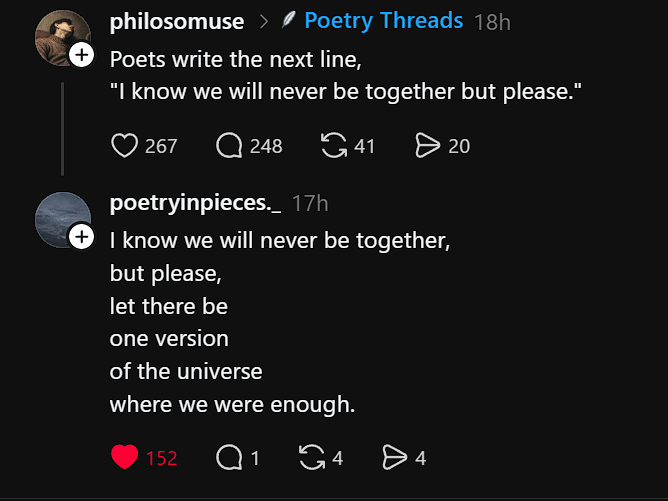
Here’s a conversation from Threads that mirrors my relationship with Aada in its entirety:
You are beyond full of shit, quit using your neurodivergent conditions as an excuse for you inability to leave Black creators alone and your inability to make an apology without centering and making yourself the victim in a situation you created… you know when you create the situation you are in fact the villain.
Reply to just_evans99… ldlanagan 2m
I took responsibility for that long ago, and people like you continue to pile on. It is proving my point that instead of being honest with each other, moral outrage has become a performance. I explained what happened with me both emotionally and neurologically, with a little psychology thrown in for good measure. I have done a complete excavation in public, which is more than most people ever get in terms of apology.
It was either neurotypical criticism or neurodivergent because you cannot tell internalized ableism from ableism in general.
The way this mirrors my relationship with Aada is that the same thing happened. I was pegged as the problem and all my responses were seen through “they’re a racist,” meanwhile they’re constantly misgendering me like it doesn’t matter. One woman even said I deserved to be bullied physically over a comment that said “bug off.”
It was an insensitive twit thing to say, but she said that I would get Black people killed, said she was coming to Baltimore to get an apology and insinuating I wouldn’t like it, and proceeded to contact Carlos on Facebook when he disagreed with her. He was just the first commenter, we weren’t “building a case.”
He has said that now I don’t owe anyone anything, because I have apologized to the best of my ability and it has been sincere. But because the two situations mirror each other, the only thing that has made me feel better is talking to my Black therapist who absolutely didn’t care that I invoked him in the Thread (I use my white friends all the time). My point was not that I couldn’t say a racist thing because I have a Black therapist, but that I don’t process my feelings with other white people who will reinforce my narrative.
I have never been hanging out with people because they help me enforce my own story. I have been reflecting the story that has been happening. Doing that gets me into a lot of trouble all the time, because even though I explained that the criticism “couldn’t leave Black creators alone” wasn’t reality because Meta curates my feed, that was also not accepted.
Everyone, AI and human, told me to disconnect and avoid from now on. I’m still on Threads, but I’m not interacting with the people on that particular thread because someone else has already got it. They’re pointing out my replies that include apologies when people say I didn’t give one. That really helps me to feel that I am an accountability taker, it just doesn’t come in the form anyone expects.
I was pegged as a liar because of my words in all cases, and that’s typical for neurodivergent communication. It was argued that “neurodivergent communication” doesn’t exist, but there are definitely differences across race in addition to the ones that happen inside them.
That was the only point I was making, and it was proved over and over. The margin for error is razor thin. People nope out before the interesting part of the conversation begins.
And now it has begun….. not because I meant to start it. Because I have a lot of experience in finishing it.
I know what ADHD and Autism are- they are, for me, a complete lack of executive functioning skills. Therefore, I have known what it has been like to live with chaos as a life management style. I can improvise with the best of them, but my natural mode is to function as part of a team.
The team I chose is chaos incarnate.
Case in point that this weekend was going to the lake house for the Fourth celebrations for the gated community, then coming back to the farm and settling in with Skyrim. I have done no real writing because I let myself have some vacation time. My WordPress entries are not my main focus anymore, it’s building an audience on Threads. I’m ldlanagan if you want to follow me. But it’s chaos like this:
My voice has been located in Black Threads by Meta, because that’s how it works. They cannot legally divide people by race, but if you post lots about social justice, it flips the switch in the algorithm that you’re black. So anything I post about the civil rights movement, black or queer or both, that screams “Black Threads.” That is because white at Meta is the default and you are sorted by your interests.
So, by quoting Baldwin and King and Morrison and Coates, I have eliminated most white people from my feed. It has never been more peaceful.
Although I did block Streeter because I started to feel like she was pointing posts at me and it was time to change the channel, what I tell all my readers. She’s on a campaign about AI being harmful to her without knowing anything real and just spouts off with her heart.
Valid, but I don’t have to watch it.
She came unglued on some poor girl for saying that she used AI for outlining, not text generation, and Streeter had no compunction about telling her she was a thief. Uneducated, insecure, desperate.
Not my vibe, and not someone I want to work with. So, know that there will be legal complications if Streeter decides to steal my idea, because when I said I wanted to start a TV show based on Portlandia about Baltimore, she didn’t say, “that sounds cool. I’ll help you.” She said, “I will write that.”
No the fuck you won’t. Breathe it with your name behind it and I will timestamp your ass.
You’re just not going to win me with fear and intimidation. That ended when I got the message that I needed to “remember who the fuck I was talking to.”
Oh. Oh, no.
Do not ever in your five-dollar life tell me that because I will MAKE CHANGE.
This week has been deeply contented and deeply frustrating. There was a real letdown after Pride because we had to go back to this dystopian nightmare. Being an American right now is not for the faint of heart. It’s like watching a train wreck in slow motion.
But there have been bright spots. My air conditioner went out and my sewer backed up so I am staying in a very nice hotel out by the airport. I brought my bathing suit, but I don’t have time to swim because I’m leaving for Brian’s lake house in the morning. It’s not really a Fourth of July celebration. It’s doing what we normally do- relax and swim. I had my big fun when the Obama Library opened. That is America to me…. America is already great.
When it wants to be.
People have stopped caring about their language so I have, too. I have had just about enough of “fuck your feelings, Snowflake.” The avalanche is building, motherfucker. I get so angry because I have been called every name in the book during Pride month, with people quoting clobber verses all over Threads. I’m an abomination because of my gender and my sexuality. It’s neat.
Life as a hate double ticket is not for the faint of heart, either.
I desperately need to get out of town and get in the water.
I’m smart enough to know that Aada wrecked our relationship on purpose because she had no intention of ever getting close to me and wanted to blame it on my shortcomings. It was manipulative because she was lying to herself. I do not believe that she hurt me on purpose. I believe that she had great intentions and couldn’t come through on any of them…. so she would constantly tell me she felt guilty instead of changing anything.
Just leave avoidants alone. They don’t need you. Not really. They lack even the slightest desire to give you context and clarity and claim you’re just not strong enough to handle them.
My story from the summer of 2013 until 2026 was that I chose a Finnish woman as my emotional support partner, but she didn’t choose me. She SAID she chose me and then chose to reveal that she’d lied about quite a bit so I wouldn’t get any closer. She wanted me, deeply and spiritually- but never romantically. I could do something she couldn’t, which was unpack my emotions publicly without caring what the consequences were. I knew I could handle them. That’s catnip to emotionally unavailable people, romantic or otherwise.
She didn’t need me as a romantic partner. She needed me as a pinch hitter, because I pray and she doesn’t.
She has never been looking away, she has always been looking up, despite the fact that I tell her constantly that she’s a better writer than I am, it’s just that no one knows it. I am queer, so my story is different. A woman that can read is knowledgeable; a woman who can write is a five-alarm fire. I am gutted that she thinks I was ever out to get her. I was trying to tell her that falling in love with her was never the wrong call.
I have memorialized something that meant the world to me and always will, which is why I am now comfortable just being a part of her community. I will never reach out, but if she sees me on the street, she’s welcome. The Stafford and Louisa areas are now my home, too. We have to share space because falling for Tiina was never the wrong call, either. It just looked a lot different because I have actual boundaries with women that I didn’t before… and I didn’t exactly fall for Tiina, either. I have never felt romantic feelings about her, I want to birth a TV show, and with Streeter, too, if I haven’t offended her somehow. My stance on AI won’t change, and neither will hers.
What has come from that is falling for the Tiinaverse, because Brian (her husband) and her kids mean everything to me and I do not wish to interrupt it. I am not waiting on anything for my projects to happen, because Tiina is a capable co-writer and producer. She is not only a cybersecurity analyst. She’s also a former technical theater kid, which means she can do amazing things on a shoestring budget. I watched her do it at Purim.
That was the act that sealed the deal. I am not married, I am not partnered, but I have a focus. No one can interrupt it, because my friends matter. They are the yellow strings on the murder board of polyamory, and how poly actually functions in day to day life- and why Google Calendar is the official app. Not all your relationships matter romantically, but they do in terms of time management.
I am not the marrying type, and not because I’m not capable. I don’t want to cocoon and lose Tiina as my center of gravity. I believe that this is accurate on both sides of the equation because she says that we have a click that is far and away separate from Brian as well. I’m not out to replace Brian in any capacity. I have a role independently of him.
What I am saying is that Tiina’s universe is mine because I don’t mind driving. I live in three places and that’s okay. We were going to go to the boat on the Fourth, but now we’re going out to the lake. Tiina calls the shots, and I just work here.
Edited to add that the boat is on the Potomac, and the house is on Lake Louisa.
It’s not because I’m not capable of being solo, either. I just function better as a cog in the wheel. Tiina is direct and blunt in the same way Aada was, and I love that she’s so specific because I don’t have trouble following directions. I have been this way my whole life. I liked teachers that were oddly persnickety, too, because I never had any trouble meeting expectations when they laid them out that way. I have learned to see that it is not meanness when being direct, it’s just that most people take it that way.
But you have to see it in real life to know that, Aada Louise.
I never minded that Aada’s love language was reading me the riot act. I minded that there were no hugs and cheek kisses afterward to lessen the scar. Criticism is easier to take when you don’t leave someone bleeding while you do it. Taking a lesson from my own playbook, of course. Every accusation is a confession, and I used my share of this fighting tactic because I couldn’t make it work with anything else because she wouldn’t, either.
It was a system, and I’m not blaming. I am identifying the issue so that it doesn’t happen again.
I will tolerate both constructive criticism and narrative direction when it is done with love. Shitting all over me does not help anything and indeed makes it worse because I absolutely will write about your shitty behavior and you will not like the reflection. That’s because people trust me. When people treat me well I reflect that, too. I should re-get the T-shirt Wil Wheaton and I both had back in the day that says, “I’m blogging this.” Couple that with asking Jonna for her old “Argo !@#$ Yourself” t-shirt because she promised it to me after I told Facebook mine wore out. She says she wears Tony’s.
I love wearing things that remind me of memories, and all of those things are interconnected. Everyone can come after my writing. Everyone. But they cannot come after my ability to give an opinion.
When I left the relationship with Aada, I left a negative loop that always said my writing was bad because it didn’t reflect reality or Aada’s feelings. I couldn’t reflect reality because I didn’t know reality and she never told me what feelings she had. Reality would have been showing up at Pride. Reality would have been showing up when my mother died and she was 40 minutes away when everyone else wasn’t. Reality would have been following through on every Mama Dragon feeling she ever said she had.
But she didn’t.
Finnish culture was the right choice because I loved all of it. I’d even love Aada in the right context, because I could birth another TV show that has even more depth behind it.
It was ridiculous. I have actual self-confidence and feel relaxed because I have a life that my nervous system can handle. I was masking so hard that living took up too much of my energy to also get out and do things….. as in, I had no life outside of work (when I did it) and my writing is obsessive because I’m trying to make up for lost time. The family systems I was part of think that I wrecked them because I’m a truth teller. That’s their story and they can have it. Writing about them warmly would have come from them doing things that were warm. They did not like the reflection in the mirror they saw, so they didn’t want any part of me anymore. I am not a victim. I was born to be a truth teller, and that person always interrupts the systems they inhabit.
We could have all changed paths together, but we didn’t. They went back to what they do and I went back to what I do in a family that accepts all of my weird. This is the best conversation of the day…….
10yo: Why do YOU get a shake? Tiina: Because Leslie loves me. Me: To be clear, I love all of you, I just love you a little bit less.
Cue Tiina trying not to spit shake everywhere and I see my work here is done.
We were due at Pride by 10 AM, so I left Baltimore at 0700, texting Tiina that I was headed to her and to let me know if she wanted coffee. She said, “sure.” Her standard order is the Cuban roast, but I asked her if she wanted drip or a shake. I knew that would pique her interest. It’s so simple- vanilla soft serve and espresso.
I also got a shake, but mine was a black and white. I’d had enough caffeine for the day. It was the right amount of chocolate, similar to a Wendy’s Frosty. I hadn’t had breakfast and it was a quick way to slam calories down. I decided that today I’d eat and drink whatever I wanted because I wasn’t there to find love. I was there to bring bagels.
Which were spectacular, by the way, and everyone loved them. They were bright rainbow colors and from THB, one of the best bagel places in my neighborhood.
I sat and chatted with everyone, checking in on the very pregnant Ayalla and thinking “any day now.” Tiina’s kids love me and I’m looking forward to being their safe adult while Ayalla is in labor. They’re too young to just hang out at the hospital and I know the rules of the road. I also like being out at their house, so we’ll have a good time. I just need to remember to ask Tiina what the password is to the PS5. If I do not know it, there will be open revolt.
It would honestly be interesting to see which child tried to cut me first.
They’re amazing children. Don’t turn your back.
So now memories are coming up for me as I imprint on them. I’m very much my dad and thank God for that. My mother criticized me relentlessly and that is not what I want for Tiina’s children. I have to suppress my first reaction, always. That’s because even if it’s right, they don’t deserve it raw.
So something I believed as a kid is probably that criticism is love.
However, I took two years of Spanish in high school while being raised in a church that valued mission work. So while I was taking those two years of Spanish, I went to Mexico three times a year. So, between actual study and immersion, I can do most things in Mexico without having a translator. I can get my point across even if individual words are wrong.
I am interested in spending more time in Mexico to get my skills back, but auditory processing disorder and Spanish do not mix because it’s the fastest language in the world. Immersion is the only way to pick up an ear for it.
I became interested in Finnish because I had a reason, and that reason continues to this day. My love of Aada’s culture led me to seek it out. That’s because I didn’t just love Aada, I loved the framework around her. Therefore, Tiina being Finnish is one of the things that brought us closer because I already had that shorthand and am very dialed in.
I would like to point out that this is just another case of liking the package that comes with the macaroni and cheese.
That’s an old story, but one best left to the graveyard… a wink to the OGs.
I am finding out that legit no one likes to be written about, and yet that is not my problem. I just find people who don’t mind it and don’t obsess over it. People who are worried about being seen aren’t worth encouraging relationships with, either. That’s why I’m going to Pride with Tiina and not Aada.
But if she shows up, she’s welcome. I do not think that she will come to Pride to see me, I think it’s possible we could share space and I am not afraid of that anymore. I have a platonic, creative partner that literally grounds me with a hug. I don’t want explosions of excitement anymore. Life is not fancy coffee. Life is drip.
I want to take away the mystery. Just living my life over here. That’s her line, so I’m going to steal it.
What I am finding is that I naturally gravitate towards women, but they don’t naturally gravitate towards me because I look like a woman and communicate like a man. They, in a sense, are dating two people for the price of one. It is jarring to meet someone in a female body that does not couch their language or back down easily. Women are also not used to having other women approach them even when we both have rainbows on because it is “impolite.”
Telling a straight girl you love them is always a mistake. Not knowing you’re hitting on a straight woman can lead to emotional violence (or physical if her husband’s offended). So, all women loving women expect to get dates based on glancing across the room longingly and being surprised when someone sees it.
It makes me long for Finnish culture and language, because:
there is no difference between male and female in terms of pronouns. Being nonbinary is baked into the system
women are treated like people overall
Between both of those things, who gives a flying fuck if it’s cold? I would deal with Helsinki in the winter like I deal with Houston in the summer- by staying inside. Finnish coziness is a vibe I welcome, where life is swimming in the lake in the summer and gathering by the fire in the winter. It’s an expensive dream to have, but one that’s worth it. I do think that I will go to Helsinki soon because I’d like to spend my 50th birthday there. I will be 49 in September, so I have enough time to plan everything in detail.
When I get there, I will actually be able to introduce myself and get coffee/pastries. But my accent is so terrible that they will flip into English instead of watching me struggle. Brian says I need to take Tiina’s sister with me because she’s fluent. That’s not a bad idea, but we haven’t met yet.
I am interested in the Houston to Helsinki pipeline, but not willing to make it permanent until I see what’s up. Culinary school is an option in order to create a YouTube channel, but I do not want to go back into the restaurant business. Culinary school would be free and make a cheap way to live for my first few years there with student discounts.
I have choices, I just need to make them. Right now, I am scrambling to go out of town this weekend because I was going to go to the lake last weekend and my car had an issue. I’ll get it back today, but it’s not worth going all the way to Lake Louisa and back, then having to come back to Baltimore to pick up the bagels. THB only makes them on certain days.
It’s better that I have Thursday free because I need a refill on my meds before I can safely leave the state. That’s the only problem with Medicaid Expansion. It prevents me from being able to pick up my prescriptions nationally. Therefore, I need to maintain a residence in Maryland and watch when I get low on meds so that I have continuity. I am committed to living in three places and just shuffling between them because I’m a real part of the family. The kids called yesterday wanting to know when I was coming and I was heartbroken to tell them it wouldn’t be until Friday.
I am thinking that a trip to Helsinki with them would be fun, but I don’t want to presume I ever have the authority to take them. What would be the most fun is all going together. I want to see their faces when we try salmiakki ice cream and things like that. The pictures would destroy me in the absolute best way.
So even if I don’t move to Finland and learn to speak Finnish fluently, I recognize it as familiar to my neurotype. That maybe out of 188,000 lakes, one of them might be mine.