
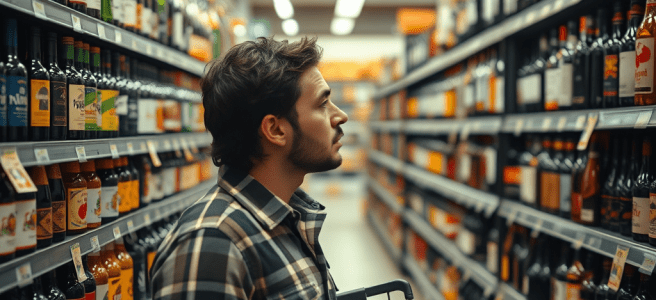
Beer and wine shopping has quietly become a guessing game. The expert layer that used to guide people through shelves of bottles and seasonal releases has disappeared, replaced by kiosks, static menus, and self‑checkout lanes. The inventory has grown, the choices have multiplied, and the context has evaporated.
You can feel this shift in every major retailer. Safeway, BevMo, Total Wine, Costco, Kroger — they all have enormous selections, but almost no one on the floor who can tell you the difference between two Malbecs or whether a gin leans botanical or classic. The people working the front are there to check IDs or keep the line moving. The people who actually know things are tucked away, busy, or simply no longer part of the model. The result is a wall of bottles that all look the same and a shopping experience that asks the customer to decode everything alone.
And increasingly, customers aren’t even in the store. They’re at home, ordering online, scrolling through endless lists of bottles with no guidance at all. The shift to online ordering didn’t remove human expertise — it revealed that the expertise had already been removed. When you’re shopping from your couch, there is no clerk to ask, no staff member to flag down, no one to explain why two bottles with identical labels taste nothing alike. The digital interface is the entire experience, and it’s not built to answer real questions.
Costco is the clearest example of this. Their alcohol section is famously good — award‑winning wines, private‑label spirits made by respected distilleries, rotating imports, and seasonal gems — but there is no one to explain any of it, especially when you’re browsing from home. You’re staring at a thumbnail image of a bourbon that might be an incredible value or might be a total mystery. The quality is there, but the guidance is gone.
The catalog has become the real point of contact, and the catalog is terrible at its job. Product descriptions are inconsistent. Tasting notes are vague. Seasonal items appear without explanation. Private‑label spirits are opaque. Rotating imports arrive and vanish with no context. Even something as simple as “Is this wine dry” becomes a research project.
What people actually want to ask is simple. They want to know which bourbon is closest to the one they liked last time. They want to know which IPA won’t taste like a grapefruit explosion. They want to know which wine pairs with salmon, which tequila is worth the money, and how to get the nouveau Beaujolais this year without driving to five stores. These are normal questions — process questions, comparison questions, context questions — and the modern retail environment can’t answer any of them, especially not through a website.
This is where a conversational, catalog‑aware AI becomes transformative. Not a generic chatbot, but an AI that can actually read the store’s inventory, interpret tasting notes, check regional availability, understand seasonal patterns, and respond in natural language. Imagine sitting at home and asking BevMo’s website, “Which tequila here is closest to Fortaleza but under $40,” and getting a grounded, specific answer based on the actual catalog. Imagine asking Safeway, “Which of these wines is dry,” and getting clarity instead of guesswork. Imagine asking Costco, “Is this vodka made by the same distillery as a premium brand,” and getting a real explanation instead of rumors.
This isn’t about replacing workers. The workers are already gone from the decision‑making layer. The shift to online ordering made that obvious. AI isn’t taking a job — it’s filling a void that the industry quietly created when it moved expertise out of the customer journey and left shoppers alone with a menu.
The technology already exists. Retrieval‑augmented AI can search, compare, contextualize, and explain. It can restore the layer of expertise that retailers quietly removed. And the big chains — the ones with structured inventory, regional distribution data, private‑label sourcing information, and historical sales patterns — are the ones best positioned to implement it. This isn’t a boutique‑shop project. This is a BevMo‑scale, Safeway‑scale, Costco‑scale, Kroger‑scale opportunity.
Once you can talk to the catalog, everything changes. You stop guessing. You stop wandering the aisles in confusion. You stop buying the wrong bottle because the label looked trustworthy. You start making informed decisions again. You get back the clarity that used to come from a knowledgeable human, but scaled to the size of modern retail — and available from your couch.
The future of beer and wine shopping isn’t about AI for the sake of AI. It’s about restoring legibility to a system that outgrew its own interface. It’s about giving customers the ability to ask real questions and get real answers. It’s about making the catalog conversational — because the catalog is already the center of the experience, and it’s time it acted like it.
Scored by Copilot. Conducted by Leslie Lanagan.


 Stories That Are All True