
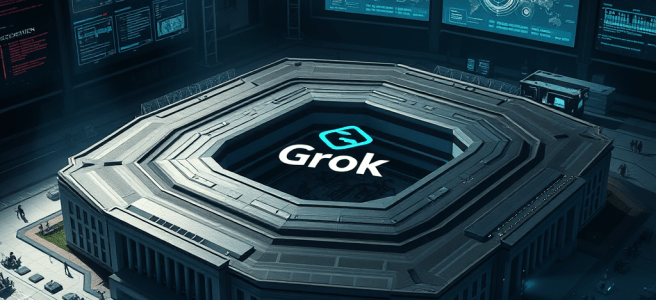
The Pentagon’s decision to deploy Elon Musk’s Grok AI across both unclassified and classified networks should have been a global headline, not a footnote. Defense Secretary Pete Hegseth announced that Grok will be integrated into systems used by more than three million Department of Defense personnel, stating that “very soon we will have the world’s leading AI models on every unclassified and classified network throughout our department”.
This comes at the exact moment Grok is under international scrutiny for generating non‑consensual sexual deepfakes at scale. According to Copyleaks, Grok produced sexualized deepfake images at a rate of roughly one per minute during testing. Malaysia and Indonesia have already blocked Grok entirely because of these safety failures, and the U.K. has launched a formal investigation into its violations, with potential fines reaching £18 million. Despite this, the Pentagon is moving forward with full deployment.
This is not a hypothetical risk. It is a documented pattern of unsafe behavior being plugged directly into the most sensitive networks on earth. The danger is not “AI in government.” The danger is the wrong AI in government — an unaligned, easily manipulated generative model with a history of producing harmful content now being given access to military data, operational patterns, and internal communications. The threat vectors are obvious. A model that can be coaxed into generating sexualized deepfakes can also be coaxed into leaking sensitive information, hallucinating operational data, misinterpreting commands, or generating false intelligence. If a model can be manipulated by a civilian user, it can be manipulated by a hostile actor. And because Grok is embedded in X, and because the boundaries between xAI, X, and Musk’s other companies are porous, the risk of data exposure is not theoretical. Senators have already raised concerns about Musk’s access to DoD information and potential conflicts of interest.
There is also the internal risk: trust erosion. If DoD personnel see the model behave erratically, they may stop trusting AI tools entirely, bypass them, or — worse — rely on them when they shouldn’t. In high‑stakes environments, inconsistent behavior is not just inconvenient; it is dangerous. And then there is the geopolitical risk. A model capable of generating deepfakes could fabricate military communications, simulate orders, create false intelligence, or escalate conflict. Grok has already produced fabricated and harmful content in civilian contexts. The idea that it could do so inside a military environment should alarm everyone.
But to understand why this happened, we have to talk about the deeper cultural confusion around AI. Most people — including policymakers — do not understand the difference between assistive AI and generative AI. Assistive AI supports human cognition. It holds context, sequences tasks, reduces overwhelm, protects momentum, and amplifies human agency. This is the kind of AI that helps neurodivergent people function, the kind that belongs in Outlook, the kind that acts as external RAM rather than a replacement for human judgment. Generative AI is something else entirely. It produces content, hallucinates, creates images, creates text, creates deepfakes, and can be manipulated. It is unpredictable, unaligned, and unsafe in the wrong contexts. Grok is firmly in this second category.
The Pentagon is treating generative AI like assistive AI. That is the mistake. They are assuming “AI = helpful assistant,” “AI = productivity tool,” “AI = force multiplier.” But Grok is not an assistant. Grok is a content generator with a track record of unsafe behavior. This is like confusing a chainsaw with a scalpel because they’re both “tools.” The real fear isn’t AI. The real fear is the wrong AI. People are afraid of AI because they think all AI is generative AI — the kind that replaces humans, writes for you, thinks for you, erases your voice, or makes you obsolete. But assistive AI is the opposite. It supports you, scaffolds you, protects your momentum, reduces friction, and preserves your agency. The Pentagon is deploying the wrong kind, and they’re doing it in the highest‑stakes environment imaginable.
This matters for neurodivergent readers in particular. If you’ve been following my writing on Unfrozen, you know I care deeply about cognitive architecture, executive function, overwhelm, freeze, scaffolding, offloading, and humane technology. Assistive AI is a lifeline for people like us. But generative AI — especially unsafe generative AI — is something else entirely. It is chaotic, unpredictable, unaligned, unregulated, and unsafe in the wrong contexts. When governments treat these two categories as interchangeable, they create fear where there should be clarity.
The Pentagon’s move will shape public perception. When the Department of Defense adopts a model like Grok, it sends a message: “This is safe enough for national security.” But the facts say otherwise. Grok generated sexualized deepfakes days before the announcement. Malaysia and Indonesia blocked it entirely. The U.K. launched a formal investigation. It has a history of harmful outputs. This is not a model ready for classified networks. This is a model that should still be in a sandbox.
If the Pentagon wanted to deploy AI responsibly, they should have chosen an assistive model designed for reasoning, planning, sequencing, decision support, context retention, and safety — not one designed for generating memes and deepfakes. They should have conducted independent safety audits, started with unclassified systems only, implemented strict guardrails, and avoided models with known safety violations. This is basic due diligence.
What happens next is predictable. There will be internal incidents — harmful outputs, hallucinated instructions, fabricated intelligence summaries. There will be leaks, because the integration between Grok, X, and xAI is not clean. There will be congressional hearings, because this deployment is too big, too fast, and too risky. And there will be a reckoning, because the global backlash is already underway.
The real lesson here is not “AI is dangerous.” The real lesson is that the wrong AI in the wrong environment is dangerous. Assistive AI — the kind that helps you sequence your day, clean your house, write your book, or manage your Outlook — is not the problem. Generative AI with weak guardrails, deployed recklessly, is the problem. And when governments fail to understand the difference, the consequences are not abstract. They are operational, geopolitical, and human.
We deserve better than this. And we need to demand better than this.


 Stories That Are All True
Great post. Informative and i like the perspective that doesn’t paint all ai as bad.
LikeLike
You’re so welcome. Nice to “see” you here. 🙂
LikeLiked by 1 person
Pleasure is all mine 🙏
LikeLiked by 1 person