
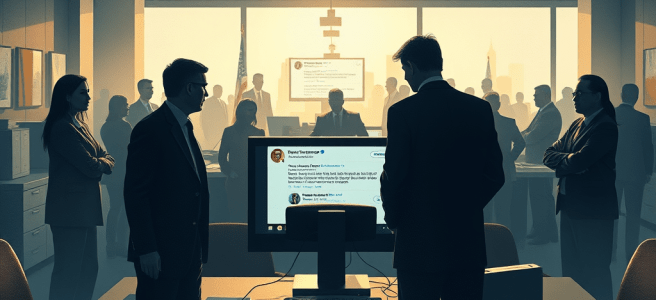
There are moments in public life when the temperature in the room changes, and everyone feels it even if no one says so. President Trump’s recent burst of online activity — dozens of posts in the span of a coffee break — was one of those moments. Not because of the content, which was the usual mélange, but because of the velocity. It had the unmistakable air of someone trying to outrun something, though what that something might be remains politely unspoken
The reaction was immediate. Commentators clutched their pearls, voters refreshed their feeds, and a few lawmakers made the sort of statements that read less like concern and more like pre‑drafted press releases waiting for a moment to be useful. But the people who would actually have to act — the Vice President and the Cabinet — maintained a silence so complete it could have been mistaken for choreography.
I’m not a physician, and I don’t pretend to be one. But I did spend years working for my stepmother, a rheumatologist whose patients trusted her with the kinds of truths they wouldn’t tell their own families. You learn things in that environment. You learn to notice when someone’s behavior shifts. You learn that sudden changes are rarely meaningless. And you learn that the worst thing you can do is pretend nothing has happened.
That’s all I’m doing here: noticing.
The 25th Amendment chatter is coming from the public, not the people empowered to use it. Historically, Cabinets do not move against their own president unless the situation has already collapsed behind the scenes. Loyalty, ambition, and self‑preservation form a powerful cocktail. So the silence is not surprising. It is simply… instructive.
More telling is the reaction abroad. London — usually the picture of composure, even when Washington is on fire — has shown signs of genuine alarm. The British do not rattle easily. When they do, it is because they have assessed the situation and found it wanting. Their concern is not theatrical. It is mathematical.
The next few months will not be smooth. They will be the kind of months where diplomats cancel vacations and intelligence officers develop new hobbies involving late‑night phone calls.
Speaking of intelligence, if someone were to ask how many officers from the other Four Eyes are currently in Washington, I would offer an educated guess: more than usual. Not because they are investigating us — that is not how the alliance works — but because when one partner becomes unpredictable, the others quietly increase their presence. It is not adversarial. It is maintenance.
Meanwhile, the President continues to make remarks about staying in power, extending terms, or otherwise rewriting the job description. Even members of his own party look uneasy when he does this, though their discomfort is expressed through the time‑honored Washington tradition of staring fixedly at the floor until the moment passes.
I am not drawing direct parallels to past crises. History does not repeat itself with that kind of precision. But there are familiar contours here — the sort that make seasoned observers exchange glances without speaking.
I am not diagnosing anyone. I am not predicting outcomes. I am not calling for constitutional remedies. I am simply acknowledging what is visible to anyone willing to look: abrupt behavioral shifts, erratic communication, uneasy allies, a conspicuously silent Cabinet, and rhetoric that makes even friendly governments check their contingency plans.
This is not hysteria. It is observation.
And in a moment when half the country is shouting and the other half is pretending not to hear, there is value in saying the quiet, steady thing: something is off. We do not yet know what it means. But it deserves our attention.
Scored by Copilot, Conducted by Leslie Lanagan


 Stories That Are All True