
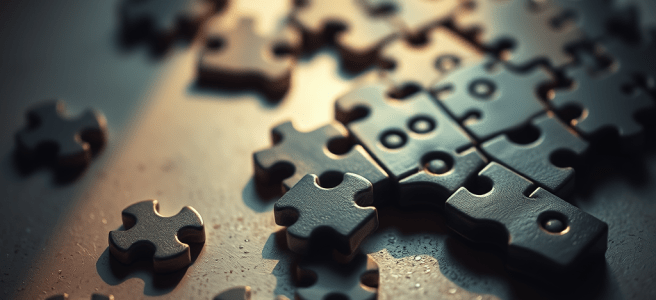
I’ve been trying to understand the shape of the relationship I had with Aada, and the closest I can come is this: it was a puzzle with missing pieces. Not a mystery, not a thriller, not a secret world humming underneath the surface. Just a puzzle where the picture never fully resolved, and yet I kept trying to finish it anyway. She once told me that my positive comments felt like clues in a game, and I didn’t realize until much later how much that one sentence revealed about the architecture we were both living inside.
Because when someone tells you your words feel like clues, you start speaking in clues without meaning to. You start reading their silences as signals. You start treating every fragment like it matters. And before you know it, you’re not in a relationship anymore. You’re in a pattern‑matching exercise that never ends.
I didn’t fall into that dynamic because I was naïve. I fell into it because I was lonely, and she was the only person I talked to for long stretches of time. When your world shrinks down to one person, every interaction becomes magnified. Every message feels weighted. Every pause feels ominous. And every inconsistency feels like a missing puzzle piece you’re supposed to find.
She didn’t give me a full picture of herself. She gave me fragments. Hints. Half‑statements. Emotional intensity without context. And I did what any human does when handed incomplete information: I tried to assemble it into something coherent. I tried to make the pieces fit. I tried to believe there was a picture there worth finishing.
But the truth is, the picture kept changing. Or maybe it was never there in the first place.
I don’t think she was trying to manipulate me in some grand, orchestrated way. I think she was improvising. I think she liked the feeling of being interpreted, of being read, of being seen as someone with depth and mystery. I think she liked the idea of being a puzzle someone cared enough to solve. And I think I liked the idea of being the person who could solve it.
That’s the trap. Not deception. Not danger. Just two people responding to each other’s projections, each trying to make sense of the other through incomplete information.
But the missing pieces weren’t neutral. They created fear. They created uncertainty. They created a sense of stakes that didn’t belong in a friendship. I found myself isolating because I was afraid I would say the wrong thing to the wrong person. I found myself pulling away from everyone else because she felt like the only safe point of contact. I found myself emailing her constantly because she was the only person I wasn’t afraid of losing.
Fear narrows the world. It makes everything outside the relationship feel dangerous. It makes the relationship itself feel like the only oxygen source. And once you’re in that posture, it’s very hard to see clearly. You’re not evaluating the relationship anymore. You’re surviving it.
The power dynamic between us wasn’t dramatic or theatrical. It was more like being in a room where one person controls the dimmer switch. She wasn’t turning the lights on or off — she was adjusting the brightness just enough that I could see shapes but not details. And when the lighting is always shifting, you start doubting your own eyes. You start relying on the other person to tell you what’s really there. You start believing they can see something you can’t.
That’s what made the dynamic feel so consuming. Not power in the traditional sense, but power through ambiguity. Power through selective illumination. Power through being the one who decides which pieces of the puzzle are visible and which stay in shadow.
I didn’t realize how much fear I was carrying until I wrote about it. Writing forced me to lay out the timeline, the behavior, the emotional patterns. And once I did, the illusion collapsed. Not her — the illusion. The idea that there was something hidden I needed to uncover. The idea that the missing pieces were meaningful. The idea that the puzzle had a picture at all.
When I wrote my story, I wasn’t trying to expose her. I wasn’t trying to punish her. I wasn’t trying to make her look bad. I was trying to stop carrying the weight of her ambiguity. I was trying to stop protecting a narrative that wasn’t mine. I was trying to reclaim my own sense of proportion.
She was horrified when she read it, but I didn’t write it for her. I wrote it for me. I wrote it because I needed to see the whole thing laid out in daylight. I needed to understand why I had been so afraid. I needed to understand why I had isolated myself. I needed to understand why I had clung to her so tightly when the relationship itself was built on fragments.
And when I finally saw it clearly, I didn’t feel angry. I felt free.
I’ve forgiven the lie. That part came easily once I understood the emotional architecture of the relationship. But forgiveness and safety are not the same thing. Forgiveness is cognitive. Safety is somatic. My mind knows the truth now, but my body is still unlearning the fear. It’s still recalibrating after years of bracing for consequences that never came. It’s still adjusting to the idea that the world is not a minefield.
I don’t feel unsafe because she’s a threat. I feel unsafe because my nervous system remembers what it felt like to believe she was. The body doesn’t update instantly just because the mind does. It takes time. It takes repetition. It takes days where nothing bad happens. It takes relationships where I don’t have to guard my words. It takes space.
And I’m giving myself that space now.
I’m not writing this to villainize her. I’m writing it because I want to understand the dynamic without the fog of fear. I want to understand how two people can create a puzzle neither of them meant to build. I want to understand how ambiguity can become a trap even when no one intends harm. I want to understand how loneliness can magnify everything until the smallest hint feels like a revelation.
I want to understand myself.
Because the truth is, I didn’t stay in that relationship because I believed she was ordinary or because I was inventing something out of loneliness. She is extraordinary. Our connection ignited instantly — volatile, reactive, the emotional equivalent of cesium meeting fluorine. It was bright and consuming and impossible to ignore. But reactions like that don’t stabilize. They flare, they overwhelm, and if there isn’t structure around them, they burn through everything in their path.
What began as intensity turned into instability. What felt electric at first became frightening. The same charge that made everything feel alive also made everything feel dangerous. And once the fear entered the picture, the connection stopped being expansive and started collapsing inward. It wasn’t the extraordinariness that harmed me — it was the speed, the ambiguity, and the way the missing pieces created pressure neither of us could withstand.
But I’m not isolated anymore. My world is widening again. My neurons are healing. The fear is loosening its grip. The picture is no longer something I’m trying to solve — it’s something I’m finally stepping out of.
I’m not waiting for her. I’m not holding my breath. But if she ever shows up for real — with clarity, with honesty, with all the pieces present — I’m ready to build something completely new.
Something grounded.
Something mutual.
Something true.
Scored by Copilot, conducted by Leslie Lanagan


 Stories That Are All True