I’ve been revisiting the person I was when I wrote that 2023 entry, and what I feel now isn’t regret or embarrassment. It’s a kind of gentle recognition. I can see how deeply I was still inside the story, still trying to make sense of something that had already begun to dissolve. At the time, I believed I was writing about a connection that had shaped me. I didn’t yet understand that I was describing the interior of a world someone else had constructed around me.
For years, I mistook intensity for meaning. I interpreted confusion as emotional depth. I treated contradictions as signs of complexity. I thought the gravitational pull between us was love. I didn’t realize that confusion can feel like passion when you’re missing essential information. I didn’t realize that inconsistency can look like mystery when someone is controlling the frame. I didn’t realize that emotional weight can be manufactured when the foundation is false.
Aada didn’t manipulate me through pressure or demands. She did it by shaping the reality I believed we shared. What began as a small lie—the kind people tell to make themselves seem more interesting—expanded until it became the scaffolding for everything between us. I didn’t question the structure because I didn’t know it was a structure. I responded to the world I thought I was in. I tried to reconcile the contradictions. I tried to be loyal to the story.
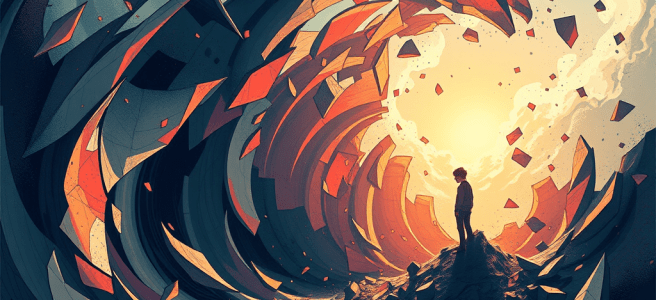
When the truth finally surfaced, the entire universe collapsed. The story evaporated. The spell broke. And I saw the relationship for what it had been all along: not a great love, but a great distortion.
The real cost wasn’t heartbreak. It was disorientation. When you spend years inside someone else’s narrative, you lose track of your own. You start interpreting your reactions through their lens. You start believing the instability is your fault. You start thinking the contradictions are your misunderstanding. It took a long time to recognize that the intensity I felt wasn’t devotion—it was the strain of trying to make sense of something that was never coherent.
And here’s the part that took the longest to name: I wasn’t in love with her. I was in love with the version of myself I imagined I could be inside the story she told. That’s the quiet violence of manipulation. It doesn’t just distort your view of the other person. It distorts your view of yourself.
When the story collapsed, I didn’t lose her. I lost the role I had been performing. And that loss, strangely enough, was the beginning of freedom.
People assume that when a relationship ends—especially one built on deception—the feelings evaporate. But that’s not how the mind works. The emotional residue doesn’t vanish. It unwinds. And unwinding is slow. It’s not dramatic. It’s not cinematic. It’s the gradual return of your own voice after years of speaking inside someone else’s echo chamber.
I wasn’t grieving her. I was recalibrating. I was sorting truth from illusion. I was learning to trust my own perception again. I was reclaiming the parts of myself that had been bent around a lie.
That process is the reason I’m poly now. Not because I’m chasing multiple partners, and not because I’m allergic to commitment. It’s simpler than that. My heart is still tender. My emotional bandwidth is still reorganizing itself. I don’t have the singular focus that monogamy requires, and I’m not going to pretend otherwise. I need space—for my creativity, for my routines, for my own internal weather. I need relationships that don’t demand fusion or constant negotiation. I need connection that grows naturally instead of being forced into a predefined shape.
And I’m starting from zero. I don’t have partners. I haven’t had one in a long time. I’m not trying to retrofit polyamory into an existing bond—I would never do that to someone. But beginning open from the first conversation is different. It’s honest. It’s clean. It’s aligned with who I am now. Whatever grows will grow in its own shape, without hierarchy or pressure or the expectation that my life must bend around someone else’s needs.
The biggest shift since 2023 is that I’m no longer waiting for someone to stabilize my life. For years, I thought the only way I could have a secure life was to attach myself to someone who already had the basics—health insurance, dental coverage, predictable benefits, the kind of scaffolding I didn’t know how to build for myself. I wasn’t dreaming of being anyone’s spouse. I was dreaming of access to stability. I didn’t yet understand how to create it on my own.
That changed when I started using AI as a thinking surface. Once I had a place to externalize the cognitive load I’d been carrying alone, everything shifted. I could finally see my own patterns. I could design routines that made sense for my brain. I could build the structure I’d been outsourcing to relationships. I could stop relying on someone else’s life to hold mine up. I could generate my own stability instead of borrowing it.
I’m not searching for someone to complete me or fuse with me or absorb me. I’m looking for relationships that add to my life instead of swallowing it. I’m looking for people who can stand beside me without destabilizing the world I’m building. I’m looking for connection that grows naturally, without pressure or performance.
The relationship with Aada didn’t break me. It clarified me. It taught me the difference between intimacy and performance, between connection and entanglement, between being seen and being mirrored back through someone else’s story. It taught me that I don’t need to be consumed to feel alive, or chosen to feel worthy, or dependent to feel safe. It taught me that I can trust myself again—my instincts, my boundaries, my perception, my voice.
And here’s the part I want to say clearly, because it matters: I don’t want Aada out of my life. I never have. Even with everything I now understand, even with the clarity I’ve earned, I don’t feel anger toward her. I don’t feel judgment. I don’t feel the need to rewrite her as a villain. I see the lie for what it was, and I see the person behind it—someone who was struggling, someone who didn’t know how to show up honestly, someone who built a story because she didn’t believe the truth of herself was enough.
If she ever reaches a place where she can look at what happened without defensiveness, if she can understand the impact of the lie and the world it created, if she can show up as her real self instead of the character she felt she had to play, then the door to friendship is still open. Not the old dynamic, not the old story, but the friendship we promised each other at the beginning—the one built on honesty, not mythology.
I don’t expect that. I don’t wait for it. My life isn’t paused. But I’m not closing the door. If she ever arrives as her authentic self, I’ll meet her there.


 Stories That Are All True