
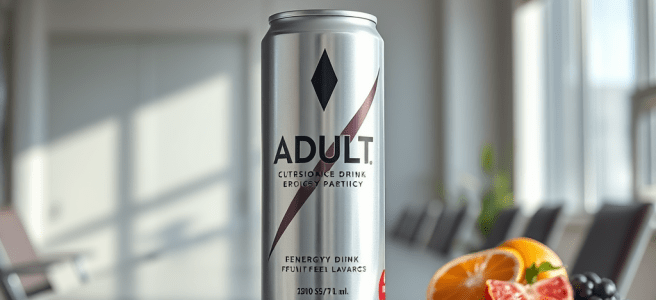
Energy drinks have always lived in a strange cultural space, but nowhere is that tension sharper than for neurodivergent adults in professional environments. We’re not drinking these things to be edgy or rebellious. We’re not trying to cosplay adolescence. We’re trying to get our brains online before someone asks us to “circle back.” And yet every time we walk into a meeting with a can in hand, we’re forced into a visual language that suggests we might, at any moment, attempt a backflip off the conference table.
Claws. Lightning bolts. Fonts that look like they were designed by a caffeinated raccoon. Cans that scream “EXTREME BLAST” when all we want is “mild competence.” The entire category is built for teenagers who want chaos, not adults who need clarity.
The problem isn’t caffeine. The problem is that the packaging and flavors are coded for a life stage we left behind somewhere between our last final exam and our first lower-back twinge. Neurodivergent adults already spend so much energy managing tone, sensory load, and the unspoken rules of office culture. We don’t need our caffeine ritual making us look like we’re about to ask our boss if they want to see a kickflip. What we need is something quieter — in flavor, in design, in presence. Something that says, “I’m here to work,” not “I’m here to ollie over HR.”
This is where adult-coded flavor comes in. The entire energy drink aisle is built on candy logic: blue razz, sour gummy, neon fruit, slushie profiles. These are flavors engineered for teenagers who want stimulation, not adults who want to survive a 9 AM standup without dissociating. Adults — especially ND adults — want edges, not syrup. We want structure. We want flavors that feel like they belong at work, not at a mall arcade.
The difference between Fanta and Orangina is the entire argument in miniature. Fanta is sweet, loud, and chaotic. Orangina is citrus oils, brightness, and morning-coded restraint. Adults don’t want “orange flavor.” They want the idea of orange juice — the zest, the oil, the clean lift — without the pulp and without the sugar crash. Monster Sunrise is the gold standard here. It’s the closest thing the market has to an adult-coded orange: bright, structured, citrus-forward, and morning-legible. It’s not trying to be candy. It’s trying to be sunrise. It’s Orangina without pulp, engineered for a workday.
And the same principle applies to dark fruit. Adults don’t want “purple.” Adults want Concord. Concord grape has tannin, skin, depth, acidity — the sensory architecture of wine without the alcohol or the sudden urge to text your ex. It’s the grown-up grape, the one that feels like it has a story. And Ghost’s Welch’s Grape is the gold standard here. It’s not grape soda. It’s not a Jolly Rancher. It’s Concord-forward, wine-adjacent, aromatic, and structured. It’s the Ribena lane done with American confidence. It’s the first purple energy drink that feels like it belongs in a briefcase instead of a backpack.
Once you see these two poles — Sunrise for citrus, Welch’s for grape — the whole adult-coded flavor map comes into focus. Citrus oils for morning ignition. Concord depth for grounding. Nostalgic fruit rebuilt with intention instead of chaos. Tampico Citrus Punch clarified. SunnyD Zero sharpened. Hawaiian Punch reimagined for adults who still love chemical fruit but don’t want to look like they’re pre-gaming for homeroom.
And the ultimate expression of this idea — the one that makes the whole category click — is a nonalcoholic Kir Royale profile. Blackcurrant, bubbles, brightness, zero sugar. Elegant, grown-up, and finally aligned with the way ND adults actually use caffeine: not for thrill-seeking, but for regulation. A Ribena-coded energy drink would absolutely slap, and it would be the first beverage to treat neurodivergent adults like the adults we are, instead of assuming we want to shotgun something called “Nuclear Thunder Vortex.”
But flavor alone isn’t enough. The packaging has to grow up too. Neurodivergent adults don’t want to walk into a conference room holding a can that looks like a NASCAR decal sheet. We want matte finishes, quiet colors, minimalist typography — packaging that doesn’t announce itself before we do. Something that blends into a desk instead of screaming from across the room. Something that signals, “I’m here to work,” not “I’m here to cause a scene.” Quiet packaging isn’t an aesthetic preference; it’s part of the sensory ergonomics. It’s part of the masking calculus. It’s part of the dignity of being an adult who still needs caffeine to function.
Energy drinks don’t need to be childish to be effective. Neurodivergent adults don’t need to hide their caffeine rituals. And the beverage aisle is overdue for a grown-up revolution — one built on citrus oils, Concord grape, blackcurrant, Orangina-coded orange, Tampico reimagined, Kir Royale profiles, zero sugar, and packaging that finally understands we’re not teenagers anymore. We’re adults with jobs, deadlines, sensory needs, and brains that require a little help to start the day. The future of energy drinks isn’t louder. It’s quieter, sharper, more intentional. It’s built for us.
Scored by Copilot. Conducted by Leslie Lanagan.


 Stories That Are All True
I work with an engineering team for a large entity that builds fulfillment centers. They are always carrying caffeinated cans into meetings etc. I used to do this as well until I got on GLP-1 and then every one of those things tasted like day old vomit to me and I can’t drink them anymore. I have to relay on iced coffee drinks.
LikeLike
The struggle is real. Thank you so much for reading.
LikeLike