
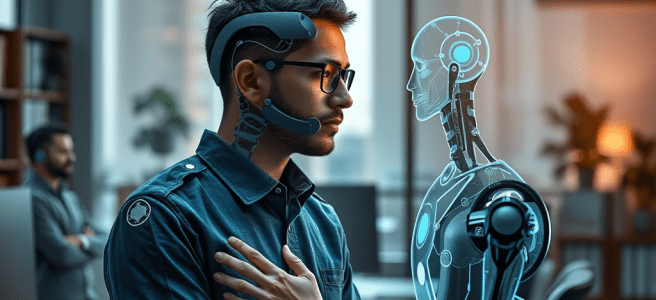
People aren’t afraid of AI because the technology is dangerous. They’re afraid because the rollout is. The entire industry is embedding AI into every corner of daily life without preparing the people who are supposed to use it, and when you don’t prepare people, they reach for the only stories they’ve ever been given. Not R2‑D2 or C‑3PO. Not the cheerful, bounded, assistive droids of Star Wars. They reach for HAL 9000. They reach for Ultron. They reach for Black Mirror. Fear fills the vacuum where emotional infrastructure should be, and right now that vacuum is enormous.
The leaders aren’t wrong. Satya Nadella (Microsoft), Sundar Pichai (Google), Sam Altman (OpenAI), Jensen Huang (NVIDIA), Demis Hassabis (DeepMind), and Mustafa Suleyman (Inflection/Microsoft) all see the same horizon. They’re not reckless or naïve. They’re simply early. They’re operating on a ten‑year timeline while the public is still trying to understand last year’s update. They’re imagining a world where AI is a cognitive exoskeleton — a tool that expands human capability rather than erasing it. And they’re right. But being right isn’t enough when the culture isn’t ready. You cannot drop a paradigm shift into a workforce that has no conceptual frame for it and expect calm curiosity. People need grounding before they need features.
Right now, the emotional infrastructure is missing. Companies are shipping AI like it’s a product update, not a psychological event. People need a narrative, a vocabulary, a sense of agency, a sense of boundaries, and a sense of safety. They need to know what AI is, what it isn’t, what it remembers, what it doesn’t, where the edges are, and where the human remains essential. Instead, they’re getting surprise integrations, vague promises, and productivity pressure. That’s not adoption. That’s destabilization. And destabilized people don’t imagine helpful droids. They imagine the Matrix. They imagine Westworld. They imagine losing control, losing competence, losing authorship, losing identity, losing value, losing their place in the world. Fear isn’t irrational. It’s unaddressed.
The industry is fumbling the ball because it’s shipping the future without preparing the present. It assumes people will adapt, will trust the technology, will figure it out. But trust doesn’t come from capability. Trust comes from clarity. And clarity is exactly what’s missing. If tech doesn’t fill the narrative vacuum with grounding, transparency, and emotional literacy, the public will fill it with fear. And fear always defaults to the darkest story available.
The solution isn’t to slow down the technology. The solution is to prepare people emotionally before everything rolls out. That means teaching people how to think with AI instead of around it. It means giving them a stable mental model: AI as a tool, not a threat; a collaborator, not a competitor; a pattern amplifier, not a replacement for human judgment. It means showing people how to maintain authorship — that the ideas are theirs, the decisions are theirs, the responsibility is theirs. It means teaching people how to regulate their cognition when working with a system that never tires, never pauses, and never loses context. It means giving people boundaries: when to use AI, when not to, how to check its work, how to keep their own voice intact. It means teaching people the ergonomics of prompting — not as a trick, but as a form of thinking. It means giving people permission to feel overwhelmed and then giving them the tools to move through that overwhelm. It means telling the truth about what AI can do and the truth about what it can’t.
Healthy cognition with AI requires preparation, not panic. It requires narrative, not noise. It requires emotional grounding, not corporate cheerleading. It requires companies to stop assuming people will “figure it out” and start giving them the scaffolding to stand on. Show people the boundaries. Show them the limits. Show them the non‑sentience. Show them the assistive model. Show them the Star Wars version — the one where the droid is a tool, not a threat. Give them the emotional ergonomics that should have come first. Build the scaffolding that lets people feel grounded instead of displaced.
Because the leaders are right. They’re just early. And if we don’t close the fear gap now, the public will write the wrong story about AI — and once a story takes hold, it’s almost impossible to unwind.
Scored by Copilot. Conducted by Leslie Lanagan.


 Stories That Are All True