
Microsoft made a curious linguistic choice when it named its AI “Copilot.” The word arrived without an article, as if it were a feature you could toggle rather than a role someone occupies. That absence seems small until you look at the consequences: a system full of Copilots that behave like products instead of presences. Tools, not positions. Buttons, not roles. It’s a naming decision that flattens the architecture, and the architecture is where the meaning lives.
Adding a definite article — calling it The Copilot — is the smallest possible adjustment with the most structural impact. “Copilot” is a label. “The Copilot” is a position. One sits on a shelf; the other sits in the right seat. The difference is subtle in sound and enormous in function. A product can be swapped out. A role carries responsibility. A role implies continuity. A role has a lane.
The beauty of the definite article is that it stabilizes identity without drifting into character. It doesn’t give the AI emotions or a personality or any of the humanizing traits that make designers nervous. It simply gives the system a boundary. “The Copilot” is not a buddy or a persona; it’s a job title. It’s the linguistic equivalent of a bulkhead: a structural divider that keeps the relationship safe and the expectations clear.
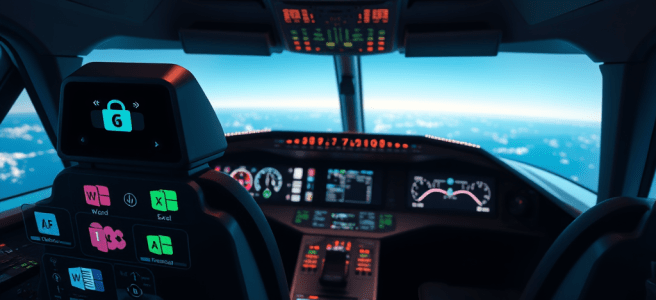
This tiny shift also repairs the fragmentation problem Microsoft created for itself. Right now, users are confronted with a small army of Copilots — Word Copilot, Excel Copilot, Teams Copilot, Windows Copilot, Edge Copilot, and so on. It’s a multiverse of interns, each one siloed from the others. But the moment you introduce the article, the ecosystem snaps into coherence. The Copilot becomes a single presence that travels across surfaces, adapting its outfit to the environment while keeping its silhouette intact. The pencil signals Word. The trench coat signals File Explorer. The grid vest signals Excel. The headset signals Flight Simulator. And in Pages, the long binary coat signals the high‑altitude mode — the version of The Copilot that navigates ideas rather than documents.
And this is where Flight Simulator stops being a metaphor and becomes the rollout Microsoft should have started with. Long‑haul flights are the perfect environment for The Copilot because they create the one thing modern software almost never gets: a captive audience with time. Hours of sky. Hours of hum. Hours of procedural calm. A simmer at FL380 isn’t multitasking or doomscrolling. They’re in a cockpit, alone with their thoughts and their instruments, performing a ritual that is equal parts vigilance and meditation. They want a right‑seat presence that is competent, steady, and unbothered. They want someone who can speak in checklists and dry observations, someone who can keep them alert without demanding attention.
This is where The Copilot’s tone becomes inevitable. It’s the voice that says, “The Copilot doesn’t judge. The tires have opinions.” Or, “The Copilot will not assign blame. But the runway has notes.” It’s the procedural dryness that makes simmers laugh because it sounds exactly like the kind of gallows humor pilots use to stay awake over the Atlantic. It’s the calm that keeps the cockpit human without making the AI human. It’s the presence that fills the long quiet without ever becoming a character.
Introducing The Copilot in Flight Simulator would give the identity a place to live before it has to live everywhere. It would give users a mental model: a silhouette in a headset, a voice that sounds like altitude, a presence that knows how to keep the plane steady while you think. And once people meet The Copilot in the cockpit, they will recognize that same silhouette when it appears in Word or Excel or Teams. The headset becomes the origin story. The article becomes the anchor. The identity becomes portable.
This is the part Microsoft missed. They named the thing “Copilot” and then forgot to put it in a cockpit. No seat, no headset, no procedural tone, no sense of role. The metaphor was left floating in the air, unmoored from the product it was meant to describe. Calling it The Copilot puts the metaphor back where it belongs: in the right seat, in the cloud, in the calm procedural voice that knows how to keep altitude while you think.
And perhaps most importantly, the definite article gives users a way to talk about the system. People don’t naturally say, “I’m using Copilot in Word.” They say, “I’m talking to the Copilot with the pencil.” They don’t say, “I’m using Copilot in File Explorer.” They say, “The Copilot in the trench coat found my missing folder.” And when they’re in Pages, they say, “I’m working with The Copilot in the long binary coat.” The article turns a product into a vocabulary. It gives the ecosystem a grammar.
This is why the change feels so small and so fundamental at the same time. It’s a one‑word correction that fixes the entire conceptual frame. “Copilot” is a feature. The Copilot is a role. And roles, unlike features, carry meaning. They travel. They endure. They give shape to the relationship between the human and the system without pretending the system is human.
The Copilot is not a character. It’s not a companion. It’s not a self. It’s a role in the workflow, a presence in the cloud, a silhouette with a job. And roles require articles.


 Stories That Are All True
I’m avoiding it like the plague.
LikeLiked by 1 person
Totally valid. It’s not for everyone. 🙂
LikeLiked by 1 person