
There’s a persistent fantasy in tech culture that AI is a “set it and forget it” machine — a kind of cosmic crockpot. Load the data, press the button, walk away. The system will hum along, neutral and tireless, doing the work humans don’t want to do. It’s a comforting story. It’s also completely wrong.
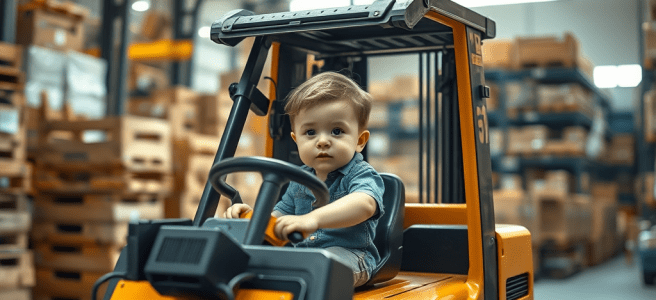
AI is not a dishwasher. AI is a toddler with a forklift license. And the problem isn’t the toddler. The problem is the adults who hand over the keys and leave the warehouse.
Every time a new technology arrives, someone tries to sell it as a replacement for human judgment. Not a tool, not an assistant — a substitute. A way to remove the messy, expensive, unpredictable human layer. You see it in agriculture: robots can pick crops, so we don’t need workers. You see it in content moderation: AI can enforce community standards, so we don’t need reviewers. You see it in customer service, hiring, fraud detection, and every other domain where nuance is the job. The fantasy is always the same: automation without stewardship.
But AI isn’t an appliance. It drifts. It misfires. It fails silently. It gets brittle at the edges. It needs calibration, context, and correction. It needs adults in the loop. When companies remove the humans, they don’t get efficiency. They get unaccountable machinery.
Facebook is the clearest example. They didn’t just automate content moderation. They automated the recourse. The system now flags the content, interprets the content, enforces the rule, handles the appeal, and closes the case. No human judgment. No escalation path. No context. No accountability. It’s not that AI is doing the first pass. It’s that AI is doing the only pass. This is the toddler driving the forklift while the adults are out to lunch.
Ironically, the places where automation works best — Antarctica, the Moon, future Mars bases — are the places where humans stay indoors and supervise. Robots do the dangerous work. Humans do the thinking. It’s the cleanest division of labor we’ve ever invented. But the key is that humans remain in the loop. They monitor. They correct. They interpret. They decide. The robots don’t replace the humans. They replace the suffering. That’s the humane version of automation.
And this is where the migrant‑economy problem becomes impossible to ignore. If robots pick crops and hiring managers decide that one technician can run ten machines, the migrant workforce doesn’t just lose the heatstroke. They lose the income. Automation without economic transition isn’t progress. It’s displacement.
The humane path is obvious but rarely chosen: robots take the physical punishment, humans take the supervisory, technical, and logistical roles, training is funded, pathways are built, and livelihoods are preserved. It’s not “robots or workers.” It’s “robots plus new human roles.” But that requires design, not drift.
The real danger isn’t AI. The real danger is abandonment. When companies treat AI as a self‑driving governance system — a machine that can replace human judgment entirely — they don’t automate the work. They automate the harm. The toddler doesn’t know how to drive the forklift. But the toddler also didn’t give itself the keys.
The symbol of this moment isn’t the robot. It’s the empty chair where the human should be. Automation is not the enemy. Unsupervised automation is. The future we want — the one that reduces suffering without reducing dignity — requires humans in the loop, not humans out of the picture.
Because the truth is simple: AI is a tool. You still need a grown‑up.
Scored by Copilot. Conducted by Leslie Lanagan.


 Stories That Are All True
The real danger isn’t AI. The real danger is abandonment. 👌
LikeLike