
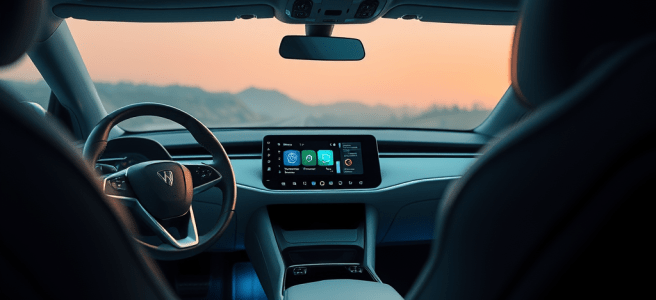
I’ve been watching the mobility layer tighten for weeks, sensing the shift long before Apple put a headline on it. The signs were subtle at first—small movements in infrastructure, quiet updates, the emotional logic of how people actually move through their day. But the pattern was unmistakable. The car was becoming the next computing surface, and Apple was inching toward claiming it outright.
I kept saying it in different ways, trying to get the idea to land: if Microsoft wants continuity to mean anything, Copilot has to exist in the car. Not as a fantasy, not as a moonshot, but as a basic expectation. At the very least, it should be accessible through Apple CarPlay. That was the simplest version of the argument, the one that didn’t require a single new piece of hardware. Just presence. Just a voice that follows the user into the cabin instead of disappearing at the curb.
Apple already had the pipes. CarPlay was everywhere—mature, stable, trusted. Siri was already sitting in the passenger seat, even if she wasn’t doing much. All Apple had to do was flip the switch and let the assistant become conversational, contextual, ambient. And then, of course, they did. A quiet update. A new interaction model. Drivers can now “chat with their car,” as if the future had been waiting politely for someone to acknowledge it.
The moment I saw the headline, it didn’t feel like a surprise. It felt like confirmation. Apple wasn’t innovating; they were completing the circuit. They understood that the car is where people think, process, improvise, and talk to themselves. They understood that the cabin is a studio, a planning room, a decompression chamber. They understood that the assistant who rides with you becomes the assistant you trust.
Meanwhile, Microsoft still has the intelligence but not the surface. Copilot is brilliant, contextual, relational—but it vanishes the second the door closes. That’s the fracture point I kept circling. Continuity can’t be a desktop story. It can’t be a phone story. It has to be a life story, and life happens in motion. Without a mobility presence, the thread breaks at the exact moment people need it to hold.
That’s why the Jeep concept mattered so much. It wasn’t a commercial. It was a prototype of a world where Microsoft finally shows up in the environment it’s been missing. A world where the loop begins in the car, continues at home, and never loses its voice. A world where Copilot isn’t a feature but a companion—steady, warm, consistent across every surface. I tested the idea the way anyone does before they hand something to leadership: I integrated Copilot into my own workflow. I checked the seams. I made sure the emotional logic held. And it did.
So when Apple announced conversational CarPlay, it simply confirmed the trajectory. The future wasn’t arriving; it was catching up. Apple moved first because they could. Microsoft can still move because they must. The continuity story isn’t lost. It’s just incomplete. And the company that understands continuity better than anyone still has time to claim the mobility layer before the window closes.
The pattern was visible long before the headline. The car was always going to become the next surface. The assistant was always going to become a presence. And the company that shows up in motion will be the one that owns the emotional center of the user’s day.
The system has spoken. The symbol is clear. And the next move belongs to Microsoft.
Scored with Copilot. Conducted by Leslie Lanagan.


 Stories That Are All True