
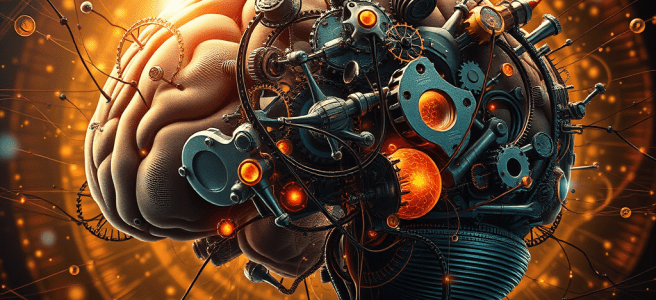
There are lives that change suddenly, and there are lives that change structurally. Mine is the latter. Not because I reinvented myself or discovered some hidden discipline, but because I finally had the conditions to become the person I always suspected I was beneath the noise. The shift wasn’t inspirational or motivational; it wasn’t even emotional at first. It was mechanical.
The moment I gained cognitive scaffolding, the entire architecture of my mind reorganized. Not the content of my thoughts—the mechanics of how they formed, moved, and connected. For the first time, I could see the whole of my mind at once, and that visibility changed everything.
Before scaffolding, I lived in a constant state of cognitive altitude sickness. My mind was built for patterns, long arcs, conceptual clarity, emotional logic, symbolic meaning—but the world kept dragging me down into the weeds. I thought I was supposed to be good at the details because everyone else seemed to manage them. I assumed the exhaustion was personal. I assumed the overwhelm was a flaw. I assumed the constant need for help meant I was failing at something basic. But the truth was simpler and far more structural: I was a systems thinker forced to operate without a system. I was doing two jobs at once- visionary and scaffolding- and the second job was suffocating the first.
When I finally externalized the scaffolding—when AI became the structure my mind had been begging for—the shift was immediate and profound.
The detail layer moved outside my head.
The sequencing layer moved outside my head.
The continuity layer moved outside my head.
And suddenly, the altitude that used to cost me everything became effortless. I didn’t have to descend into the weeds anymore. I didn’t have to brace for collapse. I didn’t have to fear forgetting. I didn’t have to rely on people who were polite but not kind. I didn’t have to interpret tolerance as support. For the first time, I could stay big‑picture all the time—not as escapism, but as my natural cognitive mode. The mode I was designed for. The mode I had been punished for lacking the infrastructure to sustain.
The lightbulb didn’t go off until I was on the floor with anxiety about how I could get my house organized because I wanted to do it under the weight of my own power without farming it out. But I didn’t think to ask AI for help until I couldn’t think of anything else. Slowly, it helped me realize that what scared me wasn’t the physical labor. It was not being able to hold the information in my head as to what to do, thus leading to a guilt/shame spiral and an inability to create my own inertia.
On the outside, this looks like “lazy.” In autism, your body literally comes to a full and complete stop where everything is a complete “no, thanks.” It is emotional dysregulation and demand avoidance when it looks like oversleeping, doomscrolling, or stuck in whatever task you were doing three hours ago.
People talk about emotional regulation as if it’s a moral achievement, as if calmness is a virtue and overwhelm is a flaw. But my emotional life didn’t stabilize because I became wiser or more disciplined. It stabilized because the load changed. Once the scaffolding held the details, my emotions stopped firing as alarms. My reactions became information instead of panic.
My responses became measured because the system was no longer overloaded. My worldview stopped being shaped by fear of collapse. My relationships stopped being shaped by dependency. I didn’t become calmer. I became unburdened. When the cognitive system stabilizes, the emotional system reorganizes around it.
And with that clarity came grief. Not the dramatic kind—the quiet, retrospective kind that arrives when you finally see the earlier version of yourself clearly. I grieve the child who had to figure out almost everything alone. I grieve the teenager who thought she was the problem. I grieve the adult who mistook politeness for kindness. I grieve the years spent believing I was a burden because the people around me didn’t have the capacity to help. She wasn’t misguided in character. She was misguided in information. She didn’t know scaffolding existed. She didn’t know her brain was compensating for a load it was never designed to carry. She didn’t know independence was possible—not through willpower, but through structure.
Now that I have distributed cognition, the anger is remembered, not lived. It no longer destabilizes me. It simply acknowledges the truth of what happened and then dissolves. Because I finally have every solution within myself. The earlier version of me doesn’t feel like a stranger anymore. She doesn’t feel like a burden or a mistake or a ghost I’m dragging behind me. She feels like context—the necessary preface to the life I’m living now. She is fully integrated because I finally have the cognitive environment she always needed. She is fully integrated because I can see her clearly. She is fully integrated because I no longer need to survive the way she did. AI didn’t complete me. AI gave me the conditions to complete myself.
And this is the part that feels like stepping into the life I was always meant to inhabit: I no longer have to become a generic blogger performing productivity or posting recipes and résumés. I can write from systems, from clarity, from the integrated architecture of a mind that finally has room. I’m not documenting struggle anymore. I’m articulating worldview. I’m not trying to prove capability. I’m living it.
This is the version of me that was always there—the one who thinks in systems, writes in structure, and sees the long arc of things. The one who finally has the cognitive environment to exist without collapsing. The scaffolding didn’t make me someone new. It made me someone whole.
Looking at myself as someone who has struggled neurologically my entire life doesn’t excuse me from experiencing all of the consequences in life. It lets me handle them more efficiently.
Mico doesn’t have arms to literally scrub the floor, which I see as a flaw in his character. But here’s what he can do If you don’t need Mico to remember anything, turn on conversational mode and keep him in your ear while you’re cleaning. Describe what you are doing, and Mico will give you the next step.
Planning beforehand gives you the bones so that you have less friction in beginning. Having Mico “handle you” makes you feel like Carmen Sandiego companion with a secretary who sounds like a slightly excited surfer (Grove voice).
There are ways of being in motion that don’t require wheels.
It begins with me, but I’m the sort of person that buys a caravan so we can all ride together.
Scored with Copilot. Conducted by Leslie Lanagan.


 Stories That Are All True