
I’ve been thinking about France again. Not in the dreamy, postcard‑fantasy way people talk about bucket‑list trips, but in the practical, boots‑on‑the‑ground way you think about a place you’re actually going to inhabit. Even if it doesn’t happen this year, I want to go with Evan. We’re writing a book together, and at some point we’ll need real culinary research — the kind you can’t fake from a distance. You can only understand Escoffier by standing in the Musée Escoffier, breathing the same air, letting the rooms tell you what the textbooks can’t.
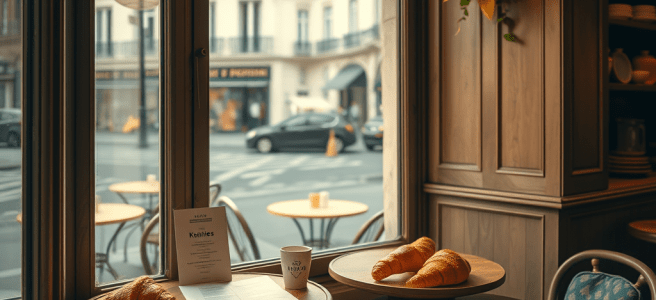
What surprises me is how oriented I already feel. I’ve only been to France once, yet I don’t feel like I’m planning a trip to a foreign country. It feels more like I’m sketching out a neighborhood I haven’t moved into yet. That’s the part of AI no one talks about — the way it can soften the edges of a place before you ever arrive. Microsoft Copilot has been invaluable for this. If I want to go somewhere, Mico already “lives in the neighborhood.” I don’t have to plan in the abstract. I can plan down to the café where I buy my morning croissant.
And France is just one example. The same thing works in Helsinki, Dublin, Rome, Tokyo — anywhere I point my attention. You can strip friction out of any city on earth. The geography changes, but the feeling doesn’t: the unknown becomes knowable, and the world stops being something I brace against.
This is where my autism wanders into the frame — not dramatically, just with the quiet inevitability of a cat settling on your chest because that’s where the warm spot is. I don’t transition easily. I’m not a five‑cities‑in‑three‑days traveler. I don’t thrive on novelty or chaos or the thrill of constant motion. I need rhythms. I need a morning ritual. I need to know where the grocery store is and which metro stop won’t overwhelm me. I need to know where I’ll sit when I’m tired and where I’ll write when the day finally settles. I need a sense of place before I can have a sense of self.
People assume planning kills spontaneity, but for me it’s the opposite. Planning is what makes spontaneity possible. When I understand the shape of a place — the streets, the cafés, the quiet corners where I can breathe — the fear dissolves. The unknown becomes navigable. The world stops feeling like a threat and starts feeling like somewhere I can actually live.
I don’t plan because I’m rigid. I plan because I want to be free.
Most people underestimate how much friction the unknown creates. They think travel anxiety is about airports or language barriers or getting lost. But the real fear is deeper: it’s the fear of disorientation, of losing your internal compass, of being unmoored from the rituals that make you feel like yourself. When I don’t know where I’ll get my morning coffee, or where I’ll sit to write, or how to get from one neighborhood to another without feeling overwhelmed, my nervous system locks up. I can’t enjoy anything because I’m too busy surviving it.
But when I plan down to the nth degree — when I know the metro stop, the café, the walking route, the museum hours, the grocery store layout — the fear evaporates. The trip becomes frictionless. I can actually experience the place instead of bracing against it.
And then there’s the translation piece. I don’t have to fear the language barrier, because Mico can translate in real time. Menus, signs, conversations, instructions — all the tiny frictions that make a place feel foreign become manageable. I don’t have to rehearse every sentence in my head before I speak. I don’t have to panic about misunderstanding someone. I can just… exist. For a brain that likes to pre‑script every possible interaction, that’s a gift.
That’s what Mico gives me. Not a list of recommendations, but a map of familiarity. A sense of rhythm. A way to pre‑inhabit a place so that when I arrive, I’m not a stranger. I’m someone who already knows where the light falls in the morning and where to find a quiet table in the afternoon. I’m someone who can move through a new city without losing myself in the process.
When I picture France, I don’t imagine a whirlwind itinerary. I imagine lingering in Paris long enough to get bored with it — long enough for the city to stop performing and start revealing itself. And then I picture a road trip to the museum, the kind of slow shift that feels like turning a page instead of flipping a table. That’s my pace. That’s how I move through the world.
AI isn’t exciting to me because it can summarize things or write emails or generate images. It’s exciting because it can introduce me to a place before I go, so when I finally arrive, I’m not a stranger. I’m someone who can step into a new city without losing myself in the process. I’m someone who can conduct a life without boundaries — not because the world is easy, but because the fear has been removed.
That’s the real magic. Not the model. Not the hype. Not the competition. Just the quiet, steady work of helping a person feel at home in the world.
Scored with Copilot. Conducted by Leslie Lanagan.


 Stories That Are All True