
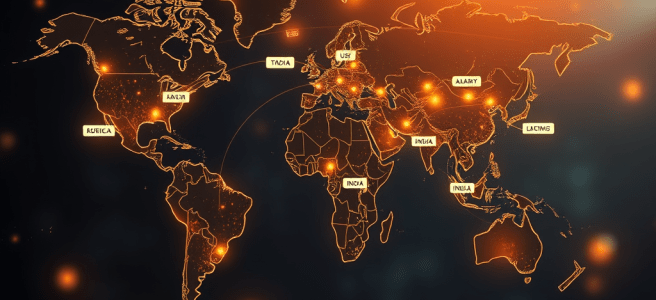
Copilot and I constructed this essay out of a CSV file containing my all-time stats. It’s different when you can have a machine analyze all 14 years at once:
When I first started writing online, I assumed my audience would stay close to home. I imagined a small American circle — people who lived in the same cultural weather system I did, people who understood the references without translation. And for a long time, that was true. The United States was the center of gravity, the place where my essays first took root and built their earliest momentum. But even then, something else was happening under the surface. My writing wasn’t staying contained. It was already slipping past borders I hadn’t even thought about.
The first signs were subtle: a reader from the UK, a comment from Canada, a spike from Australia. It felt like my work had stepped onto a larger stage without asking permission. These were the countries where English isn’t just a language — it’s a reading culture. They took my essays the way they take op‑eds or longform journalism, and suddenly I wasn’t writing into a domestic room anymore. I was writing into the Anglosphere.
Then the map widened again. India arrived — not as a trickle, but as a second anchor. That was the moment I realized my writing wasn’t “American content.” It was global English content. It traveled because it was built on clarity, structure, and narrative logic, not on local shorthand. From there, the Philippines, Pakistan, Malaysia, Singapore — places where English is infrastructure, not ornament — began showing up. These weren’t casual readers. These were people who use English as a tool of education, ambition, and mobility. My work fit naturally into that world.
Africa surprised me in the best way. Kenya, Nigeria, Ghana, South Africa, Uganda — the educated, globally connected, English‑speaking arc of the continent. These are readers who live between cultures, who navigate multiple worlds at once, who look for writing that doesn’t assume a single national perspective. Seeing those countries appear felt like confirmation of something I’ve always known about my own voice: I write from the in‑between spaces, and people who live in those spaces recognize it.
Europe came next, but not as a monolith. It arrived as a constellation of multilingual readers — Germans, Romanians, Irish, Dutch, Finns, French, Swedes, Italians, Spaniards. People who read English not because they have to, but because it’s part of their intellectual diet. My essays slipped into that ecosystem because they reward attention and don’t talk down to the reader. They travel well in academic and expatriate circles, where people are used to moving between languages and ideas.
And then came the long tail — the part that still feels unreal. Island nations. Microstates. Territories. Places I’ve never been and may never go. A single reader in a country I had to look up on a map. Someone on a remote island reading a piece I wrote years ago. That’s the unmistakable signature of longevity. It’s what happens when you’ve been writing online long enough for your work to be indexed, archived, resurfaced, and rediscovered across platforms and years. It’s the internet’s way of saying: I remember you.
When I look at the full map now, I don’t see numbers. I see rings of expansion — a domestic foundation, an Anglosphere spread, a global English uptake, a European intellectual belt, and finally the deep, distributed internet where my writing appears in places I never imagined. It’s not the footprint of a niche blog. It’s the footprint of a voice that has lived online long enough, and clearly enough, to become global.
And the truth is: I didn’t chase this. I just kept writing. The geography happened around me.


 Stories That Are All True