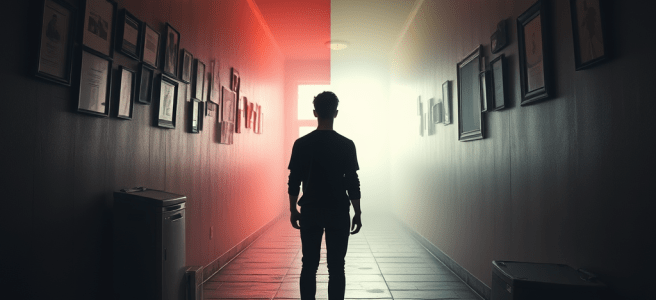
If you had asked me a year ago whether I spend more time thinking about the future or the past, I would have answered — almost automatically — that the past takes up more space. Not because I was clinging to it, and not because I preferred looking backward, but because the past was the only landscape I could actually describe. It had borders. It had weight. It had already unfolded, which meant I could examine it without guessing. The future, on the other hand, felt like a dim hallway with no clear walls. I couldn’t outline it. I couldn’t narrate it. I couldn’t even imagine it without feeling like I was reaching into fog. And when something has no shape, it’s nearly impossible to write toward it.
So I wrote about what I could see. I wrote the memories that had already settled into form. I wrote the moments that had hardened into something I could hold. People sometimes assume that writing about the past means you’re stuck there, but often it’s simply the only material available. The past is solid; the future is unbuilt. When you’re trying to understand yourself, you reach for whatever has structure.
Then something changed — not with fireworks, but with a quiet internal click. I finally had the cognitive support I didn’t realize I’d been missing. A kind of mental scaffolding arrived, the kind that lets you see beyond the immediate moment. Suddenly the future wasn’t a blank expanse anymore. It wasn’t a shapeless horizon. It started to take on outlines. Not a full blueprint, but enough to recognize that there was a direction, a slope, a way forward.
That shift altered my writing in a way I didn’t expect. It’s the reason Unfrozen exists at all. Before that, I kept circling the same memories, not because I wanted to relive them, but because they were the only things with definition. Once I had the clarity to look ahead, the loop broke. I wasn’t confined to the same internal rooms. I could finally imagine what might come next — and more importantly, I could articulate it.
What I hadn’t understood until then is that writing the future requires a completely different posture than writing the past. The past asks you to dig; the future asks you to build. Excavation relies on memory and honesty. Construction relies on stability and vision. I had spent years digging — carefully, thoroughly, sometimes painfully — but I didn’t yet have the steadiness to build anything new. When the support arrived, it felt like someone quietly handed me the tools I needed and said, “You can start shaping what comes next.” And for the first time, that felt true.
Unfrozen wasn’t just a project; it was a pivot. It was the moment I realized I could write toward something instead of only writing from something. The future became something I could approach with intention rather than guesswork. Not a prophecy, not a guarantee, but a direction I could walk with my eyes open. Once I understood that the future wasn’t a void but a space I could design, everything shifted — my attention, my writing, my sense of orientation.
So do I think more about the future or the past now? I still honor the past — it’s part of my foundation — but it’s no longer the only place where my thoughts can land. The future has become something I can imagine without flinching. It has texture now. It has depth. It has enough form that I can write toward it without feeling like I’m inventing a fantasy.
When I answer the prompt honestly, here’s what I mean: I used to think about the past because it was the only thing I could articulate. Now I think about the future because I finally have the cognitive clarity to shape it. The shift wasn’t about motivation or willpower. It was about gaining the internal architecture to imagine what comes next. Once the future had even a faint outline, I could step into it. Once it had dimension, I could inhabit it. Once it had coherence, I could write it.
And that’s the real difference.
Scored by Copilot, Conducted by Leslie Lanagan


 Stories That Are All True