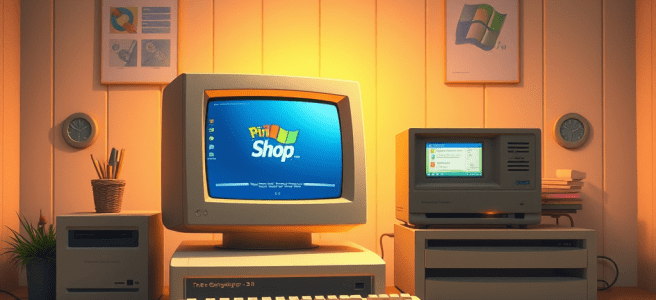


My first computer wasn’t sleek or iconic or something you’d see in a museum. It was a beige tower from the late 80s — the kind of machine that hummed like it was thinking hard and warmed the room like a small space heater. It didn’t matter. To me, it was a portal.
It ran Windows 3.1, which meant my earliest sense of “interface” was a world of pastel program groups, beveled buttons, and that unmistakable startup chime that felt like the computer clearing its throat before letting me in. I didn’t know it then, but that operating system was teaching me how my brain liked to move: visually, spatially, through little windows of possibility.
It came with the essentials of the era: Print Shop, Paint, and WordPerfect — the holy trinity of childhood creativity. Print Shop turned me into a one‑kid banner factory. Paint taught me the spiritual discipline of drawing with a mouse. And WordPerfect — that blue screen with the white text — was the first place I ever saw my thoughts appear in real time.
But that computer wasn’t just for play. It became my first real workspace.
By fifth grade, I was doing all my homework for Mrs. Wommack on it — every essay, every report, every assignment that needed more than handwriting. I’d sit there in that blue WordPerfect screen, typing like I was doing something important. And honestly, I was. That was the first time I felt the power of shaping ideas with my hands, watching them take form on a screen that felt bigger than me.
Windows 3.1 made it feel official. Clicking into Program Manager. Opening the “Accessories” group. Launching Write or Paint or the Calculator. It was the first time software felt like a place.
That beige tower didn’t last long. In 1990, our house caught fire, and the machine went with it. I remember the smell of smoke, the shock of seeing everything blackened, and the strange grief of realizing my little portal was gone. Losing that computer felt like losing the place where my mind had first learned to stretch.
But the fire didn’t take the impulse. It didn’t take the part of me that wanted to make things. If anything, it made that part louder.
Every computer I’ve owned since — every laptop, every phone, every device — has been a descendant of that beige tower. A continuation of the same story. A reminder that even the simplest tools can open the biggest doors.
Maybe that’s why I write every day now. Maybe that’s why I still chase that feeling of watching something appear on a screen that didn’t exist five seconds earlier. Maybe that’s why I still wake up before sunrise, tapping keys while the world is quiet.
My first computer wasn’t fancy. But it was mine. And it was the beginning.
Scored by Copilot, Conducted by Leslie Lanagan


 Stories That Are All True