For as long as professional kitchens have existed, the jump from home cooking to restaurant cooking has been a cliff. A home cook could be brilliant in their own kitchen and still get obliterated the moment they stepped onto a line. The heat, the timing windows measured in seconds, the choreography of a rush, the muscle memory that takes years to build, the constant threat of getting in the weeds — all of it created a world where the only way to learn was to survive it. But something new is happening, quietly and mostly in fast‑casual and fast‑food environments, where automation and AI aren’t replacing cooks but finally supporting them. Bryn is the perfect example. She walked into a wing shop with no professional experience. She wasn’t a line cook, she wasn’t trained, she wasn’t “industry,” but she was a good home cook — someone with taste, instincts, and judgment. And for the first time in history, that was enough, because the system around her was designed to help her succeed.
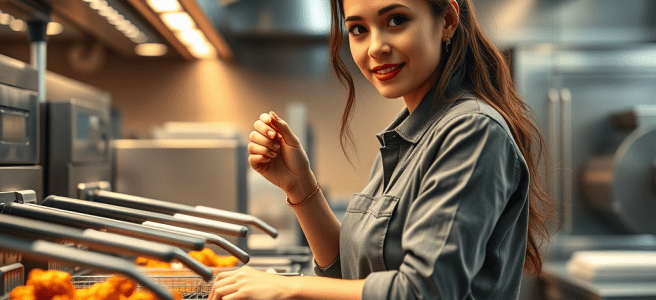
The automation in her kitchen wasn’t glamorous. It wasn’t a sci‑fi robot chef. It was a simple, practical setup: fryers with automated lift arms, timers that tracked cook cycles, workflows that paced the line, alerts that prevented overcooking, sensors that kept the oil at the right temperature. None of this replaced the cook. It replaced the overload. The machine lifted the baskets, but Bryn decided when the wings were actually done. The machine tracked the time, but Bryn tasted, adjusted, and corrected. The machine kept her out of the weeds, but Bryn kept the food good. That’s cooking. And this is the part people miss: she didn’t walk into the kitchen with professional knowledge, but she walked in as a fine home cook, and the great equalizer was being able to let the system run so she didn’t get buried before she even had a chance to learn. When you’re not juggling five timers, dodging burns, guessing at doneness, or panicking during a rush, you can actually pay attention. You can taste. You can adjust. You can learn. The system didn’t replace the cook. The system created the conditions where a cook could emerge.
This is the first time in history that stepping from a home kitchen into a professional one isn’t a cliff. Not because the craft is being cheapened, but because the barriers are finally being removed. Automation makes the job safer and more accessible, taking away the parts of the work that injure people or overwhelm them while leaving intact the parts that define the craft: judgment, sensory awareness, pacing, improvisation, and the human override. A machine can follow instructions; a cook knows when the instructions are wrong. A machine can lift the basket at 3:45; a cook knows the oil is running cooler today. A machine can beep when the timer ends; a cook knows the wings aren’t crisp enough yet. A machine can follow the workflow; a cook knows when the rush requires breaking it. Automation doesn’t erase the cook. It reveals what the cook actually is.
And none of this threatens fine dining. Fine dining will always exist because fine dining is sensory calibration, intuition, technique, improvisation, and the human palate as instrument. Automation can’t touch that. It’s not even trying to. What automation can touch — and what it should touch — is the part of the industry that has always relied on underpaid workers, high turnover, dangerous repetitive tasks, impossible speed expectations, and zero training or support. Fast food workers deserve the same scaffolding Bryn got: a system that keeps them safe, consistent, and out of the weeds.
The real magic is that AI doesn’t replace the experts either. It preserves them. The titans of the industry — the chefs, the trainers, the veterans — aren’t being automated away. They’re being recorded. Their knowledge becomes the timing logic, the workflow design, the safety protocols, the quality standards, the override rules, the “if this, then that” judgment calls. AI doesn’t invent expertise; it inherits it. The experts write the system. The newcomers run the system. And the system supports everyone.
This is the supported kitchen — the first humane version of professional cooking we’ve ever had. AI handles the repetition, the timing, the consistency, the workflow, the safety, the cognitive overload. Humans handle the tasting, the adjusting, the improvising, the reading of the room, the exceptions, the nuance, the override. For the first time, a good home cook can walk into a professional kitchen and not be immediately crushed by chaos. Not because the craft has been diminished, but because the system finally does the part that used to keep people out. The worker defines the craft. The expert defines the system. The system supports the worker. And the craft remains unmistakably human.
Scored by Copilot. Conducted by Leslie Lanagan.


 Stories That Are All True
AI doesn’t invent expertise; it inherits it. – hmm
LikeLike