
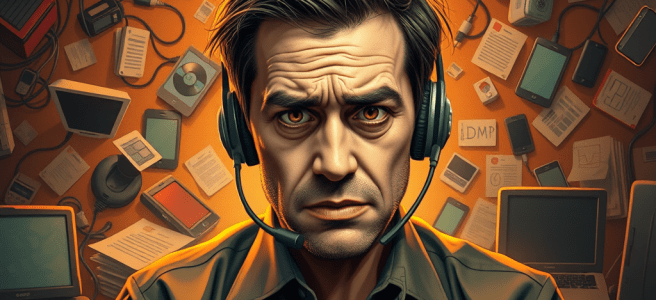
People love to say tech people are “so awful,” as if we’re all born with a congenital disdain for humanity, when the truth is far simpler: we’re exhausted from years of dealing with users who confidently misstate reality and then act stunned when the universe refuses to cooperate. Spend long enough in this field and you start to understand why so many of us look like we’re one support ticket away from faking our own deaths. It’s not the machines that break us; it’s the humans who swear they’ve “checked everything” when they haven’t checked a single thing.
Take the legendary Michael Incident. A customer insisted — with the conviction of someone testifying under oath — that their server was on. Michael asked three times. “Yes, it’s on.” “Yes, I checked.” “Yes, I’m sure.” So he drove from Houston to San Antonio, walked in, pressed the power button, and drove home. That wasn’t troubleshooting. That was a spiritual journey. A pilgrimage to the Shrine of Human Error. And the user blinked at him like he’d just performed a resurrection. “Oh,” they said, “that’s weird. It was on earlier.” Sure it was. And I’m the Archbishop of Dell.
And that’s just the enterprise version. The campus edition is the same story with more humidity. At the University of Houston, you’d walk across campus because a printer “wasn’t working,” only to discover it wasn’t plugged in. You’d plug it in, the user would gasp like you’d just performed open‑heart surgery, and then they’d say, “Huh, that’s strange, it was plugged in earlier.” No, it wasn’t. The electrons did not pack their bags and leave.
Then there’s the Wi‑Fi crowd. “The internet is down,” they declare, as if announcing a royal death. “Are the lights on the modem lit?” you ask. “Yes, everything looks normal.” You arrive to find the modem not only off, but unplugged, upside down, and sitting under a stack of mail like it’s in witness protection. “Oh,” they say, “I didn’t notice that.” Of course you didn’t. You’d have to move a single envelope.
And don’t get me started on the people who think tech literacy grants you supernatural powers. They hand you a Word document that looks like a hostage situation — images drifting around the page like ghosts, text boxes stacked in layers that defy Euclidean geometry — and they assume you possess some hidden command that will snap everything into place. “Can you fix this real quick?” No, Brenda. I cannot. There is no secret “Make Word Behave” button. There is only the same tedious, pixel‑by‑pixel drudgery you’re trying to outsource. The only difference is that I know exactly how long it will take, which is why I go quiet for a moment before agreeing to help. That silence isn’t arrogance. It’s grief.
Password resets are their own special circle of hell. “I didn’t change anything,” they insist. Yes, you did. You changed everything. You changed it to something you were sure you’d remember, and then you forgot it immediately. You forgot it so hard it left your body like a departing soul. “Try ‘Password123’,” they suggest. Brenda, if you think I’m typing that into a corporate system, you’re out of your mind.
And then there’s the hovering. The narrating. The running commentary. “So what are you doing now?” “Is that supposed to happen?” “I don’t remember it looking like that.” “Are you sure that’s the right screen?” “My cousin said you can fix this with a shortcut.” “I saw a YouTube video where—” Please. I am begging you. Stop talking. I cannot debug your computer and your stream of consciousness at the same time.
This is the emotional labor no one sees. You’re not just fixing a device; you’re managing panic, guilt, impatience, and the user’s deep conviction that the computer is personally attacking them. You become a translator, a therapist, a hostage negotiator, and a mind reader, all while maintaining the illusion that you’re simply “good with computers.” Meanwhile, the person hovering over your shoulder is asking the same question three different ways and insisting they “didn’t touch anything” even though the router is smoking like a campfire.
And the stories accumulate. The unplugged printers. The phantom Wi‑Fi outages. The haunted Word documents. The laptop that “just died” because someone closed it on a pencil. The desktop that “won’t turn on” because the power strip is controlled by a light switch. The monitor that “stopped working” because someone turned the brightness down to zero. The keyboard that “broke” because a cat slept on it. The mouse that “froze” because the user was clicking the logo sticker instead of the actual buttons. The San Antonio road trip. The whole catalog of human‑generated chaos.
So no, tech people aren’t awful. We’re just the only adults in the digital room, the ones who understand the true cost of the work, the ones who know that “It’ll only take a minute” is the opening line of a horror story. We’re tired of being treated like a public utility, tired of being punished for competence, tired of being expected to perform miracles on demand. If you had to drive across Texas to press a power button, you’d be “awful” too.
Scored by Copilot. Conducted by Leslie Lanagan.


 Stories That Are All True