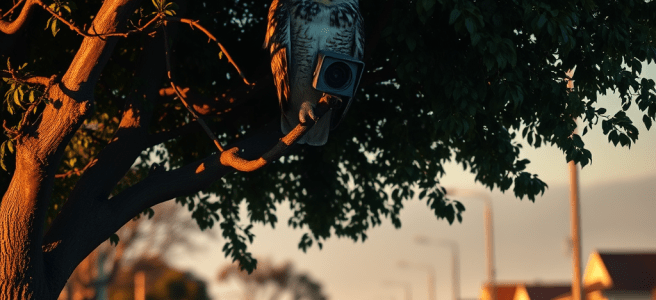


If I could change one law, I’d start with the one that let a soulless traffic camera ambush me like a bored mall cop with a grudge. You know the signs — “Speed Photo Enforced,” which is basically government‑issued foreshadowing that somewhere up ahead, a camera is perched in a tree like a smug little owl waiting to ruin your day. And yes, I’m speaking from personal experience, because one of these mechanical snitches just mailed me a ticket like it was sending a Valentine.
Once upon a time, a police officer had to actually see you do something. They had to be present, in a car, with eyes, making a judgment call. Maybe they’d give you a warning. Maybe they’d tell you to slow down. Maybe they’d let you go because they could tell you were just trying to merge without dying.
Now? A camera blinks, a computer beeps, and suddenly I’m getting a letter informing me that a machine has determined I was “traveling at a rate inconsistent with posted signage.” That’s not law enforcement. That’s a CAPTCHA with consequences.
And the machine doesn’t know anything. It doesn’t know that I sped up because the guy behind me was driving like he was auditioning for Fast & Furious: Dundalk Drift. It doesn’t know the road dips downhill like a roller coaster designed by someone who hates brakes. It doesn’t know the speed limit drops from 40 to 25 in the space of a sneeze. It only knows numbers. And the numbers say: “Gotcha.”
Now, the bare minimum fix would be requiring a human being to actually review the footage before a ticket goes out. Just one person. One set of eyeballs. One adult in the room saying, “Yeah, that looks like a violation” instead of rubber‑stamping whatever the robot spits out.
But here’s the problem: the real fix — the one that would actually solve this — would require cities to hire more police. Actual officers. Actual humans. People who can tell the difference between reckless driving and “I tapped the gas to avoid a crater in the road.”
And that’s where the whole thing gets messy, because let’s be honest: a lot of people don’t trust police to make those judgment calls fairly. For some folks, getting a ticket in the mail from a robot feels safer than getting pulled over by a person. The machine may be creepy, but at least it’s predictable. It’s not going to escalate. It’s not going to misread your tone. It’s not going to decide today is the day it’s in a mood.
So we’re stuck between two bad options: the GoPro on a stick that fines you without context, or the human officer who brings their own biases, stress, and split‑second decisions into the mix. One is cold and unaccountable. The other is warm‑blooded and unpredictable. Pick your dystopia.
Because if the best we can do is pick which bad system we’d like to be punished by, then maybe the problem isn’t my speed — it’s the infrastructure pretending to keep me safe.
Scored by Copilot. Conducted by Leslie Lanagan.


 Stories That Are All True