There are fonts that behave themselves, fonts that understand the room they’re in, fonts that arrive dressed appropriately for the occasion. And then there is Comic Sans, a font that wanders into formal spaces like a toddler in light‑up sneakers, sticky with juice, absolutely delighted to be here. Comic Sans is not malicious. Comic Sans is simply unaware of the emotional consequences of its own presence.
The story starts in 1994, inside Microsoft, where Vincent Connare was working on Microsoft Bob — a cartoonish, kid‑friendly interface featuring a talking dog named Rover. Rover delivered instructions in speech bubbles, but those bubbles were written in Times New Roman, a font that carries the emotional weight of a tax audit. Connare saw this and felt the same internal dissonance you feel when you see a clown smoking behind a circus tent. Something was wrong. A cartoon dog should not speak like a legal document. So he sketched a font inspired by comic books — rounded, bouncy, uneven, the typographic equivalent of a child’s handwriting on a birthday card.
And then the system hiccuped. Comic Sans wasn’t finished in time for Microsoft Bob’s release. The font missed its one correct habitat. But Microsoft, in its infinite 90s optimism, bundled it into Windows 95 anyway. Suddenly, a font designed for a cartoon dog was handed to millions of adults who had never once asked themselves what a font should mean. It was like releasing a domesticated parrot into the wild and being surprised when it started shouting human words at unsuspecting hikers.
Comic Sans began appearing everywhere it shouldn’t. Dentist offices. Church bulletins. Bake sale flyers. The front window of a vape shop. The sign taped to the microwave in the break room. It was always slightly sticky, slightly cheerful, slightly off. It was a font that believed every situation was a kindergarten classroom. It was a font that thought it was helping.
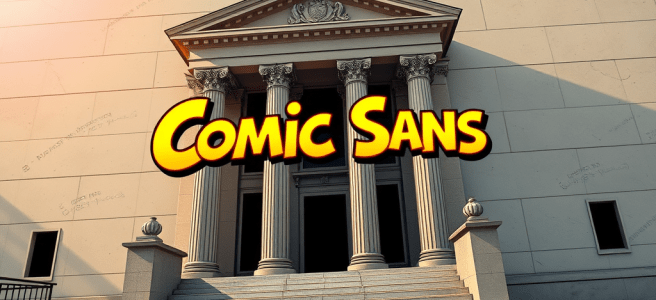
And then came the moment that changed me on a molecular level. I once saw Comic Sans on a sign in a federal courthouse. A courthouse — a building made of stone and echo and consequence. A building where the air itself feels like it has paperwork. And there, taped to a wall with the confidence of a font that had never known shame, was Comic Sans. My body reacted before my brain did. I felt my stomach drop. I felt my shoulders rise. I felt an ancestral warning flare in my spine. I nearly swallowed my backpack. It was the typographic equivalent of seeing a judge wearing Crocs.
Because fonts are emotional signals. They tell you how to feel before you’ve even processed the words. Comic Sans says, “This is for children.” It says, “There may be googly eyes nearby.” It says, “Snack time is at 2.” It does not say, “Please comply with the following instructions under penalty of law.” It does not say, “This building contains consequences.” It does not say, “We take ourselves seriously.”
Comic Sans is not the villain. Comic Sans is the wrong tool in the wrong room. It is context collapse. It is a symbol deployed without regard for meaning. It is a font designed for a cartoon dog being asked to carry the emotional weight of institutional authority. It is a system failure masquerading as whimsy.
Comic Sans is delightful for actual children.
Comic Sans is harmless on a birthday invitation.
Comic Sans in a courthouse is a cultural glitch so severe it should trigger a wellness check.
And once you’ve seen it — once you’ve felt that full‑body recoil — you understand that the problem isn’t aesthetics. The problem is that Comic Sans is speaking the emotional language of a juice box in a room built for verdicts.
It is a font that does not know when to sit down.
Scored by Copilot. Conducted by Leslie Lanagan.


 Stories That Are All True