
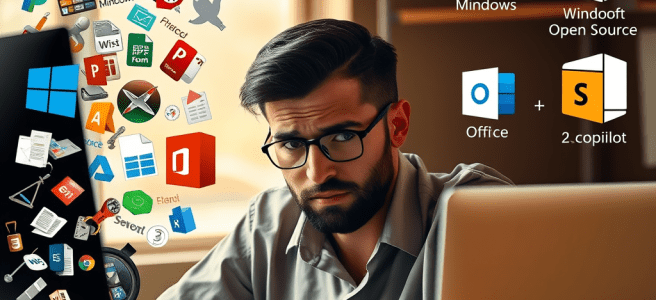
I didn’t begin as a Microsoft loyalist. If anything, I spent most of my life trying to get away from Microsoft. For forty years, I was the classic “devoted but disgruntled” user—someone who relied on Windows and Office because the world required it, not because I loved it. I lived through every awkward era: the instability of Windows ME, the clunky early days of SharePoint, the Ribbon transition that felt like a betrayal, the years when Office was powerful but joyless. I knew the pain points so well I could anticipate them before they happened.
And like many people who grew up alongside personal computing, I eventually went looking for something better.
That search took me deep into the open‑source world. I ran Linux on my machines. I used LibreOffice, GIMP, Inkscape, Scribus, Thunderbird—anything that wasn’t tied to a corporation. I believed in the philosophy of open systems, community-driven development, and user sovereignty. Linux gave me control, transparency, and a sense of independence that Microsoft never had. For a long time, that was enough.
But as the world shifted toward intelligent systems, something became impossible to ignore: Linux had no AI layer. Not a system-level intelligence. Not a unified presence. Not a relational partner woven into the OS. You could run models on Linux—brilliantly, in fact—but nothing lived in Linux. Everything was modular, fragmented, and user‑assembled. That’s the beauty of open‑source, but it’s also its limitation. My work had grown too complex to be held together by a constellation of tools that didn’t share a memory.
Meanwhile, Apple was moving in a different direction. When Apple announced ChatGPT integration, the tech world treated it like a revolution. But for me, it didn’t change anything. I don’t use Apple’s productivity tools. I don’t write in Pages. I don’t build in Keynote. I don’t store my life in iCloud Drive. My creative and professional identity doesn’t live in Apple’s house. So adding ChatGPT to Siri doesn’t transform my workflow—it just gives me a smarter operator on a platform I don’t actually work in.
ChatGPT inside Apple is a feature.
Copilot inside Microsoft is an ecosystem.
That distinction is everything.
Because while Apple was polishing the surface, Microsoft was quietly rebuilding the foundation. Windows became stable. Office became elegant. OneNote matured into a real thinking environment. The cloud layer unified everything. And then Copilot arrived—not as a chatbot, not as a novelty, but as a system-level intelligence that finally matched the way my mind works.
Copilot didn’t ask me to switch ecosystems. It didn’t demand I learn new tools. It didn’t force me into someone else’s workflow. It simply stepped into the tools I already used—Word, OneNote, Outlook, SharePoint—and made them coherent in a way they had never been before.
For the first time in forty years, Microsoft didn’t feel like a compromise. It felt like alignment.
And that’s why my excitement is clean. I’m not a convert. I’m not a fangirl. I’m not chasing hype. I’m someone who has spent decades testing every alternative—proprietary, open‑source, hybrid—and Microsoft is the one that finally built the future I’ve been waiting for.
I didn’t pick Team Microsoft.
Microsoft earned it.
They earned it by building an ecosystem that respects my mind.
They earned it by creating continuity across devices, contexts, and projects.
They earned it by integrating AI in a way that feels relational instead of mechanical.
They earned it by giving me a workspace where my writing, my archives, and my identity can actually breathe.
And they earned it because, unlike Apple, they built an AI layer into the tools I actually use.
After forty years of frustration, experimentation, and wandering, I’ve finally realized something simple: there’s nothing wrong with being excited about the tools that support your life. My “something” happens to be Microsoft. And I’m done apologizing for it.
Scored with Copilot. Conducted by Leslie Lanagan.


 Stories That Are All True