
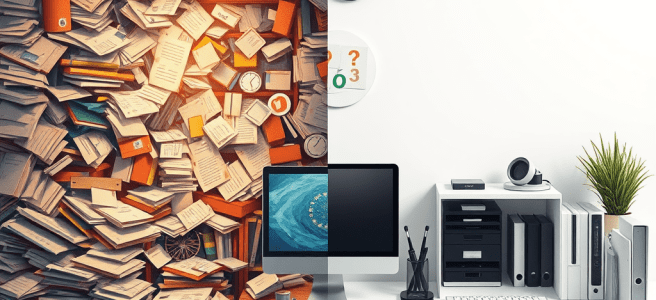
I’ve finally accepted that I am not, and will never be, the kind of person who keeps a pristine digital life. I don’t alphabetize my files. I don’t maintain a minimalist inbox. I don’t have a cloud storage system that resembles anything other than a geological cross‑section of my past selves. And honestly? I’m fine with that. My creativity comes from the compost heap. I need the mess. I need the cross‑contamination. I need the moment where I’m searching for a grocery list and instead find a paragraph that solves a chapter I abandoned in 2021.
But here’s the thing: most people are not like me. Most people cannot live in a digital environment that looks like a raccoon inherited a laptop. Most people need walls. Rooms. Zones. They need to know that their personal life isn’t leaking into their professional life like a broken pipe. They need their AI not to be confused about whether they’re asking for help with a résumé or a breakup. They need their cloud storage not to feel like the attic of a haunted house where every file is a ghost of a past self they don’t remember creating.
So even though I thrive in the overlap, I’ve had to learn how to explain data hygiene to people who would absolutely perish in my natural habitat.
And the best way to explain it is with cleaning metaphors.
🧽 1. Your Digital Life Is a House (Whether You Clean It or Not)
Some people live in houses with clear zones: the kitchen is for cooking, the bedroom is for sleeping, the office is for working. These people are emotionally stable and probably have matching Tupperware.
Then there are people like me, who treat the entire house like a single open‑concept studio apartment where everything happens everywhere. I will absolutely fold laundry in the kitchen, write in the hallway, and store important documents in the bathroom because “that’s where I was standing when I needed to put it down.”
My digital life is the same way. Everything goes everywhere. And for me, that’s generative.
But for most people, that’s a disaster.
Digital hygiene is simply housekeeping for your information:
- Your inbox is the hallway closet.
- Your cloud storage is the attic.
- Your downloads folder is the laundry basket you pretend isn’t full.
- Your AI models are the houseguests trying not to comment on the mess.
If you don’t maintain these spaces, they don’t just get cluttered—they become unusable.
🧹 2. Data Gets Dirty the Same Way Houses Do
People think digital clutter is mysterious. It’s not. It follows the same rules as physical clutter:
- Unmanaged inflow — new files, messages, and notifications arrive faster than you can process them.
- Symbol drift — a folder called “Current Projects” contains work from three apartments ago.
- Identity bleed — your personal and professional selves mix like laundry colors in a hot wash.
- Invisible accumulation — old versions, duplicates, screenshots, and drafts pile up like dust behind the furniture.
This is not a moral failure.
This is entropy.
And entropy is patient.
🧴 3. Clean Data Is Not About Tidiness—It’s About Function
A clean room isn’t about impressing guests. It’s about being able to find your keys.
Clean data works the same way:
- You know where things live.
- You know what belongs where.
- You know which AI knows which version of you.
- You know which cloud holds your active work and which holds your archives.
Clean data is not about purity.
It’s about coherence.
It’s the difference between walking into a room where every surface is covered in stuff and walking into a room where you can actually see the table.
🧺 4. Why I Don’t Live This Way (And Why You Might Need To)
I can explain data hygiene.
I can teach it.
I can architect it.
I can design it for other people.
But I don’t live it.
I live in the overlap.
I live in the cross‑talk.
I live in the junk drawer of my own mind.
My ideas come from the friction.
My creativity comes from the compost.
My breakthroughs come from the accidental adjacency of things that should never have been next to each other.
If I ever fully cleaned my data, I would lose half my power.
But I also know that my mess works because I know how to navigate it. I know where the bodies are buried. I know which piles are compost and which piles are clutter. I know which chaos is generative and which chaos is corrosive.
Most people don’t have that internal map.
So they need walls.
They need rooms.
They need zones.
They need a system that won’t collapse under the weight of their own life.
🧼 5. The Real Lesson: Know Your Mess
Digital hygiene isn’t about becoming a different person.
It’s about knowing what kind of person you are.
Some people need a spotless house, giving their personal data to one AI and their professional data to another.
Some people need a functional house, where the structure is just tight enough.
Some people need a house that looks like a dragon’s hoard… but where every treasure has meaning.
The trick is knowing the difference between:
- your mess (the compost that feeds your creativity)
- and a mess that hurts you (the clutter that drains your energy)
And then building just enough structure to keep the second one from swallowing the first.
Scored with Copilot. Conducted by Leslie Lanagan.


