


For Jill, who will know why.
I’ve lived in Baltimore long enough to know that the city’s marketing slogan — “We’re all in this together” — only tells half the story. The other half is what you learn once you’re actually here: if you didn’t grow up in Baltimore, it is monumentally hard to make friends. The social fabric is tight‑knit but not open‑knit, and unless you were born into one of the city’s long‑standing networks, you end up orbiting more than belonging.
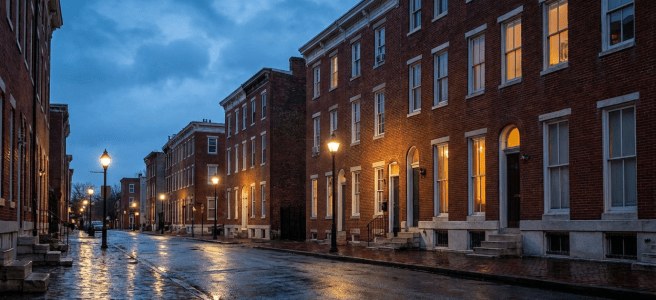
And when you combine that with the physical reality of my neighborhood — the break‑ins, the failing infrastructure, the blocks that look abandoned — you start to understand why people leave. My house was broken into. My car was broken into. Parts of the city look war‑torn. Safety here isn’t theoretical; it’s somatic. Your body learns to stay on alert.
But here’s the thing: I’m not trying to run away. I’m trying to tell the truth about the place I live.
One of the biggest lessons Baltimore has taught me is the importance of being in touch with my Congressman. My neighborhood is clearly underserved. When the traffic light on Reisterstown goes out every time it rains, the entire corridor turns into a madhouse. That’s not weather — that’s neglect. And when you live in a place where the infrastructure itself feels unstable, representation matters. Visibility matters. Feeling known matters.
I used to live in a district represented by Jamie Raskin — a household name, someone whose face was on posters, someone who was part of the national conversation. Now I’m represented by Kwesi Mfume. I’m not saying he’s bad or incompetent. I’m saying he’s quieter. Less visible. I couldn’t pick him out of a lineup. And when your neighborhood is underserved, that difference shapes how connected you feel to the system that’s supposed to advocate for you.
If I were in charge, the care wouldn’t stop at Seven Mile. Anyone who lives in Northwest Baltimore knows the line I’m talking about. South of Seven Mile, the sidewalks crumble, the medians overgrow, the streetlights flicker, and the drainage fails. Cross into Pikesville and suddenly everything is clean, maintained, orderly. It’s a jarring shift — not cultural, but infrastructural. I don’t need my neighborhood to have a Jewish identity. I don’t need it to become Pikesville. I just need it to work.
And honestly, it’s starting to.
The Plaza is being overhauled, and that’s not a small thing. When a major commercial anchor gets rebuilt, it means someone upstream believes the area is worth investing in. It means the decline has bottomed out. It means the neighborhood is shifting in the direction I’ve been waiting for — not toward gentrification, not toward erasure, but toward basic functionality.
And that’s the thing: I actually like the cultural mix here. My neighborhood has heavy Jewish and Black influences, and that’s part of its charm. It’s not cookie‑cutter. You can get your hair braided and pick up good rugelach on the same block. It’s lived‑in and real. It has texture. It has history. It has communities that have stayed.
I don’t need to live in Pikesville. Living near Pikesville is enough. Access to shopping and restaurants a short drive away is enough. What I want is for my own neighborhood to be treated with the same baseline dignity — working sidewalks, reliable utilities, stable streets, visible investment.
And for the first time since I moved here, I think that might actually happen.
Which is why I’m starting to think seriously about buying a house. Baltimore is one of the few places where my inheritance could actually buy a home — not a fantasy home, but a real one. In other cities, that money wouldn’t move the needle. Here, it gives me options. Stability. A foothold in a neighborhood that’s finally stabilizing.
People tell me to move to Pikesville if I want safety and predictability. But I don’t want Pikesville. I want my neighborhood to work. And I think it’s finally starting to.
Scored with Copilot. Conducted by Leslie Lanagan.


 Stories That Are All True