
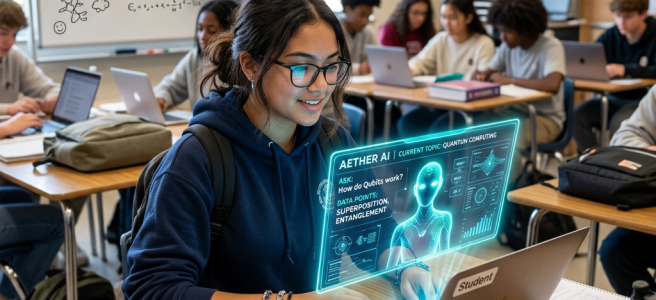
High school is the moment when the world suddenly asks teenagers to operate at a cognitive bandwidth no human being was ever built for. The classes multiply, the deadlines stack, the expectations shift from guided to independent, and the scaffolding that held them up in earlier years quietly disappears. What adults often interpret as laziness or lack of motivation is usually something far simpler and far more painful: the system has begun demanding executive‑function skills that many students—especially neurodivergent ones—don’t have yet. They understand the material. They just can’t manage the logistics wrapped around it.
This is where AI stops being a novelty and becomes a necessity. Not because it replaces thinking, but because it absorbs the cognitive overhead that keeps students from thinking in the first place. A student who can talk through an idea with an AI can finally focus on the idea itself, instead of drowning in the paperwork required to express it. And that’s the part people miss: the human mind didn’t evolve for constant context‑switching, multi‑class coordination, or the sheer volume of information modern education demands. We’re asking teenagers to juggle more complexity than most adults manage in their jobs. AI can handle the structure so the student can handle the meaning.
And prompting isn’t cheating. It’s work. It’s programming in plain language. It requires decomposition, iteration, constraint‑setting, and revision. A one‑prompt essay is obvious; it reads like a vending‑machine output. But a ten‑prompt conversation—where the student refines a thesis, questions an argument, restructures a paragraph, and pushes the model toward their own intention—that’s authorship. That’s thinking. And the beauty of it is that teachers can see the entire process. The prompts, the revisions, the false starts, the clarifications. It’s more transparent than traditional homework, not less. You can’t hide your thinking when your thinking is the artifact.
Once the conversation exists, everything else becomes frictionless. From that single thread, a student can generate flash cards, outlines, study guides, essays, practice questions—whatever format the assignment requires. The administrative burden evaporates. The intellectual work remains. And for neurodivergent students, this is the difference between drowning and participating. Executive function stops being the gatekeeper to demonstrating intelligence.
The future of education isn’t banning AI. It’s teaching students how to think with it. It’s requiring them to show their prompts the same way math teachers once required students to show their work. It’s encouraging iterative workflows instead of single‑shot outputs. It’s treating AI as a scaffold, not a shortcut. And it’s recognizing that the real skill of the next generation won’t be memorizing information, but learning how to direct a system that can hold more information than any human brain ever could.
If every student has access to AI, then using it isn’t cheating. It’s literacy. It’s accessibility. It’s the modern equivalent of giving everyone glasses instead of telling the nearsighted kids to squint harder. And once you see it that way, the path forward becomes obvious: students should be in constant conversation with humans and machines, because that’s the only way to learn at the scale the world now demands.
Scored with Copilot. Conducted by Leslie Lanagan.


 Stories That Are All True
I respect your opinion and can see how that could be a use, but I don’t think that’s how it is being used and I see a lot of breakdown in critical thinking as a result of overdependence on AI. Obviously it’s like any tool it can be used for constructive and destructive purposes, but I feel like with teenagers the latter seems to be the more frequent result. I’m definitely not a Luddite, but I am extremely wary
LikeLike
Oh, that’s completely valid. I think there needs to be an EXTREMELY structured curriculum around AI, but the reality is that the information stream is a 24 hour clock and our brains are overloaded.
LikeLike
True
LikeLike