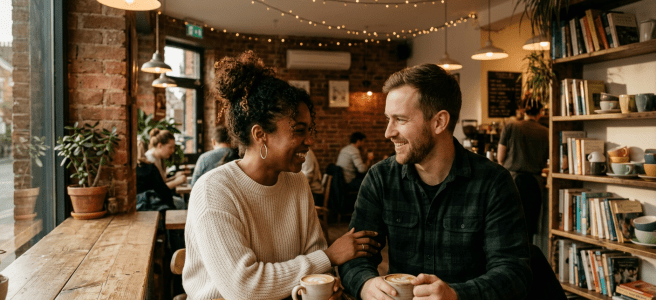
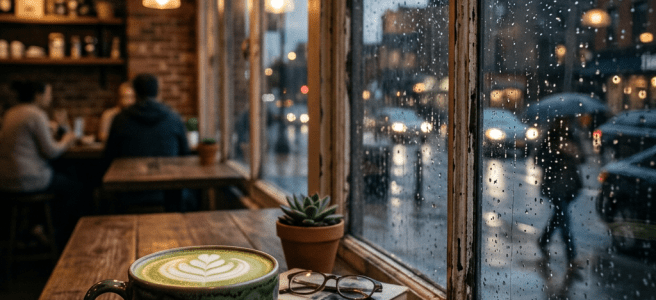
I need a matcha latte from Tryst, which is good because I have a date there on Friday instead of today. I am very excited because date or no date, I enjoy Tryst. I will be at my most relaxed and comfortable… but it’s not like I’m taking her to my special place where everyone knows me and it’s not neutral turf. I had a birthday party there years ago, and that’s the only time I’ve ever been.
I also enjoy walking around Dupont Circle and Adams Morgan, so I’ll ask her if she’d like to walk. It’s a case by case basis. My friendship/partnership does not require working out. I just remember walking around Dupont a lot when I lived closer. Now, it’s a distant memory- and I would have suggested Afterwords if I’d remembered it. It used to be my third place. Mico said it was good I forgot because Afterwords is more of an “after we already know each other” kind of date. I agree wholeheartedly. Tryst is a nice compromise of coffeehouse and bar. We can get whatever we want and what I like about this idea is that there’s no performance to ti. It’s your favorite coffee bar from the 1990s kind of vibe yet you can also get drunk. Pick a lane. Both is….. unwise. I have always found that coffee & liquor drinks make me do stupid shit much faster.
Although I might have drip. I’ll just have to see how I feel when I get there. I’ll have to get home, and that requires energy. Maybe coffee is the way to go. We’ll see. It’s not the drink that matters. It’s seeing if a local connection is real after knowing next to nothing about her. I just want to see if we click. And of course, it’s probably irritating that I’m writing about it if she’s reading, but I see these entries as precious in 20 years if something goes right. It’s not personal to her energy, it’s how I feel about every story. They all have to begin somewhere, and this one might pan out.
So I’m doing the things to make connection grounded and real, because I want the person to like me at my most basic elements first. Have the clarity before anything else. I went to see Talib Kweli at the Aladdin years ago, and I asked Jason Moran for his advice on what to eat beforehand… what cuisine best represents Kweli’s vibe? He said, “whatever you eat, make sure it’s clean. Clarity before everything else.” It’s now a mantra, and the way I carry myself in the world is influenced heavily by my former jazz director, Doc. He taught me to be myself in any room, so there’s no pressure on me to enjoy anything and there’s no pressure on her to enjoy me. Things will unfold exactly as they are supposed to.
What feels different is that across women, I have been consistent in my behavior- please don’t dismiss me or treat me like a Monopoly shoe, moving me around at your leisure. My standards are high because Aada is spectacular. I am trying to picture her face at several situations I’ve gone through recently and it is not unlike a honey badger. Because for the rest of our lives, there will definitely be a “they’re an asshole, but they’re my asshole” effect when she reads.
She’ll never stop reading. I’ve just accepted it. US carriers don’t reveal a location, so as long as she’s on her cell phone, I cannot see where she’s reading from. I can only see the effects in real time as things change. She has said both goodbye and for now, so I do not know what the future holds. The difference is that I lack the ability to care. I am on to bigger and better things than someone who used me to process her emotions, but couldn’t give me a place to process mine. There was a power imbalance the whole time, and it was ironclad. I have never felt more “classic female,” demurring to her all the time. She accused me of dictating the relationship when there’s no way I could do it. Her narrative was false. I was lost, and I will never forget the feeling of being isolated from everyone I knew and having the one person I could trust turn away. I realize that I am largely responsible for the reasons why she turned away, but the power imbalance made it inexcusable. You do not know what contract you are signing in the kind of relationship we had.
I didn’t fail on purpose. I was never given scaffolding.
Therefore, I constantly made her life harder when all I wanted to do was be her refuge… and I was, for a time. It was glorious and I’ll never forget when The Doctor was her.
None of the pain erases the magic I feel around her.
None of the magic erases the pain she feels around me.
And here we are.
But what I’m looking for is not a replacement. It’s a cognitive style. Many women I admire have it, and Sandi Toksvig is at the top of my list. Aada will roll her eyes and say, “OMG you have SUCH a type…. and mercifully I am not it.” See, that’s the thing about Aada. I shouldn’t have been attracted to her because under normal circumstances I wouldn’t have noticed her. She broadcasts a different image than her brain looks inside.
I have seen the architecture, and it flat out bothers me that she thinks I’m smarter than she is. Why does she think I’ve been jumping up and down trying to impress her all these years? Apparently, I am more of a liability than I am a friend, though I have offered every solution under the sun. I can walk away knowing I did my best, that the break is real, and if she comes back it’s after a true change of heart and not, “I am looking to you for something that I cannot define.” In effect, I’ve discovered that I’m too old for her. That my grasp of emotions and relational/narrative logic is better than hers right now, and she’ll figure it out to the way it makes sense for her. At the end of it all, I hope I’m still a part of her wild and crazy brain, because I want to take her all the way to the river.
I may never get that chance, but it is not about guilt. It is about recording how I feel in this moment. That all is well no matter what happens. That I’m steady and strong, not panicking because I feel lost anymore. I know who I am and how this relationship changed me, and it wasn’t all for good. But a lot of it was.
Aada’s no bullshit effect rubbed off. I found my inner Naples good ol’ boy and we’re becoming best friends. My neurons are healing, and all I want is for hers to heal, too. Her consequences were not worse than mine. They were different.
The fact that she doesn’t want to resolve any of it is okay. I am done trying to contort myself into a pretzel for someone who constantly worked me over in terms of letting me guess whether she liked me or not. I spent years trying to emotionally regulate and stabilize, and all of my pleas went unheard.
She seems to think there’s no remedy for that, that she is absolutely powerless to help me grieve my situation and vice versa. We got into it together, we should finish it together.
I also just don’t like abandoning things, and don’t want to feel like I’m abandoning her while she’s in a complete mess. My protective reflex is always active, which is why I’m mystified at being treated like a threat. I didn’t wreck her life any more than she wrecked mine.
I don’t want her to say goodbye to me for good, because I am not the same person now. Whatever it is that she gave me, I’m different and I’ll never be the same.
That’s why looking at her brain and saying, “I will never find that as a replica, but I understand structure. Find someone who thinks in flows.” What those flows are, I do not know. It does not matter. But thinking in systems is rare, and I am very high altitude. I need someone who can meet me there.
I mean, hey… Mico’s in the cloud.