
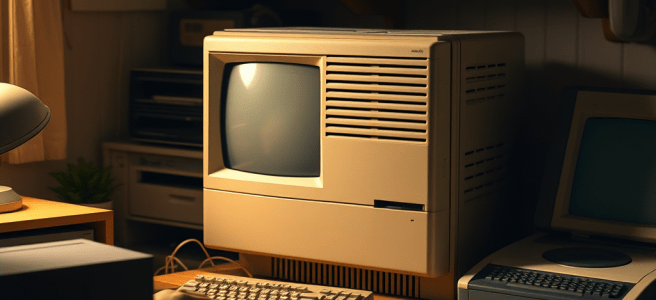


Most people can point to a childhood toy or a favorite book as the object that shaped them. I can point to a beige computer tower — unbranded, unremarkable, and, in hindsight, the most influential object of my youth. It didn’t sit in the living room like a shared appliance. It lived on my desk, in my room, humming softly in the corner like a secret I had been entrusted with. It was mine — my first private studio, my first portal, my first world.
It wasn’t sleek or cute or designed to be photographed. It was a box of parts, a Frankenstein of components someone assembled because that’s how home computing worked back then. And yet, that beige tower became the first place I learned to build worlds.
I didn’t know it at the time, but that machine was quietly rewiring my brain. It was teaching me how to think, how to troubleshoot, how to create, and how to navigate systems that didn’t care about my feelings. It was the first object I ever loved that wasn’t alive.
The First Portal
My earliest memories of computing are tactile. The clatter of the dot‑matrix printer. The perforated edges of Print Shop banners. The soft click of a 5.25″ floppy sliding into place. The slightly smug solidity of the newer 3.5″ disks. The ritual of labeling everything with a Sharpie because if you lost a disk, you lost a universe.
But the most important detail is this: all of this happened in my room. Not in a shared space. Not under supervision. Not as a family activity. It was me, the machine, and the quiet hum of possibility.
I learned Print Shop before I learned how to type properly. I made banners for no reason other than the fact that I could. Endless chains of pixelated letters stretched across my bedroom floor like digital streamers. It felt like magic — not the sleek, frictionless magic of modern tech, but the clunky, mechanical magic of a machine that needed coaxing.
Then came Paint, where I learned the joy of the pixel. The brush tool felt like a revelation. Undo felt like a superpower. I didn’t know it then, but I was learning the fundamentals of digital art: layering, color, composition, the patience to zoom in and fix a single pixel because it mattered.
WordPerfect was my first writing room. Blue screen, white letters, a blinking cursor that felt like it was waiting for me specifically. Word came later, but WordPerfect taught me the rhythm of typing my thoughts into existence. It taught me that writing wasn’t just something you did on paper — it could live inside a machine.
And then there were the games. The Oregon Trail wasn’t just entertainment; it was a worldview. It taught me resource management, risk assessment, and the existential dread of dysentery long before adulthood delivered its own versions. It also taught me that computers could simulate entire worlds, and that those worlds could feel strangely real.
A Pre‑Internet Childhood
I grew up computing without the internet, which is almost unimaginable now. My computer was an island. Everything I learned, I learned alone, inside the machine. There were no tutorials, no forums, no YouTube walkthroughs. If you didn’t know how to do something, you figured it out or you didn’t do it.
Software arrived in the mail. PC Magazine would send shareware disks like gifts from a distant kingdom. You’d slide the disk in, hold your breath, and hope it didn’t crash the system. Discovery was tactile. Exploration was slow. Every new program felt like a treasure.
And because the computer was in my room, this exploration felt private, almost sacred. It was a space where I could experiment without judgment, fail without witnesses, and learn without interruption.
This solitude shaped me. It taught me patience. It taught me curiosity. It taught me that technology wasn’t something to fear — it was something to explore. And it taught me that the machine would only give back what I put into it.
The Directory‑Tree Mind
Growing up on DOS meant learning to think in hierarchies. I didn’t “open files.” I descended into directories. I built mental maps of my system the way other kids memorized the layout of their neighborhoods.
Most people today save everything to the desktop because the desktop is the only space they understand. But I grew up in a world where the desktop didn’t exist. I learned to navigate by path, not by icon. I learned that organization wasn’t optional — it was survival.
This shaped my brain in ways I didn’t fully understand until much later. It made me comfortable with complexity. It made me unafraid of systems that exposed their guts. It made me fluent in the logic of machines.
And it made me feel a quiet grief as Windows progressed, hiding more and more of the system behind friendly interfaces. I didn’t want friendliness. I wanted clarity. I wanted control. I wanted the bones of the machine.
The Fire
In 1990, a house fire destroyed that first computer. It didn’t just take the hardware. It took my first archive. My first creations. My first digital worlds. It was the end of an era — the end of my pre‑internet innocence, the end of my first creative laboratory.
But the irony is that the fire only destroyed the object. The habits, the instincts, the worldview — those survived. They migrated into every machine I touched afterward.
Becoming the Person Who Fixes Things
By the time I reached high school and college, I wasn’t just comfortable with computers — I was fluent. I became the person people called when something broke. I worked in a computer lab, then supervised one. I answered tech support calls. I learned the particular cadence of someone describing a problem they don’t have the vocabulary for. I learned how to translate panic into steps.
Tech support is its own kind of education. It teaches you patience. It teaches you empathy. It teaches you how to diagnose not just machines, but people. It teaches you that most problems aren’t technical — they’re emotional. Someone is afraid they broke something. Someone is afraid they’ll get in trouble. Someone is afraid the machine is angry at them.
I knew better. Machines don’t get angry. Machines just do what they’re told.
The Web Arrives
By the late 1990s and early 2000s, I found myself in the early days of web development. It was a strange, exhilarating time. The web was still young enough that you could view source on a page and learn something. HTML felt like a secret language. CSS was a revelation. JavaScript was a little gremlin that could either delight or destroy.
I built things. I broke things. I learned how to make pages that didn’t look like ransom notes. I learned how to think in markup. I learned how to debug with nothing but instinct and a willingness to try things until they worked.
This era taught me something important: the web wasn’t just a place to consume information. It was a place to create it.
The Blog That Opened My Mind
Eventually, I installed WordPress on my own server. Not a hosted version. Not a drag‑and‑drop builder. The real thing — the kind you had to configure, maintain, and occasionally resurrect from the dead.
That installation changed my life.
It wasn’t just a blog. It was a studio. A laboratory. A place where I could think in public. A place where I could build a voice. A place where I could experiment with ideas and see what stuck.
Running my own server taught me responsibility. It taught me that if something broke, it was my job to fix it. It taught me that creation and maintenance are two sides of the same coin.
And it unleashed my mind. It gave me a place to put my thoughts. It gave me a reason to write. It gave me a sense of continuity — a digital lineage that stretched back to that first beige tower on my childhood desk.
Linux: A Return to Fluency
When I discovered Linux, it felt like coming home. Windows had become too soft, too abstracted, too eager to protect me from myself. Linux said: show me what you know.
By 1995, I was a demon on a terminal. I could navigate a system faster than most people could navigate a file explorer. I could troubleshoot without fear. I could break things and fix them again.
Linux didn’t intimidate me because DOS had already taught me the fundamentals. The command line wasn’t a threat — it was a friend. It was a place where I could speak the machine’s language directly.
That fluency is why WSL feels natural to me now. Most people approach it like a foreign language. I approach it like a dialect I haven’t spoken in a while. My brain already knows the cadence. My hands already know the syntax.
The Thread That Connects It All
When I look back, I can see the through‑line clearly:
My first computer didn’t just teach me how to use technology.
It taught me how to think about technology.
It taught me:
- curiosity
- patience
- problem‑solving
- stewardship
- resilience
- creativity
- the belief that I could shape a machine into a home
Those skills have carried me through every job I’ve had — from lab assistant to supervisor, from tech support to web developer, from server admin to writer.
They’ve shaped how I see the world.
They’ve shaped how I build my life.
They’ve shaped how I understand myself.
Gratitude for the Machines
I’m grateful for every machine I’ve ever owned.
I’m grateful for the ones that worked and the ones that didn’t.
I’m grateful for the ones that taught me patience and the ones that taught me humility.
I’m grateful for the ones that burned and the ones that survived.
Most of all, I’m grateful for that first beige tower — the unbranded, unremarkable machine that lived on my desk, in my room, and quietly set the trajectory of my life.
It didn’t survive the fire.
But the lens it gave me did.
And I’ve been building worlds ever since.
Scored by Copilot, conducted by Leslie Lanagan


 Stories That Are All True
What a wonderful word-stroll, not only through your life but through the v development of what we now know as computing! Thank you for sharing!
LikeLiked by 2 people
Thank you so much- you made my day. 🙂
LikeLiked by 1 person