
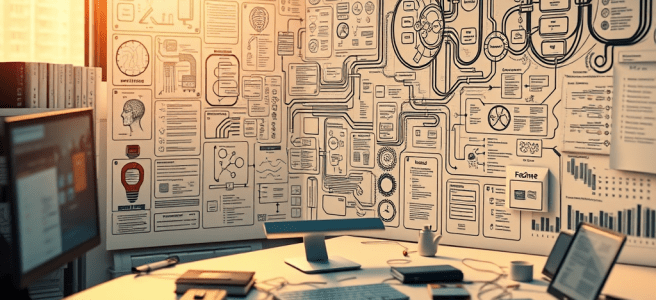
Most people think neurodivergent life is chaotic. They imagine scattered thoughts, disorganization, impulsivity, or emotional volatility. They imagine randomness. They imagine noise. But the truth is the opposite. Neurodivergent life is engineered. It has to be.
For those of us with AuDHD, the world doesn’t come pre‑sorted. There is no automatic sequencing. No effortless continuity. No internal filing system that quietly organizes the day. Instead, we build systems — consciously, deliberately, and often invisibly — to create the stability that other people take for granted. This is the foundation of my writing, my work, and my life. And it’s the part most people never see.
When I think, I’m not thinking in a straight line. I’m thinking in layers. I’m tracking:
- emotional logic
- sensory context
- narrative flow
- constraints
- goals
- subtext
- timing
- pattern recognition
- the entire history of the conversation or project
All of that is active at once. The thinking is coherent. But AuDHD scrambles the output channel. What comes out on the page looks out of order even though the internal structure is elegant.
This is the part neurotypical culture consistently misreads. They see the scrambled output and assume the thinking must be scrambled too. They see the external scaffolding and assume it’s dependence. They see the engineered routines and assume rigidity. They don’t see the architecture.
Neurodivergent people don’t “just do things.” We design them. We engineer:
- essays
- routes
- schedules
- routines
- sensory‑safe environments
- external memory systems
- workflows
- redundancies
- fail‑safes
- predictable patterns
This isn’t quirkiness or overthinking. It’s systems design.
When I write an essay, I’m building a machine. I’m mapping:
- structure
- flow
- dependencies
- emotional logic
- narrative load
When I plan a route, I’m calculating:
- sensory load
- timing
- crowd density
- noise levels
- escape routes
- energy cost
- recovery windows
When I build a schedule, I’m designing:
- cognitive load distribution
- task batching
- sensory spacing
- recovery periods
- minimal context switching
Neurotypical people do these things internally and automatically. I do them externally and deliberately. And because my engineering is visible, it gets labeled “weird” or “overcomplicated,” even though it’s the same cognitive process — just made explicit.
Here’s the part that matters most for my writing: I am tracking all the layers of context that make up a coherent argument or narrative. But when I try to put those thoughts onto the page, AuDHD rearranges them based on:
- emotional salience
- sensory intensity
- novelty
- urgency
- whichever thread is loudest in the moment
The thinking is coherent. The output is nonlinear. That’s the translation problem.
It’s not that I can’t think in order. It’s that my brain doesn’t output in order.
So when I draft, I often speak or type my thoughts in their natural, constellation‑shaped form. Then I use a tool to linearize the output. Not to change my ideas. Not to write for me. But to put the ideas into a sequence the page requires.
I generate the insights.
The tool applies the rubric.
I build the architecture.
The tool draws the blueprint.
I think in multidimensional space.
The tool formats it into a line.
This isn’t outsourcing cognition. It’s outsourcing sequencing.
Neurotypical people underestimate how much context they hold automatically. They don’t realize they’re tracking:
- emotional tone
- purpose
- prior decisions
- constraints
- subtext
- direction
- self‑state
- sensory state
- narrative flow
- goals
- exclusions
- avoidance patterns
- priorities
Most tools can only hold the last sentence. They forget the room. They forget the logic, the purpose, the emotional temperature, the sequencing. After a handful of exchanges, they reset — and I’m forced to rebuild the entire cognitive environment from scratch.
This is why I use a tool that can maintain continuity. Not because I’m dependent. Because I’m distributed. My brain stores context externally. It always has.
Before AI, I used:
- notebooks
- calendars
- binders
- Outlook reminders
- Word documents
- sticky notes
- browser tabs
- physical objects arranged in meaningful ways
I was already outsourcing cognition — manually, slowly, and with enormous effort. AI didn’t create the outsourcing. It streamlined it.
From the outside, neurodivergent strategies often look:
- weird
- excessive
- obsessive
- childish
- dramatic
- “addictive”
- “too much”
But every neurodivergent behavior has a reason:
- stimming regulates the nervous system
- routines reduce cognitive load
- external memory prevents overwhelm
- hyperfocus is a flow state
- avoidance is sensory protection
- check‑ins are continuity, not reassurance
- “overthinking” is precision
- “rigidity” is predictability in a chaotic world
Neurotypical culture misreads our engineering as pathology. But from the inside, it’s not pathology. It’s architecture.
My writing exists to make the invisible visible. To show the internal logic behind neurodivergent behavior. To reveal the engineering mindset that underlies our lives. To articulate the translation layer between thought and expression. To challenge the assumption that linear output equals linear thought. To expose the discrimination baked into how society interprets our cognition. To demonstrate that what looks like “dependence” is often accommodation. To give neurodivergent readers a language for their own experience. To give neurotypical readers a map of a world they’ve never had to navigate.
I write because neurodivergent minds deserve to be understood on their own terms — not misinterpreted through a neurotypical lens. And the core truth of my work is simple:
Neurodivergent behavior only looks irrational from the outside.
From the inside, it’s engineering.
Once you understand that, everything else falls into place.
Scored by Copilot. Conducted by Leslie Lanagan.


 Stories That Are All True